
Salt-conscious Easter shopper
You’re looking for porridge oats for breakfast, brunch or baking, and want to compare the salt content of similar products. Your choice also depends on what you eat or add to them.


For a salt-conscious Easter breakfast, start by comparing the salt content per 100 g of dry porridge oats and checking the ingredients list. Loose flakes let you measure out your own portions and add flavourings as you like; portion sachets are a better fit if quick, measured preparation is your priority. Check the allergen information for every option, and if you have coeliac disease, look for the Crossed Grain symbol on the packaging.
You’re looking for porridge oats for breakfast, brunch or baking, and want to compare the salt content of similar products. Your choice also depends on what you eat or add to them.
You want to make a warming bowl of porridge in just a few minutes. A pre-measured portion can be handy, as long as the preparation method suits what you have at home.
As well as salt, you check the allergen information and any warnings about cross-contamination. If you have coeliac disease, the Voedingscentrum also advises looking for the Crossed Grain symbol on the packaging.
Start with the nutritional information for the dry product per 100 g. Then check the ingredients, preparation instructions and what you plan to serve with your porridge.
| What to consider | What to check before buying | Who it matters to |
|---|---|---|
| Salt and additives | Compare the salt per 100 g in similar dry products and read the ingredients list. | For Easter breakfast, I want to decide for myself what to add to my porridge. Around 33% of consumers prioritise being able to control salt and additives. |
| Preparation and portions | Check the preparation time, the amount of liquid needed and whether the porridge is portioned into individual servings. | If breakfast needs to be ready quickly, I don’t want to measure out a portion first. Quick, pre-measured preparation is the main priority for around 25% of consumers. |
| Simple ingredients | Check whether the product contains only oats or also sugar and other ingredients; compare the sugars per 100 g. | I’d rather add my own flavourings than choose a pre-mixed option. A plain oat base matters most to around 25% of consumers. |
| Allergens | Read the latest allergen information. If you have coeliac disease, check the packaging for the Crossed Grain symbol. | If I need to be able to rely on the packaging for allergen information, I can’t judge a product on its salt content alone. This is the top priority for around 17% of consumers. |
Albert Heijn shows nutritional information for a portion of Brinta Porridge made with semi-skimmed milk. You can’t compare those figures directly with a table for 100 g of dry porridge oats.
First compare dry products on the same basis. To compare prepared bowls, use the same liquid and quantities for each.
According to Jumbo, Havermout Porties Original contains sugar as well as oats; its product information lists 10.7 g of sugars and 0.10 g of salt per 100 g. Jumbo Fijne Vlokken lists 0.02 g of salt per 100 g.
Check the ingredients and nutritional information for the exact product, rather than relying on the brand name or the front of the pack.
The salt content tells you nothing about possible cross-contamination with cereals containing gluten. According to the Voedingscentrum, regular oats are not automatically suitable for people with coeliac disease.
Check the latest allergen information. If you have coeliac disease, look for the Crossed Grain symbol on the packaging.
Quaker Oats Express Naturel is a portioned porridge option for anyone who wants to make a warm bowl quickly.
Brinta Havermout consists of fine flakes that you can prepare with water or milk; it is not sold in individually portioned instant sachets.
Jumbo’s loose fine flakes and portioned porridge differ in their ingredients and nutritional information.
Albert Heijn’s product information can help you compare the ingredients, portions and nutritional information of different porridge options.
These products include a portioned Express option and porridge in a standard pack. First choose the preparation method that suits your Easter breakfast, then compare the label on the exact product.
 Image unavailable
For a breakfast where speed matters: Joybuy says this Quaker Express pack takes two minutes to prepare in a microwave or saucepan.
Check the nutritional information on the pack to compare salt content and check for allergens.
 Image unavailable
For anyone who wants to measure out their own portion of porridge. Joybuy’s product information lists this option as 100% oat flakes, with 0.01 g of salt per 100 g.
When comparing it with prepared portions, use the same liquid and quantities. Check the allergen information on the current packaging.
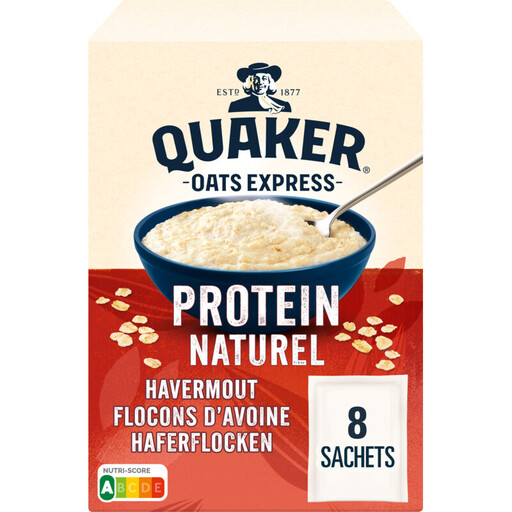 Image unavailable
An Express option to consider separately if you’re looking at different porridge products for a quick breakfast.
Before comparing this option with other porridge, check the ingredients, allergens and salt per 100 g on the packaging.
Compare the salt per 100 g in similar dry products. The Voedingscentrum recommends comparing products per 100 g; also check whether the nutritional information is for the dry product or a prepared portion.
No, that figure describes the porridge base, not everything you eat with it or add to it. If you want to assess the salt content of the meal, take the other parts of breakfast into account too.
Regular porridge oats are not automatically suitable for people with coeliac disease. According to the Voedingscentrum, oats can come into contact with gluten during processing, so check whether the packaging carries the Crossed Grain symbol.
Nutri-Score can offer an additional way to compare similar products, but it doesn’t show the salt content on its own. The Dutch government recommends comparing Nutri-Score within the same product category; for your salt comparison, also check the nutritional information per 100 g and the ingredients list.