
The cyclist who likes to stock up
You make porridge at home on different days and don’t mind weighing out your own portions. A larger pack gives you the flexibility to choose how much you use for each meal.


A larger pack of regular or fine porridge oats suits cyclists who want to prepare several meals at home and choose their own portions. Single-portion sachets are handy when speed and convenience matter most. Choose a variety with added protein only if that’s what you’re looking for and its ingredients suit you. The Netherlands Nutrition Centre recommends eating a larger meal around 2 to 3 hours before exercise. If you have coeliac disease, oats must also be explicitly labelled gluten-free.
You make porridge at home on different days and don’t mind weighing out your own portions. A larger pack gives you the flexibility to choose how much you use for each meal.
On training days, you want a measured portion that’s quick to prepare. Check that it’s the right size for the meal you have in mind: a sachet isn’t automatically a complete meal.
You check ingredients and allergens carefully, perhaps because you’re looking for a product with added protein or, if you have coeliac disease, can only choose oats explicitly labelled gluten-free. These needs call for different checks on the packaging.
First decide whether you want to make up your own portions or prioritise quick preparation. Then check the ingredients and any dietary requirements, as these may limit your choice of regular, protein-enriched or gluten-free oats.
| What to consider | What to look for | Who it matters to |
|---|---|---|
| Pack size and portion size | Check the pack size and whether you can weigh out the amount you want. Store porridge oats in a cool, dry, dark place in a well-sealed container, as recommended by the Netherlands Nutrition Centre. | When I’m planning several meals at home, I want to choose how much oats to use each time. For around 40% of consumers, that flexibility comes first. |
| Quick preparation | Check the preparation time, the amount in each sachet and what you need to make it. | Before an early ride, I want to spend as little time as possible weighing and preparing my food, without automatically treating a small sachet as a complete meal. Quick, measured preparation comes first for around 30% of consumers. |
| Added protein | Read the ingredients and allergen information. For a protein-enriched variety, compare the nutritional information per portion with the figures per 100 g. | When I’m looking for oats with added protein, I want to know which ingredient provides it and whether I can eat it. For around 20% of consumers, the ingredients are the main consideration. |
| Gluten-free oats | If you have coeliac disease, look for an explicit gluten-free label and, ideally, the Crossed Grain symbol. Check the label every time you buy. | If I have coeliac disease, I can’t rely on the word ‘oats’ alone, as regular oats can be contaminated with gluten during processing. Gluten-free oats are a must-have for around 10% of consumers. |
A measured amount of oats may not be enough for the meal you want to eat before a ride. For example, Quaker Oats Express Naturel contains 27 g sachets.
Check the amount in each sachet and plan your meal and drinks around your ride. For a larger meal, the Netherlands Nutrition Centre recommends eating around 2 to 3 hours before exercise.
You may need other ingredients or more than one sachet to make the meal you want.
Regular oats can be contaminated with wheat, barley or rye during harvesting or processing. That means a standard pack isn’t automatically suitable for people with coeliac disease.
If you have coeliac disease, choose oats explicitly labelled gluten-free. The Dutch Coeliac Society recommends looking for the Crossed Grain symbol where possible. Check the label even when buying the product again.
Protein-enriched porridge oats may contain soya. The name also tells you nothing about how much protein is in the portion you actually prepare.
Read the ingredients, allergen information and nutritional values per portion. Don’t plan a larger meal just before cycling: the Netherlands Nutrition Centre recommends leaving around 2 to 3 hours beforehand.
For cupboard storage, keep your oats in the right conditions: the Netherlands Nutrition Centre recommends storing them in a cool, dry, dark place in a well-sealed container.
Seal an opened pack carefully and check the use-by date and storage instructions on the packaging. If the smell or appearance has changed, check the product before using it.
Quaker offers regular porridge oats and Oats Express single-portion sachets, including a separate variety with added soya protein.
The Brinta Havermout 450 g product reviewed here is made with extra-fine oats for a warm bowl of porridge.
Jumbo offers fine and coarse wholegrain oat flakes, as well as a separate range of gluten-free porridge oats.
Golden Bridge is an ALDI own-brand range that includes coarse wholegrain porridge oats.
These products show three ways to enjoy oats around your bike rides: a portion for quick preparation, a variety with added protein and fine flakes you can measure out yourself. Choose according to when you plan to eat, and check the packaging if ingredients or allergens are a deciding factor.
 No image available
An option if you’d rather prepare a measured portion on training days than weigh out your own oats.
Check the portion size, allergens and use-by date on the packaging. One portion isn’t automatically a complete meal.
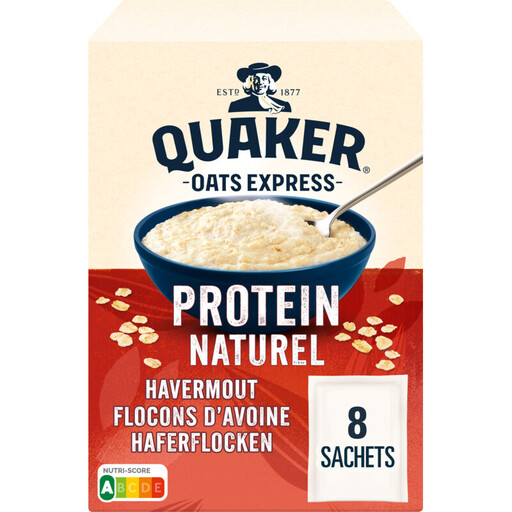 No image available
This variety is for anyone specifically looking for porridge oats with added protein; the product information lists soya protein as an ingredient.
Read the label for allergen information and check the nutritional values per portion. Leave plenty of time before your ride if you’re having a larger meal.
 No image available
A pack for anyone who wants to choose their own portion size at home and use fine flakes to make a warm meal.
The Brinta Havermout reviewed here contains 100% oat flakes. Check the label for possible traces of wheat and rye, as well as the use-by date.
For a larger meal, the Netherlands Nutrition Centre recommends eating around 2 to 3 hours before exercise. If you eat closer to your ride, consider the size and contents of your portion. Try a different timing or portion size during a regular training session first.
Store porridge oats in a cool, dry, dark place in a well-sealed container, as recommended by the Netherlands Nutrition Centre. Check the use-by date and storage instructions on the packaging, and seal an opened pack carefully.
Regular porridge oats aren’t automatically suitable for people with coeliac disease, as oats can be contaminated with gluten during the supply chain. Choose oats explicitly labelled gluten-free. The Dutch Coeliac Society recommends looking for the Crossed Grain symbol where possible.
A single-portion sachet gives you a measured amount; with a larger pack, you choose the amount yourself. If you’re buying sachets, check how much oats each one contains and whether you’ll need other ingredients or an extra portion for the meal you want to make.