
Student with their own kitchen cupboard
If you make breakfast at home and can measure out the amount you need, loose oats are a practical store-cupboard choice. Just consider where you can keep an opened pack dry.


Choose loose, fine oats if you can measure out a portion at home and want to adjust the quantity. Sachets are especially convenient when you’d rather use a pre-measured portion on a busy morning. Whichever you choose, check the preparation instructions, ingredients and allergens on the packaging.
If you make breakfast at home and can measure out the amount you need, loose oats are a practical store-cupboard choice. Just consider where you can keep an opened pack dry.
Pre-measured sachets save you the effort of portioning. Albert Heijn says Quaker Oats Express Naturel takes two minutes to prepare in the microwave or in a pan, so you’ll still need a way to cook it.
Ingredients and allergens may affect your choice. According to the Voedingscentrum, ordinary oats are not automatically suitable for people with coeliac disease. Look for the official Crossed Grain symbol on the packaging and check the latest allergen information.
Before moving into your new student home, first consider whether measuring out your own portion fits your morning routine. Then compare the packaging, preparation method and label information.
| What to consider | What to check | Who it matters to |
|---|---|---|
| Pack size | Check the quantity in each pack and whether you can store it somewhere dry once opened. | I want to keep one pack in my room and use it regularly. Around 36% of consumers prioritise having a supply to hand. |
| Ease of preparation | Check whether you need a microwave or pan, and whether the portions are pre-measured. | On a morning with an early lecture, I don’t want to measure out a portion first. This convenience matters most to around 29% of consumers. |
| Ingredients and allergens | Read the latest label. If you have coeliac disease, also check for the official Crossed Grain symbol. | If I need to watch out for certain ingredients, I want to know what’s in my breakfast. Around 21% of consumers prioritise checking the label. |
| Adjustable portions | Compare the amount in each sachet with the preparation instructions for loose oats. | Some days I want a different amount of porridge from the day before. Around 14% of consumers prioritise choosing their own portion size. |
According to the Voedingscentrum, oats are naturally gluten-free, but they can be contaminated with gluten. So an ordinary pack is not automatically suitable for people with coeliac disease.
If you have coeliac disease, look for the official Crossed Grain symbol and read the allergen information on the pack you’re buying.
Albert Heijn lists Quaker Oats Express Naturel sachets at 27 g and gives a preparation quantity of 40 g for its loose fine oats. These are different amounts, regardless of which portion is right for you.
Check the contents of each sachet and how much milk or water you’ll need before choosing.
The packaging of the product you actually buy is what matters for ingredients, allergens and preparation instructions, especially if you need to avoid a particular ingredient.
Check the label again if you pick up a different variety or pack.
Quaker’s Oats Express Naturel comes in individual sachets for anyone who’d rather not measure out a portion.
Brinta Havermout is an option with loose, extra-fine oats for anyone who wants to measure out their own portions.
AH Volkoren havermout fijne vlokken is a loose-oats option for anyone who wants to decide how much to make for breakfast.
Jumbo offers fine wholegrain oats in a 1 kg pack, among other options, so you can measure out your own portions.
Lidl lists Crownfield Biologisch havermout in a 500 g pack for in-store purchase.
ALDI lists Golden Bridge Fijne volkoren havermout in a 500 g pack.
These products show two options for student breakfasts: loose Brinta oats to portion yourself and Quaker Express varieties to compare if you want to spend less time preparing. Check the packaging of each variety for the exact contents and preparation instructions.
 Image unavailable
For anyone who wants to measure out their own portion of porridge oats. Albert Heijn describes Brinta Havermout as extra-fine loose oats and says it takes two minutes to prepare in a 900-watt microwave. Follow the instructions on the packaging of this variety.
 Image unavailable
For anyone who’d rather have a pre-measured portion in the morning. Albert Heijn and Quaker describe the 324 g Naturel variety as twelve 27 g sachets, taking two minutes to prepare in a microwave or pan. Check the pack to see which variety you’re choosing and whether the portion suits your breakfast.
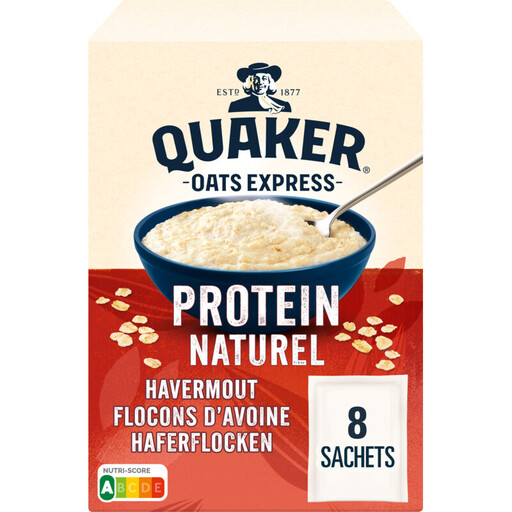 Image unavailable
For anyone who wants to compare Quaker Oats Express Protein with ordinary porridge oats. Check the packaging for ingredients, allergens, portion size and preparation instructions. Don’t assume the product is suitable for your nutritional needs based on the variety name alone.
No, not necessarily. Albert Heijn says Quaker Oats Express Naturel takes two minutes to prepare, but also gives a short cooking time for its loose fine oats. Brinta Havermout is described as taking two minutes in a 900-watt microwave. The difference also comes down to whether you need to measure out the portion yourself.
Don’t assume ordinary porridge oats are suitable if you have coeliac disease. The Voedingscentrum warns that they may be contaminated with gluten and says the pack must carry the official Crossed Grain symbol. Check the latest allergen information too.
Choose a sachet if a fixed portion suits your breakfast and you’d rather skip the measuring. Albert Heijn lists Quaker Oats Express Naturel sachets at 27 g each, compared with a suggested 40 g serving for its loose fine oats. Compare those amounts with how much you want to use.
Follow the storage instructions on the pack and seal it well after use. Albert Heijn recommends storing its fine oats somewhere cool, dark and dry; Quaker says to keep Oats Express in a cool, dry place.