
Families with different breakfast times
If family members eat breakfast separately, pre-measured sachets can save you measuring out a portion for each person. Just check that each sachet contains the right amount for everyone in the family.


Wholegrain oat sachets are a good fit for families where everyone has breakfast at a different time and pre-measured portions are useful. If several family members eat at the same time, a larger pack of loose porridge oats is more practical when you want to measure out portions yourself; finer flakes are an option if you’re also looking for a quick cooking time. To compare fibre, always check the label per 100 g, and check the exact packaging if you have any dietary restrictions.
If family members eat breakfast separately, pre-measured sachets can save you measuring out a portion for each person. Just check that each sachet contains the right amount for everyone in the family.
If you often make breakfast for several people at once, you can measure out loose wholegrain porridge oats from a larger pack. This lets you choose your own portion sizes, but you’ll need somewhere airtight to store the opened pack.
If someone has an allergy or coeliac disease, checking the exact packaging is more important than choosing a convenient portion size. Read the ingredients and allergen warnings every time you buy. According to the Voedingscentrum, people with coeliac disease should look for the official Crossed Grain symbol on the packaging when buying oats.
First, decide whether individual portions or one larger pack will suit your breakfast routine better. Then compare the preparation instructions, nutritional information and ingredients for the exact products you’re considering.
| What to consider | What to check when buying | Who is this important for? |
|---|---|---|
| Preparation and portions | Check the preparation instructions, cooking time and, for sachets, the weight per portion. | If everyone has breakfast at a different time, I don’t want to measure out oats each time. For around 36% of consumers, the convenience of quick, individual portions comes first. |
| Stock and pack size | Compare the pack weight, the portion size you want and the storage instructions. | When we have breakfast together, I want to be able to serve everyone from one pack. A larger pack is the top priority for around 29% of consumers. |
| Flavour and ingredients | For each flavour, check the ingredients and sugars per 100 g. | If family members want different flavours, I’d rather choose a plain base that everyone can customise. This freedom of choice matters most to around 21% of consumers. |
| Fibre and allergens | Compare fibre per 100 g and read the allergen warnings; if you have coeliac disease, check for the official Crossed Grain symbol. | If someone at home has a dietary restriction, the exact product must be suitable for them. This is the deciding factor for around 14% of consumers. |
Pre-measured portions are most useful when family members eat breakfast separately. If you eat together, loose oats from one pack may be a better fit for different portion sizes.
Before you buy, think about who makes breakfast and how many portions you usually prepare at once.
The product name alone doesn’t tell you whether oats are suitable for someone with coeliac disease. For example, Quaker Oats Express Naturel warns that it may contain barley and wheat.
If you have coeliac disease, check for the official Crossed Grain symbol on the exact packaging, as advised by the Voedingscentrum, and read the other allergen information too.
A sachet, a large pack and a prepared bowl don’t contain the same amount of dry oats. So a figure per portion isn’t directly comparable with one per 100 g.
First compare the nutritional information per 100 g, then check how much dry porridge oats each family member actually uses.
Storage matters when you’re using a large pack over several breakfasts.
Store porridge oats in a cool, dry, dark place in a well-sealed container, following the storage advice from the Voedingscentrum.
Quaker Oats Express Naturel is an example of instant porridge oats sold in individual sachets.
Brinta Havermout offers extra-fine loose oat flakes in a 450 g pack.
Jumbo’s fine wholegrain porridge oats come in 500 g and 1 kg packs, offering a choice of larger packs to stock up on.
Golden Bridge is ALDI’s own brand, with fine and coarse wholegrain porridge oats available in 500 g packs.
These products show two options for family breakfasts: Quaker varieties for quick preparation and Brinta as loose, extra-fine porridge oats. Check that the portion format and ingredients of each product suit your family.
 Image unavailable
A good fit for families with different breakfast times when measuring out individual portions is inconvenient.
The pack contains twelve 27 g portions. The product information lists 9 g of fibre per 100 g and a preparation time of two minutes.
If you have allergies, check the warnings for soya, wheat and barley. If you have coeliac disease, look for the official Crossed Grain symbol on the exact packaging.
 Image unavailable
A good fit for a breakfast routine where you want to measure out several portions from one pack.
The product information lists extra-fine oat flakes, 100% oat flakes as the ingredient and 9.7 g of fibre per 100 g. Follow the preparation instructions on the packaging.
This product may contain rye and wheat. If you have coeliac disease, check whether the exact packaging carries the official Crossed Grain symbol.
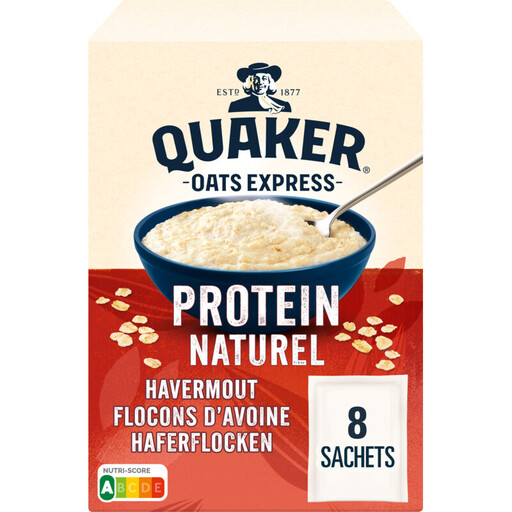 Image unavailable
This quick-to-prepare Quaker variety is worth comparing with plain porridge oats for its ingredients.
The ingredients list states 85% wholegrain oats and 15% soya protein; preparation takes two minutes according to the instructions. Check the label for a fibre comparison per 100 g and for the portion size.
This product contains soya and may contain wheat and barley. If you have coeliac disease, check for the official Crossed Grain symbol on the exact packaging.
According to the Voedingscentrum, a bowl made with 40 g of porridge oats contains an average of 4.4 g of fibre. For a specific product, check the nutritional information per 100 g and the amount of dry porridge oats you use.
The preparation format doesn’t determine the fibre content, so compare the exact products on the same basis. Quaker Oats Express Naturel lists 9 g of fibre per 100 g, while Brinta Havermout lists 9.7 g per 100 g.
If you have coeliac disease, don’t choose an oat product at random. According to the Voedingscentrum, you need oats with the official Crossed Grain symbol on the packaging; check the symbol and allergen information every time you buy.
Read the allergen information on the label of the exact product. The Netherlands Food and Consumer Product Safety Authority says that allergen information must appear on the label of prepacked products; an online product title is no substitute for checking it.
Store porridge oats in a cool, dry, dark place in a well-sealed container, as advised by the Voedingscentrum. Seal an opened pack securely after use, and follow the instructions on the packaging too.