
Desk workers with a short lunch break
You want to make a hot portion without having to measure out oats first. Check which preparation method suits the kettle, microwave or other facilities available at your workplace.


When choosing instant porridge, start with the preparation options available at your workplace and any dietary requirements you have. Then compare the fibre per 100 g and the amount you actually want to make for lunch: a pre-measured sachet saves time, while loose oats let you choose your own portion. If you need to avoid gluten strictly, choose a product with a current gluten-free label and check the packaging.
You want to make a hot portion without having to measure out oats first. Check which preparation method suits the kettle, microwave or other facilities available at your workplace.
You want to compare the fibre content in the nutritional information, rather than relying only on wording on the front of the pack. Remember to factor in your planned portion size too.
You can’t assume that every oat product is gluten-free. A current gluten-free label and the allergen information are key to making the right choice.
Start with what you can prepare at your desk. Then compare the fibre per 100 g and, if you need to, check the gluten-free label and allergen information for the specific product.
| What to consider | What should you check? | Who is this most important for? |
|---|---|---|
| Preparation at work | Check that the instructions suit the kettle, microwave or pan available, and look at the preparation time and portion size. | If you only have a short lunch break, you’ll want to be able to prepare a portion using what’s available at your workplace. Around 46% of consumers put practical preparation first. |
| Fibre per portion | Compare the fibre per 100 g in the nutritional information and check how many grams of porridge you’ll use for one lunch. | If fibre is your main reason for choosing porridge, you’ll want to know how much your planned portion contains. Around 36% of consumers put fibre content first. |
| Gluten and allergens | If you need to eat strictly gluten-free, look for a current gluten-free label. Also read the ingredients and any statements about the possible presence of allergens. | If you need to avoid gluten strictly, the suitability of the specific pack matters more than convenience. This check is the top priority for around 18% of consumers. |
A nutrition claim doesn’t tell you how much fibre your lunch portion contains. Under Regulation (EC) No 1924/2006, a product can only claim to be ‘high in fibre’ if it contains at least 6 g of fibre per 100 g or 3 g per 100 kcal.
Read the nutritional information per 100 g and work out the amount for the portion you plan to have. Separately, check that the preparation method suits your lunch break.
An oat product may state that it could contain wheat or barley. The name of the grain is no substitute for checking the label on the specific pack.
Voedingscentrum lists the words ‘gluten-free’ and the Crossed Grain trademark as signs to look for. If you need to eat strictly gluten-free, also check the current label and allergen statements.
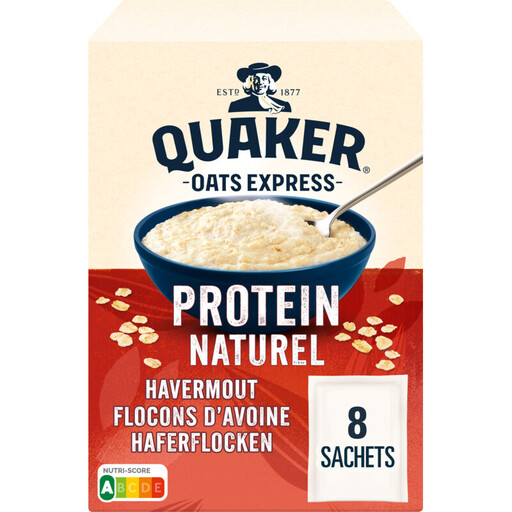
Quaker’s Oats Express Protein Naturel contains 15% soya protein and may contain wheat and barley, according to the brand. Other variants in the same product range may therefore have different ingredients and allergen information.
Compare the ingredients list for the exact variant you’re buying, especially if soya or the possible presence of wheat and barley matters to you.
The differences below relate to the specific product variants mentioned, not a brand’s entire range.
Oats Express offers pre-measured porridge for quick preparation. Ingredients and nutritional values vary between variants.
Brinta Havermout is an option if you’d rather measure out your own portion of fine loose oats than use a sachet.
The Natural Instant Oatmeal variant combines individual portions with a gluten-free label.
These two Quaker Express packs are options for a quick, hot lunch. Compare the Naturel and Protein variants for fibre and ingredients; don’t assume they have the same allergens or portion sizes.
 No image available
A pre-measured option if you have a microwave or small pan available during your lunch break.
The product description lists 12 portion sachets. The corresponding Naturel product information states that it contains 9 g of fibre per 100 g and takes 2 minutes to prepare.
Check the current label if gluten or the possible presence of soya, wheat and barley is important to you.
 No image available
An option to consider if you want to compare quick-cook porridge with added soya protein against the regular Express variant.
The product description lists a preparation time of 2 minutes. Quaker says the corresponding Protein Naturel variant contains 7.2 g of fibre and 22 g of protein per 100 g.
Quaker states that Protein Naturel contains 15% soya protein and may contain wheat and barley. Check the ingredients and number of portions on the pack if these matter to your choice.
No, it depends on the variant. According to Albert Heijn’s product information, Elovena Natural Instant Oatmeal requires 200 ml of boiling water or milk. Quaker Oats Express Naturel, meanwhile, is prepared in a microwave or small pan and takes 2 minutes. Check the instructions on the pack you choose before buying.
Under Regulation (EC) No 1924/2006, the claim ‘high in fibre’ can be used when a product contains at least 6 g of fibre per 100 g or 3 g of fibre per 100 kcal. Use the nutritional information and your portion size to compare products for lunch; the claim alone doesn’t tell you how much fibre your portion contains.
No. If you need to eat strictly gluten-free, don’t rely on the word ‘oats’ alone. Voedingscentrum lists a gluten-free label or the Crossed Grain trademark as signs to look for. Also read the current label: Quaker Oats Express Naturel may contain wheat and barley, while the Elovena Natural Instant Oatmeal variant mentioned is labelled gluten-free.