
Breakfast eaters short on time
If you want to make oats quickly around pea soup day, consider whether you need to measure a portion and what preparation method the packaging recommends.


Choose a quick breakfast or snack for pea soup day by comparing fibre per 100 g, the ingredients and the preparation method that suits your day. Sachets save you measuring; loose fine oats let you choose the amount yourself. If you have coeliac disease, ordinary oats are not automatically suitable: the Netherlands Nutrition Centre recommends oats bearing the official Crossed Grain symbol on the packaging.
If you want to make oats quickly around pea soup day, consider whether you need to measure a portion and what preparation method the packaging recommends.
You want to compare dry products on a like-for-like basis, so check the fibre per 100 g and the ingredients list rather than relying on the front of the packaging.
If you have coeliac disease or avoid soya, the exact variant matters. According to the Netherlands Nutrition Centre, ordinary oats are not necessarily suitable for coeliac disease; one Quaker protein variant contains soya.
Start by checking the nutritional information and ingredients for the dry product. Then decide whether a pre-measured sachet or a pack of loose oats better suits the way you want to prepare them.
| What to consider | Check when buying | Who it matters to |
|---|---|---|
| Fibre and oat base | Compare fibre per 100 g of dry product and check which type of oats is listed in the ingredients. | I want to choose an oat product for pea soup day whose fibre content I can compare easily. Around 36% of consumers make this their top priority. |
| Preparation and portion | Check the preparation time, how much liquid you need and whether the portion is pre-measured. | If I’m short on time, I want to know what I’ll need to do before my oats are ready. Around 29% of consumers put convenience first. |
| Ingredients and allergens | Read the current allergen information and, if you have coeliac disease, check the packaging for the official Crossed Grain symbol. | I want to choose without overlooking an ingredient or allergen that matters to me. This is the top priority for around 21% of consumers. |
| Packaging and portioning | Decide whether you want individual sachets or to measure out portions yourself, and whether you can store an opened pack. | At home, I prefer to choose how much oats to use myself, or I benefit from a pre-measured portion. Around 14% of consumers consider the packaging format most important. |
Fibre content and ingredients can vary between variants. A claim on the front of the pack is no substitute for checking the nutritional information.
Compare fibre per 100 g of dry product and read the ingredients before choosing a variant.
Oats can come into contact with gluten-containing grains during processing. It’s also worth checking the allergen information for the Quaker and Brinta variants mentioned here.
For coeliac disease, the Netherlands Nutrition Centre recommends oats bearing the official Crossed Grain symbol. Also check the current packaging.
Quaker Express Protein lists 7.2 g of fibre per 100 g, compared with 9 g per 100 g for the Naturel variant mentioned here. The Protein variant also contains soya protein.
Compare the nutritional values per 100 g and check the ingredients if soya or the product’s composition matters to you.
Worth considering if you want to compare sachets with variants containing added protein.
Worth considering if you’re looking for loose, extra-fine oats and want to choose your own portion size.
A supermarket own-brand option to consider when comparing packs of loose oats.
These products include both pre-measured Express portions and loose oats. Compare fibre and preparation instructions on each pack; don’t assume the Zonnatura variant takes little time to prepare without checking first.
 Image unavailable
An option to consider if you want a pre-measured portion that, according to the product information, takes two minutes to prepare.
The pack contains 12 sachets of 27 g. The Naturel variant lists 100% wholegrain oats and 9 g of fibre per 100 g.
Check the current allergen information. If you have coeliac disease, look for the official Crossed Grain symbol on the packaging.
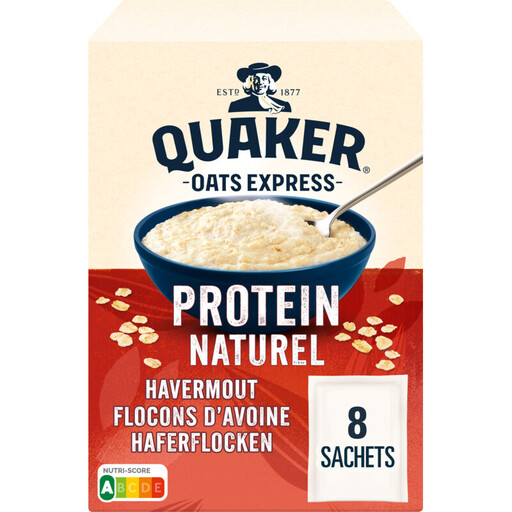 Image unavailable
This portion-sized option is for anyone comparing quick-to-prepare oat products with added protein.
The product information states that it takes two minutes to prepare and contains 22 g of protein and 7.2 g of fibre per 100 g. The ingredients include 15% soya protein and soya lecithin.
Check the preparation instructions and allergen information on the current packaging. If you have coeliac disease, look for the official Crossed Grain symbol.
 Image unavailable
Worth considering if you want to measure out loose oats yourself instead of using sachets.
The product information lists 100% oats and extra-fine flakes for a hot breakfast that’s ready in a few minutes.
Compare the fibre per 100 g on the packaging. The allergen information mentions possible traces of wheat and rye; if you have coeliac disease, look for the official Crossed Grain symbol.
 Image unavailable
A pack to consider if you want to measure out your own portions and compare the nutritional information for loose oats.
Check the fibre per 100 g and the preparation instructions on the packaging before choosing this variant for a quick breakfast.
Also read the current ingredients and allergen information. If you have coeliac disease, look for the official Crossed Grain symbol.
If you have coeliac disease, don’t assume they are. According to the Netherlands Nutrition Centre, oats can come into contact with gluten-containing grains during processing. Choose oats bearing the official Crossed Grain symbol on the packaging.
Compare the fibre per 100 g for both dry products, then check the ingredients list. Also consider how much you use per portion: the figure per 100 g isn’t the same as the amount in your bowl.
Yes, you can have oats at another mealtime if you fancy an oat-based option. What you eat overall also depends on your portion and what you add; oats aren’t the whole story.
Choose a variant with ingredients that suit your preferences, then follow the packaging instructions for the amount of water or milk and the preparation time. If you’d like to add something, try fruit or unsalted nuts instead of adding sugar.