
Carb-conscious breakfast eaters
If you have diabetes and want to keep track of the carbohydrates in your breakfast, you can weigh your own portion and include your choice of milk, yoghurt and toppings.


Choose instant oats for your store cupboard by comparing the ingredients and carbohydrates per portion you actually eat, rather than looking only at how quickly they’re prepared. A single-portion sachet makes measuring easy, while a larger pack lets you decide how much to use. Either way, remember to include milk, yoghurt and toppings. Store dry oats according to the label and seal the pack securely once opened.
If you have diabetes and want to keep track of the carbohydrates in your breakfast, you can weigh your own portion and include your choice of milk, yoghurt and toppings.
If you want a quick breakfast made with something from the store cupboard, clear preparation and storage instructions are useful, including guidance for after opening.
If you’re comparing plain oats, single-portion sachets and flavoured varieties, check the ingredients list and nutritional information before letting convenience make the decision for you.
First, work out how much oats you actually eat. Then compare products on the same basis, such as per 100 g of dry product, and check the preparation and storage details separately.
| What to consider | What should you check? | Who is this most important for? |
|---|---|---|
| Carbohydrates per portion | Compare carbohydrates per 100 g and calculate them for the amount you eat; count your chosen liquid and toppings separately. | If I want to fit breakfast into my personal eating plan, I need to know the carbohydrate content of the whole meal. Around 33% of consumers prioritise portion control. |
| Ingredients and fibre | Check which ingredients have been added to the oats and compare fibre and sugars on the same nutritional basis. | If you’re looking for a simple ingredients list, you’ll want to distinguish plain oats from a flavoured mix. Around 27% of consumers put this choice first. |
| Speed and portioning | Check the preparation time, the amount in each sachet and what you’ll need to prepare it. | On a busy morning, I don’t want to weigh out oats every time, but I do want to know how much is going into my bowl. Around 20% of consumers make this combination their top priority. |
| Storage after opening | Check the best-before date, the instructions for after opening and whether the pack can be sealed securely. | If I keep a supply in the cupboard, I want to keep the packs in good condition and be able to refer back to the storage instructions. Around 20% of consumers put stock management at the top of their list. |
Oats with no added sugar still contain carbohydrates. Milk, yoghurt and toppings also change the nutritional value of the whole breakfast.
Check the carbohydrates for the amount of oats you eat and include the other ingredients in your meal.
A nutritional table for a prepared portion may include milk. Those figures aren’t directly comparable with values per 100 g of dry oats.
For each table, check whether the values apply to the dry product, a sachet or the prepared portion.
According to the Netherlands Nutrition Centre, the best-before date applies to an unopened pack. Once opened, the instructions on the pack are important.
Store dry oats according to the label, seal the pack securely and keep the original packaging with the date to hand.
An opened pack that isn’t sealed properly may lose quality before you’ve used all its contents.
The amount of carbohydrates that suits someone is personal. According to the Diabetes Fund, switching to a reduced-carbohydrate diet may require medication adjustments.
If you have diabetes, discuss any long-term change with a doctor and dietitian, as the Diabetes Fund advises.
Quaker Oats Express Naturel is worth considering if pre-measured oats fit your morning routine.
Brinta Oatmeal is worth considering if you want to choose how much rolled oats to use and prepare them warm.
Jumbo sells coarse wholegrain rolled oats for anyone who prefers to measure out a portion from a larger pack.
These products come in different pack formats for a store-cupboard breakfast. For each product, compare the ingredients, the portion you actually eat and the nutritional information on the packaging.
 Image unavailable
Worth comparing if you’re looking for oats for a quick breakfast. The pack contains 324 g; check how much you use each time and the nutritional values for that amount.
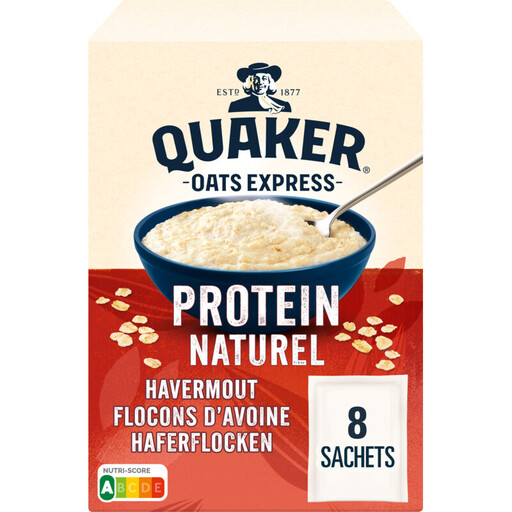 Image unavailable
Compare this variety with other oats if the ingredients are important to your choice. The pack contains 302 g; read the ingredients and check the carbohydrates for your own portion.
 Image unavailable
Worth considering if you want to choose how much oats to have for breakfast. The pack contains 450 g; check the preparation instructions if a quick cooking time is important to you.
No. The word ‘instant’ tells you nothing about the amount of carbohydrates you’ll eat. Check the ingredients, calculate the carbohydrates for your own portion and include anything you add to the oats.
Yes. Assess the nutritional value of your whole breakfast, not just the dry oats. The Netherlands Nutrition Centre lists 23,7 g of carbohydrates for 40 g of oats; your chosen milk, yoghurt and toppings add to this separately.
Follow the instructions on the packaging and seal dry oats securely after opening. Keep the label so you can continue to check the date and any specific storage instructions. According to the Netherlands Nutrition Centre, the best-before date applies to the unopened pack.
Discuss any long-term move to a reduced-carbohydrate or low-carb diet with a doctor and dietitian. The Diabetes Fund recommends this support if you have diabetes, as your medication may need adjusting.