
Vandaag of morgen in huis

Kwaliteit gegarandeerd

Welkomstaanbiedingen ontgrendelen: GRATIS bezorging | Tot 80% korting | Gratis 30 dagen JoyPlus-proefperiode
Download de app
Buying a new pan seems straightforward, until you discover that not every pan works well on an induction hob. Some models heat unevenly, have a base that is too small or lose their non-stick properties through incorrect care. Terms such as “healthy”, “durable” and “suitable for all hobs” only tell you something if you check the product specifications.
For households in the Netherlands, three pitfalls are particularly important:
Induction works by heating through a magnetic field. So choose a pan that is explicitly described as having an induction base, ideally with a flat, sturdy construction. A stainless steel plate or multi-layer base can help distribute heat evenly across the pan.
Pay attention to the diameter too. A 20 cm induction frying pan is practical for one or two people. For a family, 24 to 28 cm is often more convenient. The effective base diameter may be smaller than the diameter of the top rim, so check the technical information if your hob has small or specific cooking zones.
Aluminium usually heats up quickly and is relatively lightweight. However, it needs a suitable induction plate. You’ll find this, for example, in aluminium models with a stainless steel induction disc.
Stainless steel pans are sturdy, often dishwasher-safe and suitable for high temperatures. They can take a little more technique: preheating and using enough fat can help prevent food from sticking.
A PFAS-free pan with a ceramic coating is worth considering if you want a smooth cooking surface and prefer a product that the manufacturer describes as PFAS-free. According to the product information from the relevant brands, this is a product specification; always check the care instructions and current packaging.
A pan that is oven-safe is not automatically fully oven-safe with its lid and handle. Check:
For non-stick pans, wooden, silicone or plastic utensils are usually a safe choice according to the product instructions. Let the pan cool before washing it. A sudden change in temperature can cause it to warp.
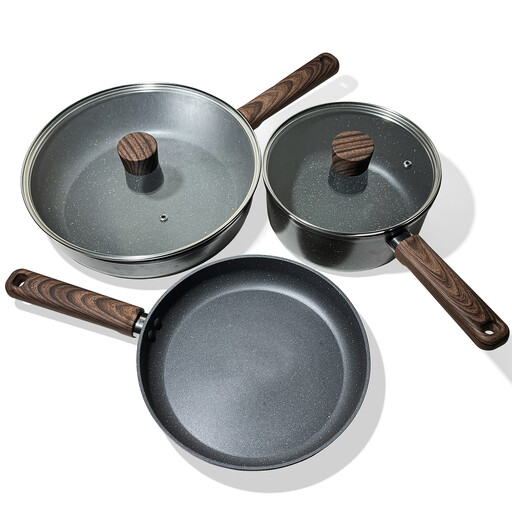
Why it suits this type of user: A compact pan set is practical for beginners who need several essential pans without having to choose individual models. According to the product information, the set is suitable for induction, gas, ceramic and electric hobs.
The product description specifies a flat stainless steel base for induction. The included pan protectors help reduce scratches when stacking the pans for storage.
A set of three pans, a non-stick surface and Bakelite handles. Before buying, check the exact contents and maximum oven temperature.
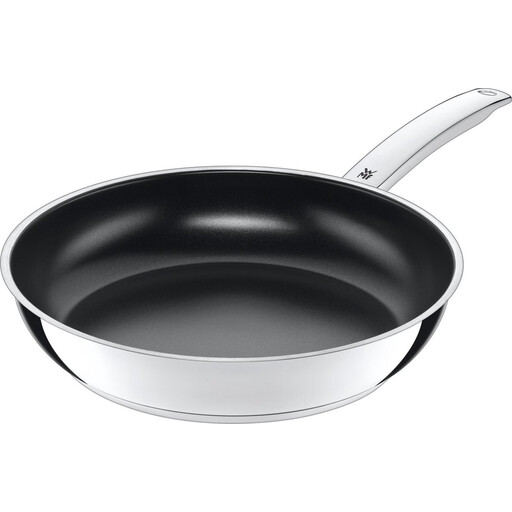
Why it suits this type of user: This 24 cm induction frying pan has a Cromargan 18/10 stainless steel construction and a ceramic coating. It’s a good choice for everyday frying for several people.
The product information explicitly states that it is PFAS-free, suitable for induction and hand-wash only. This makes it clear that the pan is not designed for the convenience of dishwasher cleaning.
Ceramic coating, a wide pouring rim and, according to the product specifications, use at up to 400 °C on the hob and up to 250 °C in the oven.
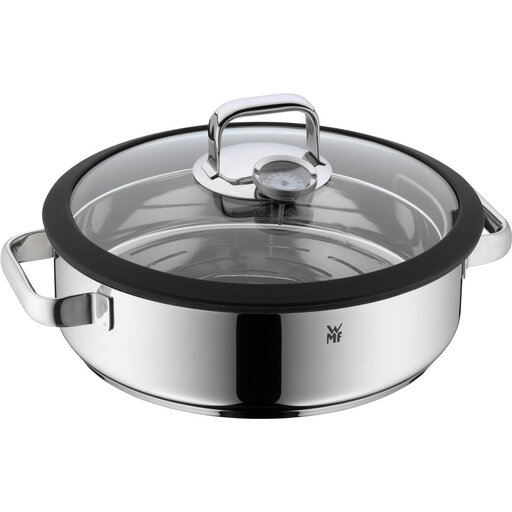
Why it suits this type of user: For home cooks who regularly steam, braise or prepare larger quantities, this induction cooking pan offers a capacity of around 5 litres and comes with a steamer insert.
The specifications list a TransTherm induction base, a thermometer and clear oven temperature limits: up to 180 °C with the lid on and up to 250 °C without it.
Cromargan 18/10 stainless steel, a capacity of around 5 litres and dishwasher-safe, except for the thermometer.
We’ve put together a complete, up-to-date list of products that meet these strict selection criteria and the applicable European safety regulations.
An induction pan set is useful when you’re equipping a kitchen from scratch. Check what’s actually included: some sets contain three pans, while others include several saucepans with lids. According to the product specifications, a set such as the WMF Astoria contains three saucepans measuring 16, 20 and 24 cm, and a 16 cm saucepan with a handle.
Individual pans are more practical if you already have plenty of cookware. Consider an induction saucepan for sauces, a 24 cm frying pan for everyday cooking or a larger cooking pot for pasta and soup. For one to three people, two frying pans measuring 20 and 24 cm may be enough; larger families often benefit more from a 28 cm pan or a capacity of several litres.
Check the packaging or product page for “suitable for induction” and look for a flat, magnetic base. You can do an initial check at home with a magnet, but the official product specifications are the definitive guide. A pan that works on gas or a ceramic hob won’t necessarily work on induction.
That depends on the material, coating and how you care for it. Stainless steel pans can last a long time with proper care. A non-stick coating is more prone to scratches, overheating and harsh cleaning. Replace the pan if the coating starts to come off, the base is warped or the handle is no longer firmly attached.
Electricity use depends on cooking time, power setting, pan size and whether you use a lid. A flat base that fits the cooking zone helps transfer heat efficiently. Cooking with a lid and turning the hob down as soon as you can help reduce energy use. Exact costs vary by household and electricity tariff.
