
Cooking with one pan
You mainly want to heat a pan of soup and clear the worktop afterwards. A portable single-zone hob could be a good fit if your pan base matches the cooking zone.


For a single soup pan, a portable single-zone hob is a sensible choice. If you’d like to prepare a side dish at the same time, consider a hob with two zones. Check that your pan is suitable for induction and fits the cooking zone, then compare the total connected load with the capacity of your electrical supply. Having more zones on a standard plug doesn’t mean you can cook with all your pans at full power at once.
You mainly want to heat a pan of soup and clear the worktop afterwards. A portable single-zone hob could be a good fit if your pan base matches the cooking zone.
You want to leave the soup simmering while you use a second pan. Compare hobs with two zones, and check how much power is available when both zones are on.
You’re replacing a hob and want to keep using several zones after this meal, too. The cut-out dimensions and electrical connection will determine which options suit your kitchen.
Choose this option if: you want to use one soup pan without fitting a hob into your worktop.
Bear in mind: you can’t use a second pan on the same hob at the same time.
Choose this option if: you want to prepare soup and a side dish at the same time without altering your worktop.
Bear in mind: check how the total power is shared between the zones and whether both pans will fit.
Choose this option if: you regularly use several pans but don’t want a built-in hob.
Bear in mind: the zones share the available power supply capacity; four zones doesn’t mean they can all run at full power at once.
Choose this option if: you’re replacing a fixed hob and your cut-out and electrical connection are suitable.
Bear in mind: checking and installation can take extra time; Consumentenbond recommends having a built-in hob installed by a qualified professional.
| What to consider | What should you check? | Who should pay particular attention? |
|---|---|---|
| Using one pan at a time | Check that the cooking zone suits the base of your soup pan and that you can select the setting you want. | If I’m only making soup, I don’t want extra zones taking up space on my worktop when I won’t use them. Around 40% of consumers give priority to using one pan at a time. |
| Using a second pan | Measure the bases of both pans and check the total connected load when both zones are on. | I want to leave the soup simmering while I cook a side dish. Around 30% of consumers prioritise cooking with two pans at once. |
| Electrical connection | Compare the connection and connected load required with what’s available in your kitchen; if necessary, have a built-in installation assessed. | If my electrical supply determines my choice, I want to know which hob will suit it first. Around 20% of consumers prioritise the electrical connection. |
| Existing soup pan | Test the base with a magnet and compare its size with the cooking zone specifications. | I want to keep using my current soup pan and find out in advance whether its base is suitable. Around 10% of consumers prioritise keeping their existing pan. |
With freestanding hobs that have limited total power, you can’t always use several zones at a high setting at the same time. Consumentenbond highlights this limitation with freestanding hobs.
Compare the total connected load with how you plan to use several pans. Don’t just look at the number of zones.
The cut-out dimensions and connection requirements may differ from those of your existing kitchen set-up.
Measure the cut-out and have the connection checked before committing to a built-in hob, especially if you want to use it before guests arrive.
For induction cooking, the pan base needs a magnetisable steel layer. It also needs to be the right size for the cooking zone you choose.
Test the base with a magnet and compare its size with the specifications. If the pan isn’t suitable, first consider whether you’d like to use a different one.
The KP 1032 is an example of a portable single-zone hob for using one pan at a time.
The VKI3020ZWA is an example of a freestanding two-zone hob for cooking with two pans.
The KIV364RVS is an example of a freestanding four-zone hob with a standard plug.
The V64IOB00FB built-in hob is an example of a fixed cooking set-up with several zones.
These product options range from a hob for one pan to a model with three cooking zones. Before buying, check that your pan and electrical connection are suitable, and consult the product documentation for the exact model.
 No image available
The single cooking zone is suited to using one pan at a time.
The product title lists 1.000 W and five power settings.
 No image available
The product description lists one portable cooking zone for using one pan at a time.
It lists 2.100 W and touch controls with several settings. The product title lists 220 V/240 V.
 No image available
The soup preset and timer are useful for making soup on a single zone.
The product description lists adjustable power from 100–2.000 W, eight power settings and a timer of up to three hours. According to the description, suitable pans have a flat, magnetic base with a diameter of 12–26 cm.
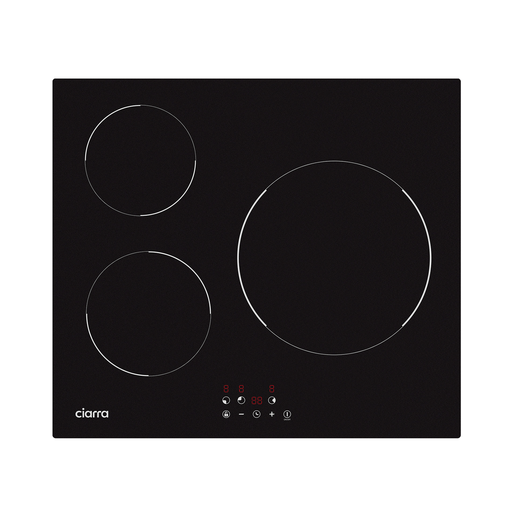 No image available
With three cooking zones, this model is designed for using several pans.
The product description lists a total power output of 5.600 W, nine power settings and a timer of up to 99 minutes.
 No image available
The single cooking zone could suit a soup pan if its base is within the stated size range.
The product description lists an XL zone of 26 cm, a power range of 200–2.000 W, ten power settings and a timer of up to three hours. Suitable pans have an induction-compatible base measuring 12–26 cm. The product warning advises people with a pacemaker to consult a doctor before use.
Yes, the base needs a magnetisable steel layer. Milieu Centraal recommends checking the base with a magnet; you should also compare the size of the pan base with the cooking zone.
Don’t count on it: Consumentenbond describes installing a built-in induction hob as a job for a qualified professional. Check the connection requirements for the exact model in advance and allow time for installation.
According to ETNA Service, induction hobs can click, hum or whistle during use, and the fan may keep running after the hob is switched off. An H indicates residual heat; if anything seems unusual, consult the manual for your model.
In the Netherlands, the retailer must offer a solution if a product doesn’t meet reasonable expectations, according to the Dutch government. The manufacturer’s warranty is in addition to your statutory rights; how long those rights apply depends on what you could reasonably expect from the product.
Electrical equipment covered by the European Low Voltage Directive must, among other things, carry a CE marking. The manufacturer must assess and document conformity, as explained by the Netherlands Food and Consumer Product Safety Authority and EUR-Lex. This is a general product requirement and does not, by itself, confirm that a specific model meets every requirement.