What should you look for when choosing?
Start with the base of your pan and where the hob will sit when in use. Also check that the specific appliance on offer carries the required CE marking: the Netherlands Food and Consumer Product Safety Authority says this is compulsory for electrical products.
| What to consider |
What to look for |
Most important for |
| Gentle simmering |
Look at the controls and low heat settings; where possible, compare an independent simmering test of the exact model. Consumentenbond treats simmering as a separate part of its testing. |
Once the soup has come to the boil, I want to turn down the heat without taking my eyes off it. That’s why around 36% of consumers prioritise gentle, controllable simmering. |
| Pan fits the zone |
Check with a magnet that the base is magnetisable, measure the base rather than the top rim, and compare its size with the model’s specified range. Milieu Centraal and Consumentenbond explain what to look for in a suitable induction pan. |
I want to keep using my small soup pan and first find out whether its base will be detected. Around 29% of consumers base their choice mainly on whether their pan is suitable. |
| Positioning and connection |
Measure the space, including the clearance specified in the manual. Also check the plug type and connected load for the exact model. |
If my worktop space is limited, I want to know in advance how much room the appliance needs and whether the connection is suitable. Around 21% of consumers prioritise positioning and connection. |
| Two pans at once |
Decide whether you really cook on two zones at the same time, then compare the number of zones, overall width and connected load. If the total available power is limited, using high settings on both zones at once may be restricted. |
I regularly want to make soup alongside a second dish, so I weigh up the extra space it requires. Around 14% of consumers choose with that second pan in mind. |
Brands and models to consider
These examples can help you compare models and types of hob. The features listed are not a general assessment of an entire brand, nor proof that a product is available.
Inventum
The KI120T is a one-zone portable hob with a pan-size range specified by Inventum.
- Inventum lists 2000 W, ten settings, a timer and a keep-warm function.
- The specified pan-size range is 15–20 cm. The manual requires at least 10 cm of clearance at the sides and rear of this model.
ETNA
The freestanding KIV12ZIL is an example of a two-zone hob.
- ETNA lists two zones, a width of 565 mm and a connected load of 3500 W.
- ETNA says it comes with a two-pin plug without an earth connection. Also consider your worktop space and the total power available.
CASO Design
The portable S-Line 2100 is a one-zone model to compare if you’re looking for a different specified pan-size range.
- CASO lists a pan-size range of 12–24 cm and twelve power settings.
- These settings and measurements alone do not tell you how evenly soup will simmer on a low heat.
Bosch
The PIB375FB1E is an example of a slim built-in hob with two zones.
- Bosch lists two zones and an appliance width of 306 mm.
- The hob requires a 270 × 490 mm cut-out and is not supplied with a plug as standard. Consider the connection and installation, not just the width.
Severin
The KP 1071 is a one-zone portable induction hob to consider when looking at compact models.
- Severin lists induction, 2000 W, pan detection and a timer.
- These specifications alone do not tell you how evenly the hob will simmer soup.
Joybuy products
Below are Joybuy product options for cooking on one zone, two zones and a built-in hob. Before buying, check that the specific appliance on offer carries the required CE marking; the Netherlands Food and Consumer Product Safety Authority says this is compulsory for electrical products.
 No image available
MELISSA induction hob, 2000 W
A one-zone hob for anyone who makes soup in one pan and wants to be able to adjust the settings while cooking.
Joybuy lists ten levels, a range of 60–240 °C, eight programmes and a timer.
View at Joybuy
 No image available
Induction hob with two zones
An option to consider if you want to make soup at the same time as cooking with a second pan.
Joybuy lists two zones and five temperature settings. One zone is described as smaller and suitable for simmering or keeping food warm.
View at Joybuy
 No image available
One-zone induction hob, 1000 W
A one-zone hob to consider if you make soup in one pan.
Joybuy lists five power settings and a power rating of 1000 W.
View at Joybuy
 No image available
Joyami JCL02M induction cooker (220V/240V/2100)
A model to consider if you’re looking for an induction cooker for making soup in one pan.
Before you decide, compare the pan fit, controls and positioning requirements for the exact appliance.
View at Joybuy
 No image available
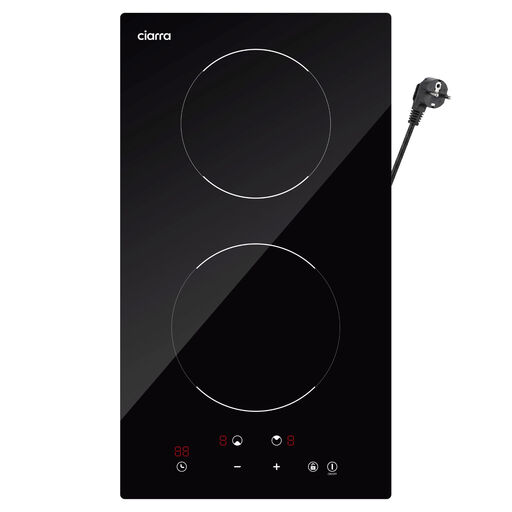
Ciarra CRGDBIH2 built-in induction hob, 3000 W
A built-in option to consider if you want to cook soup and use a second pan at the same time, and have a fixed cooking space.
Joybuy lists two zones, nine power levels, automatic pan detection and separate timers. The pan-size ranges are 120–260 mm and 120–200 mm; the stated cut-out size is 270 × 490 mm. The product information recommends installation by a qualified electrician.
View at Joybuy
Frequently asked questions
How can you check whether your soup pan works on an induction hob?
Check with a magnet that the base is magnetisable, and measure the diameter of the base rather than just the top rim. Compare this measurement with the specified range for the exact hob model.
Can you put a portable induction hob in a narrow corner?
Only if the set-up meets the requirements in the manual for your chosen model. For the KI120T, Inventum requires at least 10 cm of clearance at the sides and rear; this distance does not automatically apply to other models.
Does a built-in hob always need a higher-capacity mains connection?
Not simply because the hob is built in. Check the model’s connected load and installation instructions, and have your existing connection assessed if you’re unsure. On 30 June 2026, the Dutch government said that many households can cook electrically without upgrading their connection. This is not a guarantee for every home or hob.
What are your rights if your hob is faulty?
According to the Dutch government, you’re entitled to a product that works properly, and you can contact the retailer for an appropriate solution if it is faulty. The Netherlands does not have a fixed statutory warranty period of two years; any manufacturer’s warranty is in addition to your legal rights.
Is CE marking required for an induction hob sold in the Netherlands?
Yes. The Netherlands Food and Consumer Product Safety Authority says CE marking is compulsory for electrical products. Check the marking on the specific appliance on offer; a general reference to a model does not establish that every unit or variant carries the marking.


