
Cooking with one stock pot
You want to put the hob away after cooking and don’t need a second cooking zone while the stock simmers. Check the dimensions when it’s in use, not just how small the appliance is when stored.


If you only use one stock pot while the stock simmers, start by comparing portable single-zone hobs: you can put them away after use. Choose two zones if you often cook something else at the same time, or a narrow built-in hob if you want a permanent cooking spot. For each option, check that your pan, the space needed while cooking and the electrical connection are all suitable; a timer is no substitute for supervision.
You want to put the hob away after cooking and don’t need a second cooking zone while the stock simmers. Check the dimensions when it’s in use, not just how small the appliance is when stored.
Your stock is simmering while you use a second pan. A two-zone hob could work, provided there’s enough room for it and the electrical connection can handle both zones being used at once.
You want two zones in a permanent spot and can have the worktop checked to see whether it’s suitable for a matching cut-out.
When making vegetable stock, it’s not just the number of zones that matters: your recipe may call for a gentle simmer rather than a rolling boil. First work out how many pans you’ll use at once, then check your pan, the available space and the electrical connection.
| What to consider | What to look for | Who should consider this? |
|---|---|---|
| Usable worktop space | Measure the space with the pan and hob in place. Follow the clearance requirements in the manual for the exact model. | If I want to clear the worktop after cooking, I’ll check how much space the hob takes up while in use. Around 25% of consumers put usable worktop space first. |
| Gently simmering stock | Compare the lower heat settings and how the timer works. Stay nearby while cooking. | If I want to simmer stock gently, I need to be able to set the heat appropriately and keep an eye on the cooking time. Around 25% of consumers give gentle simmering top priority. |
| Pan compatibility | Check that the base is suitable for induction and compare its diameter with the stated range for the cooking zone. | If I want to keep using my existing stock pot, I’ll check that its base is suitable for induction and compatible with the chosen zone. Around 19% of consumers put pan compatibility first. |
| Electrical connection | Check the plug type, power rating and available circuit, including any other appliances connected to it. | If I want to use the hob with my current electrical setup, I need to know whether the connection is suitable for the model. Around 19% of consumers make the electrical connection their main consideration. |
| Using a second pan at the same time | Check that both zones and pans will fit side by side, and find out how the power is distributed when both are in use. | If I want to use a second pan while the stock simmers, I’ll check there’s enough space and power for both pans. Around 12% of consumers give cooking at the same time top priority. |
You also need to allow for the pan and the required clearance while the hob is in use. The Inventum KI120T manual specifies a minimum clearance of 10 cm at the sides and rear; this requirement applies to that model.
Measure the space with the pan on the hob and follow the manual for the model you choose.
The hob and pan take up worktop space while you’re cooking.
Consumentenbond points out that cooking at high settings on both zones at once may be limited with single-phase hobs, especially if other high-power appliances are connected to the same circuit.
Compare the power rating and power distribution, and check which other appliances are used on the circuit.
If your planned setup needs more power, the electrical connection may need upgrading. Have it assessed before making changes to the worktop or connection.
An induction hob needs a magnetisable base, but the base diameter must also fall within the stated range for the cooking zone.
Use a magnet as a first check, then compare your pan’s base size with the specifications for the model you’re considering.
If your existing pan isn’t compatible, you may need another suitable pan.
ACM ConsuWijzer distinguishes between a commercial guarantee period and the legal rights that may apply if a product, when used normally, does not meet reasonable expectations.
Keep your proof of purchase and contact the seller if something goes wrong.
The models reviewed include a portable single-zone hob and narrow built-in options. The right version for you will depend, among other things, on your worktop and how many pans you use at once.
The versions reviewed include a portable two-zone hob and a narrow domino-style built-in hob. The space available on your worktop will help determine which one to choose.
The KP 1071 is a compact single-zone option included in our research. When comparing products, check carefully that the model name and product description match.
The IK-6178 reviewed is a portable single-zone hob with adjustable temperature and time settings.
This selection focuses on portable induction hobs for making stock on a compact worktop.
 No image available
The single-zone design is suited to cooking with one stock pot at a time.
The description lists 10 settings, a temperature range of 60–240 °C and a timer of up to 240 minutes. It also mentions 8 cooking programmes and automatic pan detection.
Use a pan that’s suitable for induction and stay nearby while cooking.
 No image available
This portable hob could suit you if you want to use one pan in a separate cooking area.
The description lists 8 settings, a temperature setting of 60–270 °C and a timer of up to 3 hours. It states that suitable flat-bottomed pans have a diameter of 12–26 cm.
Check that the base of your stock pot falls within the stated range.
 No image available
This portable hob offers adjustable heat for cooking on the worktop.
The description lists 10 heat settings, 6 cooking functions and a safety lock.
Use cookware that’s suitable for induction.
 No image available
The single-zone design is suited to anyone who uses one stock pot at a time.
The description lists 2000 W, 10 settings, a range of 60–240 °C and a timer of up to 3 hours. The stated cooking zone range is 12–26 cm; the dimensions are 392 × 368 mm.
Check your pan base and leave enough room on the worktop.
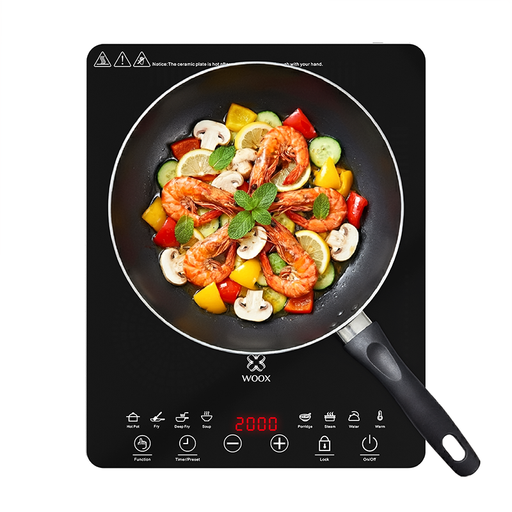 No image available
This portable hob is designed for worktop use with one pan at a time.
The description lists 2000 W, 8 settings and a temperature range of 80–240 °C. It also mentions a timer and automatic shut-off.
Use induction-compatible cookware and keep the ventilation openings clear.
Look for the induction symbol or hold a magnet against the base: according to Milieu Centraal, it needs to contain a magnetisable layer. Then compare the diameter of the pan base with the stated range for the cooking zone.
No. Check the requirements for the exact model and the electrical circuit. Inventum specifies an earthed Dutch socket for the KI120T; Consumentenbond points out that the connection and other high-power appliances on the same circuit can limit how you use it.
No. Use the timer as a reminder or for model-specific automatic shut-off, not as a substitute for supervision. The fire service advises staying near the hob.
Not necessarily; first have your planned setup checked to see whether an upgrade is needed. The Dutch government states that priority rules for new or higher-capacity connections have applied since 1 July 2026. This is relevant if you do need to make such an application.
According to ACM ConsuWijzer, the seller is responsible for the statutory guarantee. If the product doesn’t meet what you could reasonably expect, you may be entitled to a repair, replacement or refund; a manufacturer’s guarantee does not automatically cover the full duration of your legal rights.