
One-pan cook with limited space
You usually cook one pan of soup and want to put the hob away after use. The Consumentenbond describes a freestanding hob as one that you place on a surface and connect to an earthed socket.


For a single pan of broccoli soup, a portable single-zone hob is a sensible place to start. Two zones are most useful if you regularly cook something else at the same time. Check that your pan has a flat, magnetic base and is the right size for the cooking zone. In a shared kitchen, you should also consider the total power and any appliances connected to the same circuit.
You usually cook one pan of soup and want to put the hob away after use. The Consumentenbond describes a freestanding hob as one that you place on a surface and connect to an earthed socket.
You share the kitchen with people using appliances such as an oven or microwave, and want to know what the connection and simultaneous power use will allow. The Consumentenbond points out that other appliances on the same circuit can limit what you can use.
You want to keep using your current pan, so you check in advance that its base is flat and magnetic, and that its diameter is suitable for the model. The Consumentenbond lists these pan-base features as requirements for induction cooking.
Choose this if: you mainly cook one pan of soup and want to put the hob away after use.
Trade-off: you can’t use a second pan at the same time. Also check that your soup pan is within the specified size range.
Choose this if: you regularly use a second pan alongside your soup, and have enough worktop space and electrical capacity.
Trade-off: two zones don’t mean both can run at full power without limits at the same time. Compare the exact model’s maximum total power.
Choose this if: the shared kitchen is set up for a permanent hob and has the required connection.
Trade-off: the Consumentenbond states that the freestanding models above 7000 W that it tested require a Perilex socket and a two-phase connection.
| What to consider | What should you check? | Who should pay particular attention? |
|---|---|---|
| Space and cooking zones | Compare the hob’s dimensions and the space needed for the pan and controls with the available worktop space. Choose a second zone only if you’ll use it. | If I usually make one pan of soup and want to put the hob away, I consider how much space it needs; around 31% of consumers prioritise space and the number of zones. |
| Connection and power use | Check the required socket and the maximum total power. Allow for appliances on the same circuit. | If I share the kitchen and electrical circuit with others, I want to know what can be used at the same time; around 31% of consumers give connection and shared power use top priority. |
| Soup pan compatibility | Check that the base is flat and magnetic, and compare the pan size with the specifications of your chosen model. | If I want to keep using my existing soup pan, I check the base and diameter in advance; around 23% of consumers prioritise pan compatibility. |
| Adjusting the heat while simmering | Check how to change the power setting and whether the timer switches off the zone. Stay nearby while cooking. | If I want to turn the heat down after cooking, easy heat adjustment matters to me; around 15% of consumers put this control feature first. |
A two-zone hob may have a limited total power output. For example, Inventum lists a maximum total of 2000 W for the VKI3020ZWA. So two zones don’t guarantee that both will run at full power at the same time.
Before choosing a hob for a second pan, compare the exact model’s total power and the power available to each zone.
Induction also requires a flat base, and the diameter must suit the cooking zone. If your existing pan isn’t suitable, you may need a different one.
Check the base and measure the pan before comparing its size with the model’s specifications.
Setting a switch-off time doesn’t replace the advice to stay nearby while cooking.
Use the timer as a reminder and stay by the hob. Brandweer Twente recommends this too.
The Inventum models mentioned include both a portable single-zone hob and a portable two-zone hob.
The Princess models mentioned include a portable single-zone hob and a larger two-zone hob.
The IK-6178 is a freestanding single-zone option with touch controls.
KitchenBrothers describes the KB1000685 as a portable two-zone option for anyone who uses a second pan alongside their soup.
These product choices focus on portable hobs for cooking a pan of soup. Check each model’s controls, pan size and connection to make sure they suit your kitchen.
 Image unavailable
The single cooking zone is designed for one-pan meals, and the portable design means you can put it away after use.
The product name lists 1000 W and five power settings. The product description mentions a rotary knob.
Use a flat pan with a magnetic base and check that the pan size is suitable.
 Image unavailable
A single cooking zone is a good fit if you use one pan at a time to cook your soup.
The product information lists 220 V/240 V, 2100 W and touch controls with several power levels.
Check that your pan has a flat, magnetic base and is the right size for the hob.
 Image unavailable
This portable hob is designed for use with one pan. Its controls offer several settings for different stages of cooking.
The product information lists ten power settings, six pre-set functions including soup, and touch controls.
Check that your pan has a flat, magnetic base and is the right size.
 Image unavailable
The single cooking zone suits one-pan cooking. Check the diameter of your soup pan before choosing.
The product information lists a Ø 26 cm cooking zone, a suitable pan diameter of 12–26 cm, ten power settings and a timer.
Use a flat pan with a magnetic base.
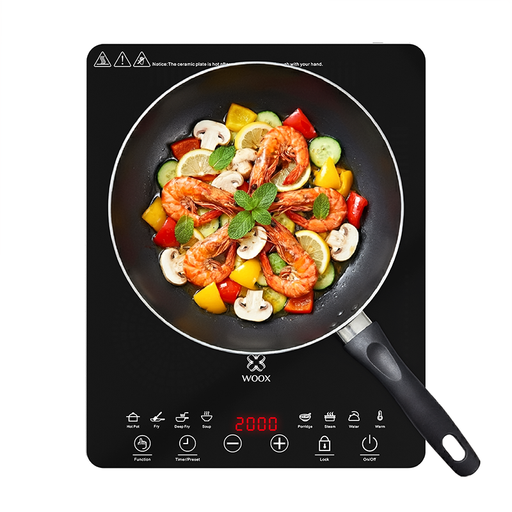 Image unavailable
This portable hob lets you cook a pan on the worktop. Check that the set-up is suitable for your shared kitchen.
The product information lists eight temperature and power settings, a timer, four pre-set cooking programmes and a 1.5 m cord.
Use a flat pan with a magnetic base.
Yes, if the base is magnetic and flat, and the diameter is suitable for your chosen model. Compare the pan base with the size specified by the manufacturer. For the Inventum KI120T, Inventum lists a suitable diameter of 15–20 cm.
Some freestanding models can be plugged into an earthed socket, but this doesn’t apply to every model. Check the plug type and power rating. The freestanding models above 7000 W tested by the Consumentenbond require a Perilex socket and a two-phase connection.
No. A timer doesn’t replace the need to keep an eye on things while cooking. Brandweer Twente recommends staying near the hob.
For a consumer purchase in the Netherlands, the product must meet the standard you’re entitled to expect. The Rijksoverheid explains that the seller must provide a solution if it doesn’t. A manufacturer’s warranty is an extra benefit, and there is no single fixed end date for the statutory warranty on every product.
Mains-powered electrical equipment must meet the applicable safety requirements. The Nederlandse Voedsel- en Warenautoriteit describes the Low Voltage Directive 2014/35/EU. CE marking is required where the relevant EU rules stipulate it. According to Your Europe, the manufacturer applies the marking; it is not an independent certificate issued by a central EU authority.