
Cooking with a soup pan
You want to know whether your pan base fits within the cooking zone’s range and whether you can simmer your soup gently. Milieu Centraal recommends checking whether a magnet sticks to the base of the pan.


Start by checking the diameter of your pan’s base and the connection available at home. Then consider whether you’ll be using other pans alongside the soup. A portable single-zone hob may be enough for one suitable pan, while a multi-zone hob gives you room for side dishes. With a plug-in model, however, the total available power can limit what you can cook at the same time. When buying, also check the installation details and the CE marking on the actual appliance being offered.
You want to know whether your pan base fits within the cooking zone’s range and whether you can simmer your soup gently. Milieu Centraal recommends checking whether a magnet sticks to the base of the pan.
You want to use induction without first having a built-in hob and cooker connection installed. Check the connection diagram and electrical circuit, not just the number of cooking zones.
You’re preparing other dishes alongside the soup and need enough space for your pans and sufficient connection capacity. The Consumentenbond points out that several zones on a single-phase hob can’t always all cook on the highest setting at the same time.
Best for: one pan of soup, provided the pan base is within the range of the cooking zone.
Trade-off: there’s no second cooking zone for a side dish.
Best for: anyone who wants to use another pan alongside the soup without choosing a built-in hob.
Trade-off: the total available power may limit cooking on high settings at the same time.
Best for: a suitable worktop cut-out and a connection confirmed as suitable by an electrician, for example if you regularly cook with several pans.
Trade-off: check the cut-out and connection diagram. A higher connection rating alone doesn’t prove that soup will simmer better.
| Concern | What to check before buying | Which consumers it matters to |
|---|---|---|
| Pan size and gentle cooking | Measure the pan base and compare it with the cooking zone’s range. Also check the low settings and whether the exact model has been tested for simmering. | If I make soup in my existing pan, I want to know whether the base fits and whether I can control the heat gently; around 36% of consumers put this first. |
| Connection and installation | Compare the connection diagram and connection rating with your electrical circuit. For built-in models, check the cut-out too, and ask an electrician to assess the setup if necessary. | I want to be able to install and connect a hob without an unsuitable installation; for around 29% of consumers, this connection is the top priority. |
| Using several pans at once | Check the cooking zone sizes and pan layout, as well as the total connection capacity for simultaneous use. | When I make a side dish alongside the soup, I need enough space for my pans and sufficient power; around 21% of consumers are most concerned about cooking several dishes at once. |
| Controls and maintenance | Compare the controls, timer and residual heat indicator on the exact model. Follow the cleaning instructions and stay nearby while cooking. | For consumers who mainly want clear controls and practical maintenance, this is the priority; around 14% rank these above their other buying concerns. |
With a plug-in model, the total connection rating may limit the power available at the same time. So the number of zones alone doesn’t tell you how many pans you can use on the highest setting simultaneously.
Compare the connection rating and connection diagram with your electrical circuit and the number of pans you want to use at once.
The diameter of the pan base may differ from the measurement across the top. The stated pan sizes apply to the relevant cooking zone.
Measure the base and compare it with the model specifications. For example, Inventum specifies a pan diameter of 15 to 20 cm for the KI120T.
If your current pan isn’t suitable, you may need another compatible pan.
A feature description alone doesn’t show how a particular model performs on a low, steady setting. The Consumentenbond tests simmering separately.
Look for a simmering test of the exact model and compare its low-temperature controls.
Check that the controls, edge finish and connection details described match the manufacturer’s information for that version.
Compare the full model number and product specifications before assuming that two listings refer to the same version.
The Inventum KI120T reviewed here is a portable single-zone hob for one pan. Inventum gives the base diameter range for this model as 15 to 20 cm.
The ETNA KIV364RVS reviewed here is a portable four-zone hob with a standard plug, according to ETNA.
According to Bosch, the PIE631HC1M reviewed here is a 60 cm-wide built-in hob with four zones.
According to Siemens, the EH675LFC1E reviewed here is a 60 cm-wide built-in hob with four zones.
The AEG TO84IU0FFB reviewed here is a wide built-in option for anyone who also uses larger cookware.
These product picks cover portable induction hobs for soup and built-in hobs for a lunch with several pans.
 No image available
An option to consider if you’re looking for a portable induction hob with a timer; check that your pan base is suitable for the cooking zone.
The product name lists 2000 W, 10 power levels, 8 programmes, a timer and a boost function.
 No image available
The two cooking zones may suit you if you want to use a soup pan and a second pan at the same time; check the dimensions and connection details for your kitchen.
The product name lists five temperature settings and keep-warm and simmering functions.
 No image available
An option to compare if you’re looking for a portable induction hob; before buying, check that it suits your pan size and offers the low-heat control you want.
The product name lists model JCL02M and the values 220V/240V/2100.
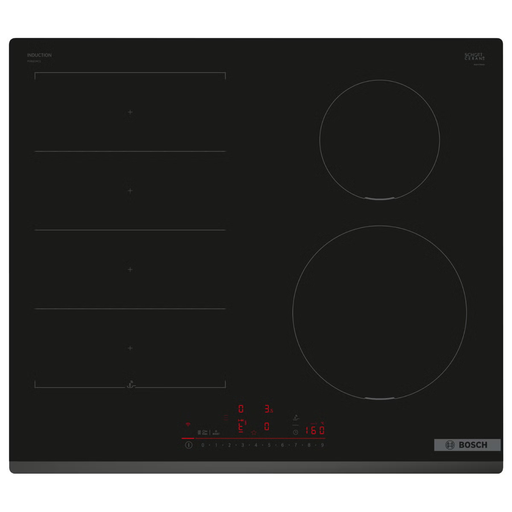 No image available
The four listed zones make this an option to compare for a lunch with several pans; check the cut-out and connection diagram.
The product name lists a width of 60 cm, four cooking zones, DirectSelect and PowerBoost.
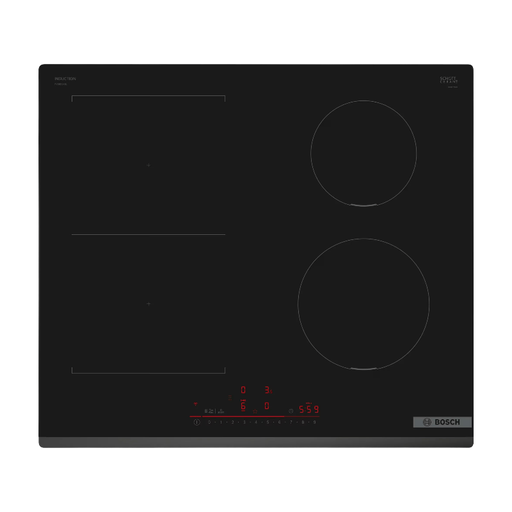 No image available
The four listed zones make this an option to compare if you use other pans alongside your soup; check that the connection is suitable for your kitchen.
The product name lists a width of 60 cm, four zones and TouchSlider controls.
A magnet sticking to the base is a practical first check: according to Milieu Centraal, the pan base must contain a magnetisable layer. Then compare the base diameter with the range of your chosen cooking zone. For example, Inventum specifies 15 to 20 cm for the KI120T.
Don’t assume so just because it’s an induction hob. Some portable models are designed for a standard plug, but Bosch and Siemens each list a connection rating of 7400 W for the built-in models reviewed here, and neither includes a standard plug. Ask an electrician to assess the connection diagram and your own installation.
Milieu Centraal recommends cleaning with a cloth and washing-up liquid. The fire service advises staying nearby while cooking, keeping flammable materials away and cleaning the extractor hood regularly.
According to the Dutch government, the retailer must provide a solution if a product is faulty. There is no fixed statutory warranty period for all products in the Netherlands, so compare any additional warranty with the rights you already have.
According to the Dutch government, electrical appliances placed on the EU market must carry the required CE marking; check this on the actual appliance being offered. On 6 May 2026, RVO listed a €400 grant for an electric cooking appliance, subject to specific conditions. These include living in a home connected to a heat network with no gas connection for heating or cooking. Replacing an appliance as a matter of course therefore doesn’t automatically qualify you for a grant.