
Vandaag of morgen in huis

Kwaliteit gegarandeerd

Welkomstaanbiedingen ontgrendelen: GRATIS bezorging | Tot 80% korting | Gratis 30 dagen JoyPlus-proefperiode
Download de app
An induction frying pan needs to do more than just be magnetic. It should distribute heat evenly, sit steadily on the hob and suit the way you cook. You may not notice you’ve made the wrong choice until later: the base could warp, the coating might wear quickly or the pan may turn out to be too small for a family meal.
There are plenty of options for home cooks, families, students and food lovers, too: from a ceramic frying pan or non-stick frying pan to a wok, griddle pan or lidded sauté pan. Below, we’ve listed the key things to check and some popular options based on verifiable product specifications.
Induction works through magnetic transfer. So, a pan may be magnetic but still heat slowly or unevenly if its base is too thin, too small or not completely flat. Make sure you check:
A frying pan for gas and electric hobs can be a practical choice if you’re moving house or use more than one type of hob. Bear in mind, though, that a pan suitable for induction is not automatically ovenproof.
Terms such as ‘healthy’, ‘natural’ and ‘chemical-free’ are no substitute for a full description of the materials. If you’re looking for a PFAS-free frying pan, it’s worth checking the exact product information. A ‘PFOA-free’ or ‘PTFE-free’ claim is not the same as a general PFAS-free statement.
For example, the product description for Naturepan pans states that they have a PTFE/PFAS/PFOA-free ceramic coating. Other models may only exclude certain substances. Always check exactly what is being claimed, and who is making the claim. Statements about long-lasting performance or extra durability come from the brand’s product description and shouldn’t be taken as a guaranteed result.
A 20 cm pan is handy for one or two eggs, an omelette or a small portion. For several people, 26 to 30 cm is usually more practical. A deep frying pan or lidded sauté pan is better suited to sauces, stir-fries and one-pan meals than a shallow frying pan.
Don’t just look at the outer diameter. The usable cooking surface may be smaller because of a thick rim or sloping sides.
Aluminium usually heats up quickly, while stainless steel can be sturdy and hard-wearing. A combination of the two can offer both benefits. According to the product information, the Naturepan Hybrid has a multi-layer stainless steel body with an aluminium heat-conducting core. The stated base diameter is 19.4 cm for the 28 cm model.
A fully stainless steel surface often requires more care to prevent food sticking. A coating can make it easier to release food, but it needs to be treated with care. Use wooden, silicone or nylon utensils with coated pans, and avoid heating them empty for a long time.
A non-stick frying pan is especially handy for eggs, fish and dishes that tend to stick. A ceramic frying pan may be an alternative if you’re specifically looking for a ceramic coating. Check:
‘Dishwasher-safe’ doesn’t automatically mean the coating will last as long as it would with hand-washing. Hand-washing is recommended for several Naturepan models to protect the coating, although the product description says they can be used in a dishwasher.
A 20 cm pan is a good fit for a small kitchen and is suitable for breakfast or small portions. A 28 cm pan gives you more room for meat, vegetables or a meal for several people. A lid makes a lidded sauté pan more versatile: you can fry ingredients first, then cover them and let them cook through.
An induction wok is particularly useful for stir-frying. Pay attention to its shape: a wok with a flat magnetic base is generally more practical on an induction hob than a traditional round-bottomed wok without a suitable base.
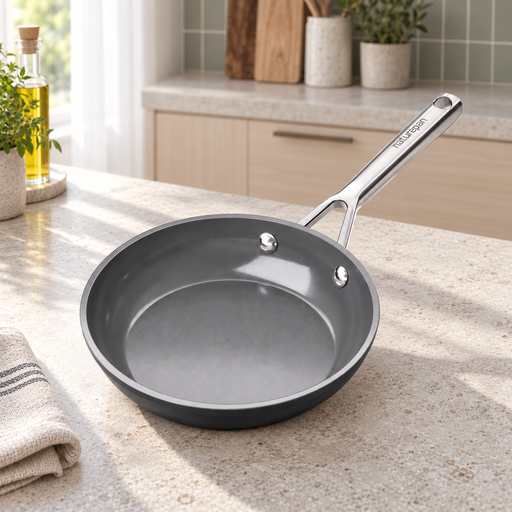
Why it suits this type of cook: Its compact size is ideal for students, small kitchens and single portions. According to the product specifications, the pan works on induction, gas, electric and ceramic hobs.
The specifications list four heat sources and a base diameter of 15.8 cm, making it easier to match the pan to your cooking zone.
20 cm size, ceramic coating according to the product description, and ovenproof up to 260 °C.
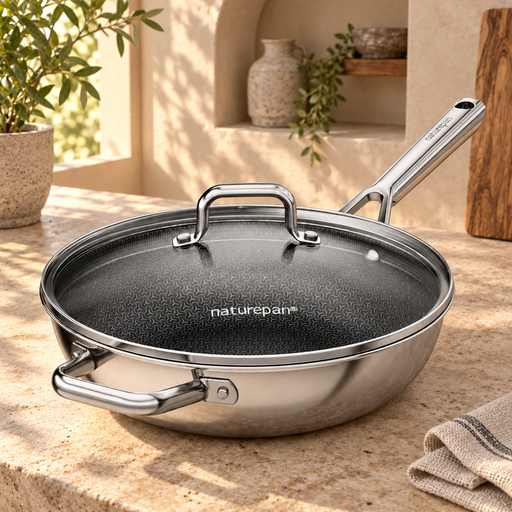
Why it suits this type of cook: This deep pan lets you fry, sauté and cook with the lid on. It’s a good fit for cooks looking for one versatile pan for larger meals.
The product information lists induction, gas, electric and ceramic hobs as compatible. Remove the lid before using the pan in the oven.
28 cm diameter, 7.8 cm-deep pan, hybrid hexagonal cooking surface and a matching lid.
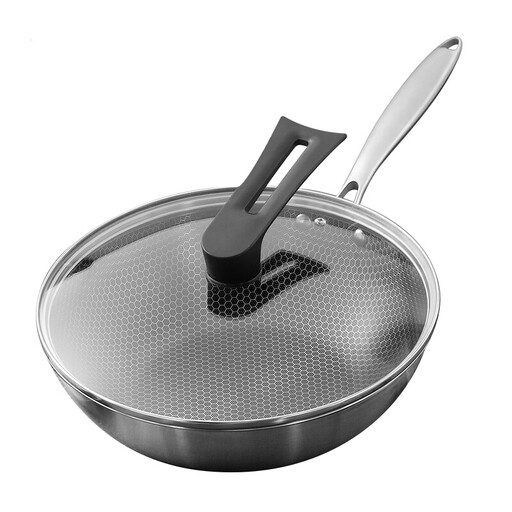
Why it suits this type of cook: The wok shape gives you extra capacity for stir-frying, sautéing and deep-frying. According to the product description, this model is suitable for gas, induction and electric hobs.
The stated 30 cm diameter and included lid make the pan suitable for larger portions and dishes cooked covered.
Stainless steel construction, honeycomb surface according to the product description, and three listed heat sources.
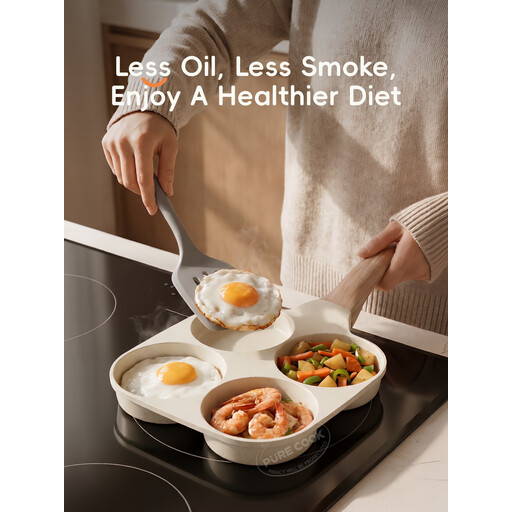
Why it suits this type of cook: The four wells are designed for eggs, mini pancakes, burgers or sausages. That can be handy for a quick breakfast or cooking several portions at once.
The product specifications list a diameter of 19 cm and compatibility with induction, gas and ceramic hobs. This makes it clear what the pan is designed for.
Four separate cooking wells, an aluminium body and clear care advice to hand-wash the pan.
We’ve put together a complete, up-to-date list of products that meet these strict selection criteria and current European safety regulations.
The lifespan of a coated pan depends greatly on how you use it. Follow the manufacturer’s care instructions and bear these tips in mind:
If you’re looking for a complete induction pan set, check first that all the pans have the same base quality, coating and oven-use limitations. A set isn’t automatically better value if you’re unlikely to use some of the sizes.
A 20 cm pan is often enough for one person or smaller dishes. For two to four people, 26 to 28 cm is more practical. A 30 cm pan gives you room for larger portions, but check that your cooking zone is big enough.
Check the official product specifications and look for ‘induction’ in the list of compatible heat sources. A magnet test can give you an initial indication, but it won’t tell you whether the base is flat, distributes heat evenly or has the right diameter.
Not necessarily. First, check that the material claim is clear and specific. Then consider whether the size, heat source, care requirements and cooking style suit you. A ceramic coating may be worth considering if you want to avoid a particular type of coating, but the pan should still be used on a low to medium heat with suitable utensils.
