
Vandaag of morgen in huis

Kwaliteit gegarandeerd

Welkomstaanbiedingen ontgrendelen: GRATIS bezorging | Tot 80% korting | Gratis 30 dagen JoyPlus-proefperiode
Download de app
Choosing an induction frying pan might seem straightforward, but product pages don’t always explain what a specification means in practice. A pan may be suitable for induction, yet still be a poor fit for your cooking zone. Likewise, a non-stick coating can start to underperform after a short time if you use the pan incorrectly or put it in the dishwasher too often.
The main pitfalls to watch out for are:
Only looking at the diameter
A 24 cm frying pan can have a smaller effective base. On induction, it’s the diameter of the magnetic base that really matters. It needs to align well with your cooking zone.
Confusing “non-stick” with unlimited lifespan
A ceramic frying pan won’t automatically perform at its best for years. High temperatures, metal utensils and sudden cooling can all put strain on the coating.
Treating dishwasher-safe as a maintenance recommendation
A dishwasher-safe frying pan may be allowed in the dishwasher, but hand washing with a soft sponge is often gentler on a ceramic coating. Also check whether the handle and pan are oven-safe.
Look for an explicit mention of induction, not just “suitable for all hobs”. According to the product specifications, a pan for all hobs should also be suitable for gas, electric and ceramic hobs. If in doubt, check:
Models such as the Redchef Starlight Series 24 cm are described as suitable for induction, gas and electric hobs. The Brabantia Dusk 24 cm additionally states compatibility with halogen and ceramic hobs.
A PFAS-free frying pan with a ceramic coating can be appealing if you want to release food easily and cook with less oil. Do pay attention to the care instructions. According to the product information from Redchef, Brabantia, Tefal and SENSARTE, the ceramic coatings mentioned are free from PFAS; this is a product claim from those brands and not a general feature of every ceramic pan.
A stainless steel frying pan has no classic non-stick coating and can be suitable for high temperatures. With stainless steel, preheating and using the right amount of oil are important to prevent sticking. A multi-layer construction, such as stainless steel-aluminium-stainless steel, can help distribute heat more evenly. According to the product description, PURECOOK uses a triple-ply build for this purpose.
A larger pan isn’t automatically more convenient. On a small induction zone, heat distribution may be less effective, whereas a compact pan will heat up more quickly.
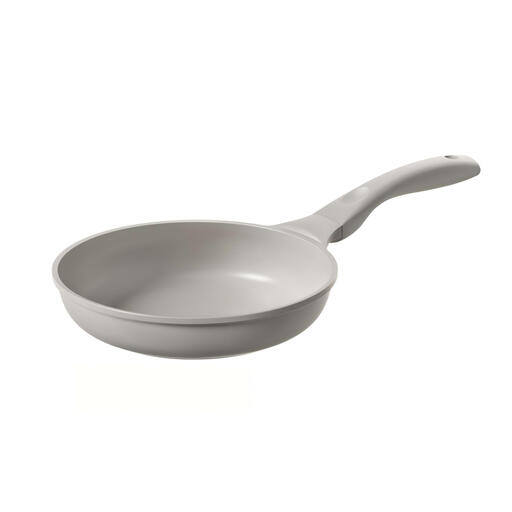
Why this fits the profile: The 24 cm size suits everyday portions for one to three people. According to the product description, the pan is suitable for induction, gas and electric hobs and has a ceramic coating.
The hob compatibility and diameter are clearly stated. Follow the instructions: do not use metal utensils and let the pan cool down before cleaning it.
24 cm, PFAS-free according to the product information, suitable for induction and dishwasher-safe as per the stated specifications.

Why this fits the profile: This pan combines a 24 cm size with 100% recycled forged aluminium according to the product information, a PFAS-free ceramic coating and oven-safety up to 200 °C.
The specifications list the heat sources, maximum oven temperature and care instructions. Although the pan is dishwasher-safe, hand washing is recommended to preserve the coating for longer.
Induction-compatible, PFAS-free ceramic coating according to the product description, oven-safe up to 200 °C and featuring RCS certification for recycled material.
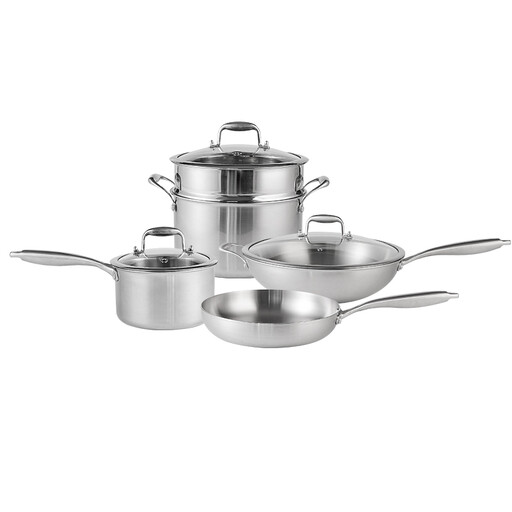
Why this fits the profile: The set is designed for households that want to stir-fry, steam and boil as well as fry. The 28 cm frying pan does not come with a lid according to the product data; other items in the set do have glass lids.
The triple-ply construction with an aluminium core is clearly described. This means you know you’re not buying a standard single-layer stainless steel pan. Do check beforehand which pieces will fit in your cupboard.
304 and 316 stainless steel in the set, multiple cooking functions, glass lids on selected items and suitable for various hobs according to the product description.
We’ve put together a full, up-to-date list of products that fully meet these strict selection criteria and comply with current European safety regulations.
A durable frying pan isn’t just about the material. Adopt these habits:
A dishwasher-safe frying pan can be convenient, but hand washing is often a sensible choice for ceramic coatings. With stainless steel pans, the dishwasher can sometimes be used according to the product specifications, although drying them straight away helps to minimise marks.
For everyday use, a 24 cm frying pan is often practical for one to three people. As well as the top diameter, also look at the diameter of the magnetic base and compare it with your induction zone.
No. Ceramic coating and being PFAS-free are separate properties. Always check the specific product information. For the models mentioned, PFAS-free is stated by the brand or in the product description; treat this as a product specification for that particular model.
The lifespan varies depending on the material, how often you use it and how you care for it. A coating can wear out more quickly due to high temperatures, metal spatulas, abrasive cleaning and thermal shock. A stainless steel pan without a classic coating can last longer with careful use, but it requires more attention during cooking.
