
Vandaag of morgen in huis

Kwaliteit gegarandeerd

Welkomstaanbiedingen ontgrendelen: GRATIS bezorging | Tot 80% korting | Gratis 30 dagen JoyPlus-proefperiode
Download de app
An induction frying pan needs to do more than just be magnetic. Its base should sit flat against the cooking zone, its size should suit your household and its coating should match the way you cook. If you focus only on a low price or the word “granite”, you could still end up with uneven heating, a non-stick coating that wears out quickly or a pan that isn’t oven-safe.
This buying guide will help you compare your options. You’ll find out which features are worth checking, which common pitfalls are easy to overlook and which models suit different needs.
A pan may be technically suitable for induction but still heat unevenly if its magnetic base is smaller than the cooking zone. So don’t just check the frying pan for all hob types label; check the base’s diameter and flatness too. A 28 cm pan doesn’t always have a cooking surface that’s exactly 28 cm across.
“Granite”, “stone” and “ceramic” don’t give you the full material specifications. A granite frying pan usually refers to the coating’s appearance or name, not to solid granite. Check the type of coating, whether metal utensils can be used and the cleaning instructions.
Also look out for the difference between PFOA-free and a PFAS-free frying pan. PFOA is one specific substance. A product that explicitly states it is free from PFAS, PTFE and PFOA makes a broader claim. Always check the product information, and don’t automatically take brand claims as a general guarantee.
A dishwasher-safe frying pan may be suitable for the dishwasher according to its product description, even if handwashing is recommended to help the coating last longer. “Oven-safe” also only applies up to a stated temperature, and sometimes not to the lid or handle. Check the maximum temperature before moving a pan from the hob to the oven.
A 24 cm frying pan is practical for one or two portions, eggs, pancakes and smaller hobs. A 28 cm frying pan gives you more room for vegetables, meat or a meal for several people. A larger pan does need a suitably sized induction zone, though; otherwise, the centre may heat up faster than the edges.
A frying pan set with, for example, 20, 24 or 28 cm pans can be useful for families. When comparing sets, consider the actual capacity and how much storage space you have. Two pans with the same diameter but different rim heights won’t necessarily be equally useful.
According to the product descriptions from various brands, some models are free from intentionally added PFOA, PFOS, lead and cadmium. This is a manufacturer’s product specification, not a general statement about all non-stick pans.
A frying pan with a lid is useful for simmering, reducing sauces and cooking dishes where you want to retain moisture. Check whether the lid is included and whether it can withstand the stated oven temperature. A Bakelite handle may stay cool during use on the hob, but it can still get hot in the oven.
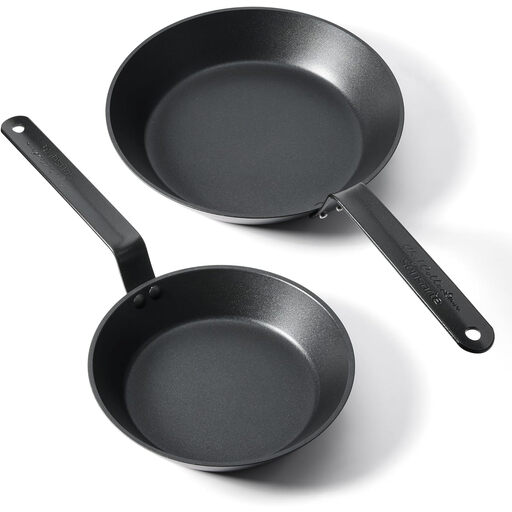
Why it suits this type of user: The set includes 20 and 25 cm pans, so you can cook small and medium portions without having to buy several separate pans straight away.
The product description specifies a magnetic stainless steel base for induction and other hob types. Handwashing is recommended, despite the stated dishwasher-safe claim.
Aluminium body, non-stick coating, induction compatibility and oven use up to 450 °F according to the product information.
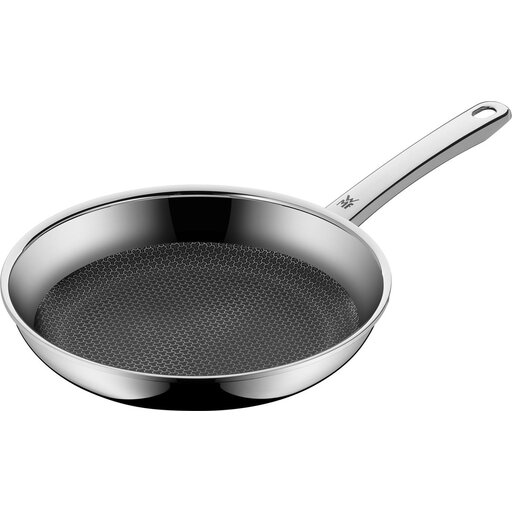
Why it suits this type of user: This pan combines an aluminium core with stainless steel layers and a protective honeycomb structure around the non-stick coating.
The three layers are clearly described, so you can see what the general term “durable” actually means. The pan isn’t dishwasher-safe and needs to be handwashed.
Suitable for induction, heat-resistant up to 260 °C and covered by a 5-year guarantee according to the product information.

Why it suits this type of user: This stainless steel pan with an aluminium core is suited to frying, searing and simmering, especially if temperature control is important to you.
The product description specifies a 304 stainless steel-aluminium-stainless steel construction, compatibility with all hob types and dishwasher use. Always check the latest temperature information before using it in the oven.
No delicate non-stick coating according to the material description, a glass lid and an oven temperature rating of up to 220 °F in the product specifications.
We’ve put together a complete, up-to-date list of products that fully meet these strict selection criteria and the applicable European safety regulations.
A 24 cm pan is often practical for one or two people. A 28 cm pan gives you more room for family meals and larger portions. Check that the base is a good match for the diameter of your induction zone.
No. Ceramic describes the type of coating. Look for an explicit PFAS-free claim in the product information and check exactly which substances are mentioned. A PFOA-free label has a more limited meaning.
How long it lasts depends on the temperature, utensils, cleaning and how often you use it. Handwashing, moderate heat and avoiding scratches can help keep the coating in good condition for longer. If it starts to peel or is clearly damaged, it’s best to replace the pan.
