
Vandaag of morgen in huis

Kwaliteit gegarandeerd

Welkomstaanbiedingen ontgrendelen: GRATIS bezorging | Tot 80% korting | Gratis 30 dagen JoyPlus-proefperiode
Download de app
Buying an induction frying pan seems straightforward until you discover that not every pan works on every hob. Terms such as “granite coating”, “ceramic” and “PFAS-free” do not tell the whole story either. A pan may be suitable for induction but still be too small for your cooking zone, difficult to clean or unable to withstand high temperatures.
This guide explains what to look for and which popular options suit different cooking styles and households.
A frying pan for all hobs must have a magnetic base for induction. An aluminium pan without a suitable composite or steel base will not work on induction, even though aluminium conducts heat quickly.
Always check that the product description explicitly mentions induction, gas, electric and ceramic hobs. Also look at the diameter of the base. For example, the Brabantia Onyx sauté pan has a listed base diameter of 17 cm. This should align well with the induction zone for even heating.
“Stone effect”, “granite” and “titanium” often refer to the appearance or product range. On their own, they do not indicate whether a coating is PFAS-free, ceramic or PTFE-based.
For example, the PURECOOK frying pan is described as having a food-safe non-stick coating, but it does not state that the coating is PFAS-free. The Brabantia Nocta, on the other hand, is described as having a PFAS-free ceramic coating. Read the precise material details and care instructions rather than relying solely on the marketing name.
A non-stick frying pan may be dishwasher-safe, but hand-washing is often gentler on the coating and handle. Other models may only be suitable for hand-washing. A pan that cannot go in the dishwasher is not necessarily a poor choice; its care requirements simply need to fit your routine.
When using a coated pan, wooden, silicone or plastic utensils are preferable. Avoid steel wool, abrasive cleaning products and prolonged heating when there is no food in the pan.
Aluminium is light and heats up quickly. This makes a lightweight frying pan pleasant for everyday use and ideal for anyone who regularly lifts the pan with one hand. For induction, an aluminium pan does require a magnetic base.
Stainless steel is robust and often suitable for intensive use. Three-layer constructions, such as those found in some woks, are designed to distribute heat throughout the pan. This can be useful for stir-frying or cooking larger portions.
A ceramic frying pan has a ceramic non-stick coating. Check that the product information also clearly states whether the pan is PFAS-free. According to the product description, this is the case for the Brabantia Nocta and Onyx models.
A frying pan with a lid is useful when you want to cook food through or keep it warm. Check whether the lid is included and whether the handle or pan is oven-safe.
A coating will generally remain usable for longer if you:
If the coating is visibly damaged or starts to peel, continued use is not advisable. Claims about durability or scratch resistance come from the brand’s product description, so treat them as product specifications rather than a guarantee of a particular lifespan.
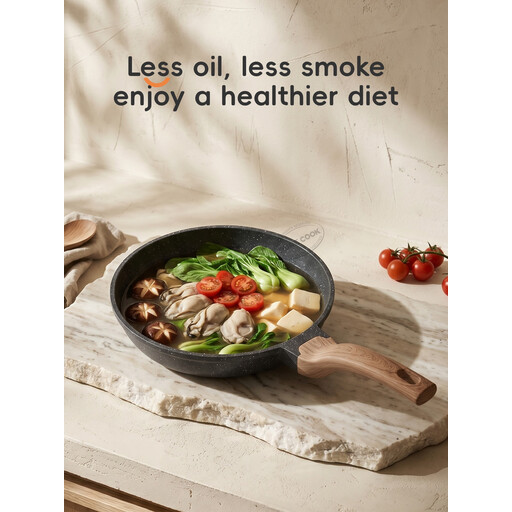
Why it suits this profile: The 24 cm diameter is suitable for everyday portions. According to the product description, the aluminium pan is lightweight and suitable for induction, gas and ceramic hobs.
The hob compatibility is clearly stated. Bear in mind that, according to the product information, this pan must be washed by hand.
24 cm diameter, aluminium body, wooden handle and a stated stone-effect non-stick coating.
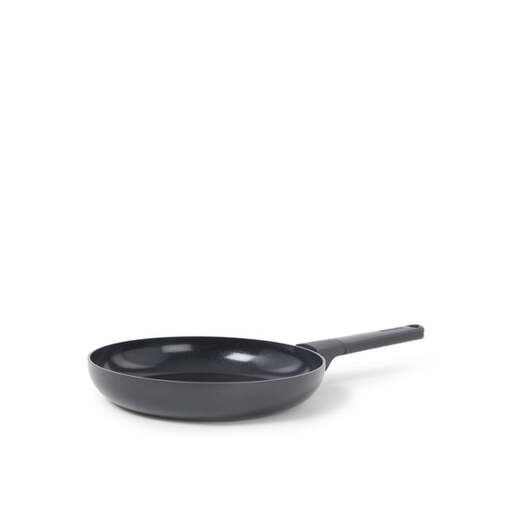
Why it suits this profile: If you are looking for a familiar size and easy cleaning, this 24 cm aluminium pan has a ceramic coating and a stated three-year guarantee.
According to the product description, the coating is PFAS-free and the pan is suitable for induction, gas, electric and ceramic cooking.
PFAS-free ceramic coating according to the product information, dishwasher-safe and suitable for four types of hob.
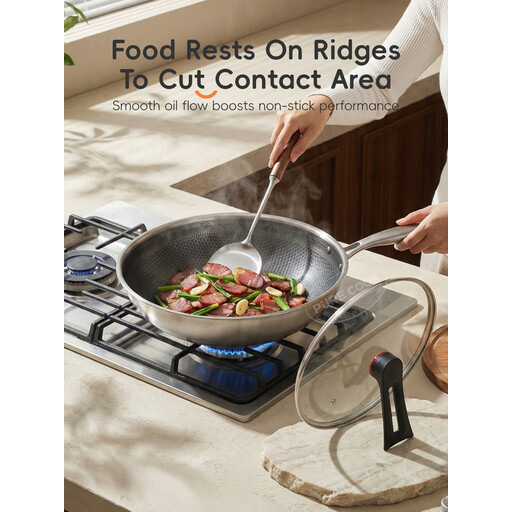
Why it suits this profile: The 32 cm wok is designed for stir-frying, stewing and cooking larger meals. Its three-layer 304 steel construction and glass lid provide added functionality.
The product description explicitly mentions induction, gas and ceramic electric cooking. Hand-washing and avoiding placing a hot pan in cold water remain important considerations.
32 cm size, glass lid, 304 stainless steel and compatibility with multiple hobs.
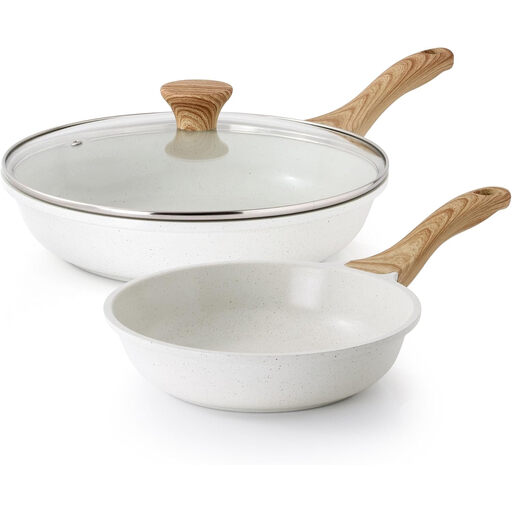
Why it suits this profile: The set includes a 20 cm pan and a 28 cm frying pan with a glass lid. This lets you combine smaller portions with family-sized meals.
According to the product description, the ceramic coating is free from intentionally added PFAS, PTFE, PFOA, PFOS, lead and cadmium. The set is suitable for induction, gas and electric cooking.
Two sizes, glass lid, aluminium body and hand-washing as the recommended care method.
We have put together a complete, up-to-date list of products that fully meet these strict selection criteria and the applicable European safety regulations.
For one person, 20 to 24 cm is often practical. For two to four people, 26 to 28 cm is usually the best choice. Choose a pan whose magnetic base matches the cooking zone. A very large pan on a small zone may heat less evenly.
No. “PFAS-free” and “ceramic” are two different properties. According to the product information, a ceramic coating may be PFAS-free, but always check the manufacturer’s specific claim. A stone-effect or granite coating is not automatically ceramic or PFAS-free.
Its lifespan depends on heating, utensils and cleaning. Cooking at a medium-high temperature, hand-washing with a soft sponge and avoiding scratches will help protect the coating. Replace the pan when the coating becomes visibly damaged or food consistently starts sticking.
