
Vandaag of morgen in huis

Kwaliteit gegarandeerd

Welkomstaanbiedingen ontgrendelen: GRATIS bezorging | Tot 80% korting | Gratis 30 dagen JoyPlus-proefperiode
Download de app
Choosing a frying pan for induction may seem straightforward. Yet many shoppers are tempted by an attractive coating, a low price or a large size without checking whether the pan is genuinely suited to their hob and everyday cooking. The result can be uneven heat, a non-stick coating that quickly becomes damaged or a pan that is too heavy for comfortable cooking.
In this guide, we explain what to look for in an induction frying pan, whether you cook with gas, on a ceramic hob or using several heat sources. You will also find practical recommendations for different cooking styles.
A 24 cm or 28 cm frying pan usually refers to the top rim. The effective base may be smaller. With induction, the magnetic base is especially important: it needs to align well with the cooking zone to distribute heat evenly.
A 28 cm pan gives you room for several portions, but it also takes up more space on the hob. For one or two people, 20 or 24 cm is often more practical.
A non-stick frying pan will not automatically perform at its best for years. Overheating, metal utensils, scouring pads and sudden changes in temperature can damage the coating. Even a dishwasher-safe pan may last longer when washed by hand, according to the product description.
So always check:
Terms such as “healthy”, “indestructible” or “lifetime non-stick” are no substitute for verifiable specifications. A brand’s own research may show, for example, that a coating lasts longer than a standard coating, but this is not a guarantee for every household.
Instead, focus on the material, base, coating, heat sources and care instructions.
Aluminium generally heats up quickly and is relatively lightweight. A suitable induction base is essential, however, as ordinary aluminium does not work independently on induction. A multi-layer pan with an aluminium core and stainless steel can distribute heat evenly while still feeling sturdy.
According to the product description, the WMF Profi Resist pans use a construction with an aluminium core and stainless-steel layers. According to WMF, the TransTherm base is designed to distribute heat quickly and evenly.
A traditional synthetic non-stick coating is particularly useful for eggs, pancakes and fish. A ceramic frying pan uses a ceramic coating and is marketed by some brands as PFAS-free. If in doubt, check the official product specification rather than relying only on an advert’s title.
The WMF Durado product information states that its ceramic coating is PFAS-free. Brabantia also states that the Onyx and Dusk models have a 100% PFAS-free ceramic coating. These are product specifications from the respective suppliers; they are not a general statement about ceramic coatings as a whole.
Check that the pan is suitable for your hob. A good frying pan for gas and induction will explicitly list both heat sources. The product specifications should also state whether it is suitable for ceramic or electric hobs.
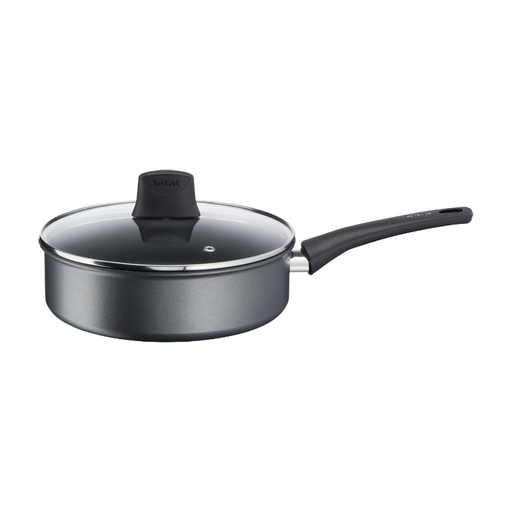
Why it suits this profile: The 24 cm size is versatile for everyday cooking, while the supplied glass lid is practical for simmering and dishes with sauce. According to the product information, the pan is suitable for induction, gas, electric, ceramic and halogen hobs.
The product specifications list several heat sources and a comprehensive induction base. This means you do not have to rely solely on the term “non-stick”.
24 cm, glass lid, oven-safe up to 175 °C according to the product information and a titanium-reinforced non-stick coating according to Tefal.
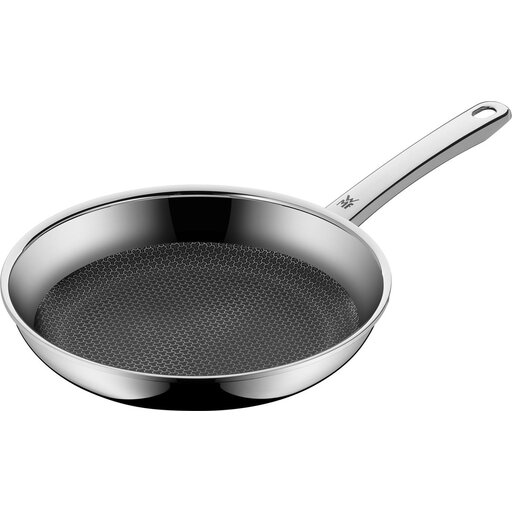
Why it suits this profile: This larger pan is ideal for home cooks who prepare meat, vegetables or several portions at once. The product description mentions a three-layer construction, a honeycomb structure and suitability for induction.
The base and material construction are clearly specified. According to the product information, the pan is not dishwasher-safe, so hand washing is part of its care routine.
28 cm, suitable for all heat sources according to WMF, heat-resistant up to 260 °C and a stated 5-year manufacturer’s warranty.
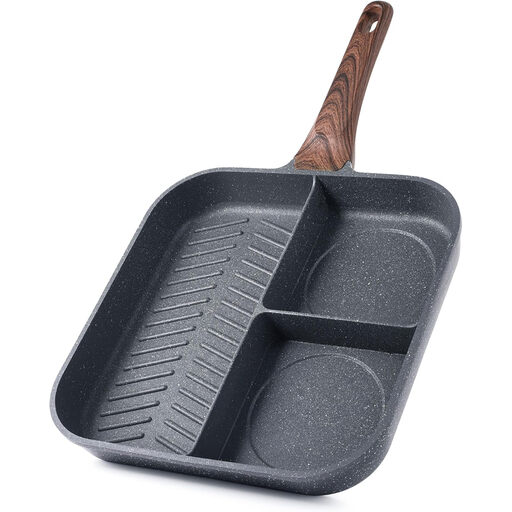
Why it suits this profile: The three sections are designed for breakfast and grilled dishes. According to the product description, you can prepare eggs, bacon, pancakes and burgers at the same time without everything mixing together.
The pan specifies a 4.5 mm-thick magnetic stainless-steel base and compatibility with induction, gas, electric, glass and ceramic hobs.
Three cooking sections, grill ridges, suitable for induction and a coating that, according to the product information, is free from PFOA, PFOS, APEO, lead and cadmium.
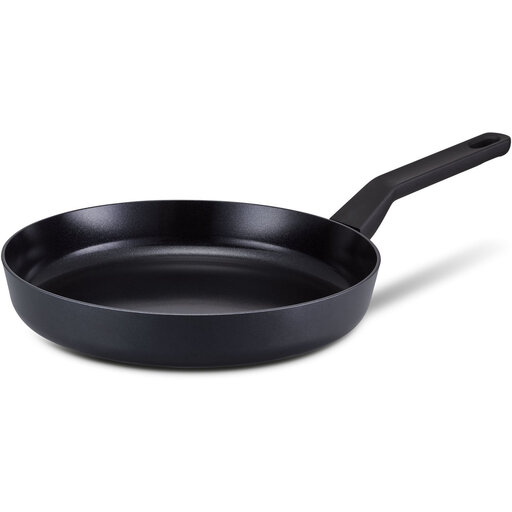
Why it suits this profile: This size is suitable for everyday meals, and according to Brabantia the pan is designed for induction, gas, electric, ceramic and halogen cooking.
The product information mentions a PFAS-free ceramic double non-stick coating and a body made from 100% recycled aluminium. Hand washing is still recommended to help protect the coating.
24 cm, lightweight aluminium, ceramic double coating, dishwasher-safe according to Brabantia and oven-safe up to 200 °C.
We have put together a complete, up-to-date list of products that fully meet these strict selection criteria and the applicable European safety regulations.
Even a durable frying pan requires proper use. Allow the pan to cool after cooking before washing it, and use a soft sponge with mild washing-up liquid. Wooden, silicone or plastic utensils help reduce the risk of scratches. Do not heat an empty non-stick pan on a high setting, and regularly check whether the coating or handle is damaged.
For a dedicated breakfast pan, you could also consider an egg pan with a non-stick coating. A model with four sections is useful for portions of egg, mini pancakes or small burgers, but less flexible for larger dishes. An induction grill pan with ridges, on the other hand, is designed for grill marks and recipes where you want to keep several ingredients separate.
A 24 cm frying pan is a useful starting size for many households. Choose 20 cm for small portions and 28 cm if you regularly cook for several people. Also check the diameter of the magnetic base and the cooking zone.
This depends on the coating, temperature, frequency of use and care. There is no fixed service life that applies to every pan. Stop using it when the coating is clearly coming away, deeply scratched or the handle is no longer firmly attached.
Not always. In the product information mentioned above, PFAS-free models such as the Brabantia Onyx and WMF Durado are described as having a ceramic coating. Always check the material and coating of the specific product before ordering.
