
Vandaag of morgen in huis

Kwaliteit gegarandeerd

Welkomstaanbiedingen ontgrendelen: GRATIS bezorging | Tot 80% korting | Gratis 30 dagen JoyPlus-proefperiode
Download de app
Choosing a new lamp seems simple until you have to compare brightness, colour temperature, controls and size. When it comes to indoor LED lamps, most disappointing purchases result from three common pitfalls:
So check the product specifications beforehand and consider what you will actually use the lighting for. An LED ceiling lamp for the living room, for example, requires a different light output from a cordless table lamp for a side table.
Lumens (lm) indicate how much light a lamp produces according to the product specification. Watts (W) indicate how much electrical power the lamp uses. A low-wattage lamp can therefore still provide enough light, depending on the number of lumens and the light distribution.
For a small table or atmospheric corner, 105 to 210 lumens is often a practical starting point. General ceiling lighting usually has a higher light output. The range, for example, includes ceiling lamps with 1300, 1350, 2000 and 2700 lumens.
Want to estimate the energy consumption? Use this simple calculation:
wattage × operating hours ÷ 1000 = consumption in kWh
According to the product specification, a 16 W LED lamp that is switched on for 1000 hours uses 16 kWh. The actual cost depends on your energy tariff and how long you use it.
Colour temperature is expressed in kelvin (K):
An LED lamp with warm white light generally works well in a bedroom or living room. For a home office, adjustable colour temperature can be more convenient. Do bear the controls in mind: some models are adjusted with a remote control, while others use a touch switch.
Measure the room and the connection point before ordering. An ultra-thin lamp measuring 2.6 cm in height can sit discreetly against the ceiling, but its diameter or length still determines whether the model is a good fit.
The IP rating indicates the extent to which a product is protected against dust and moisture. IP20 is intended for dry indoor spaces. IP44 provides greater protection against splashing water, but always check the specific installation instructions. Switch off the power before installation and use suitable fixing materials. If you are unsure about the electrical connection, it is advisable to consult a qualified installer.
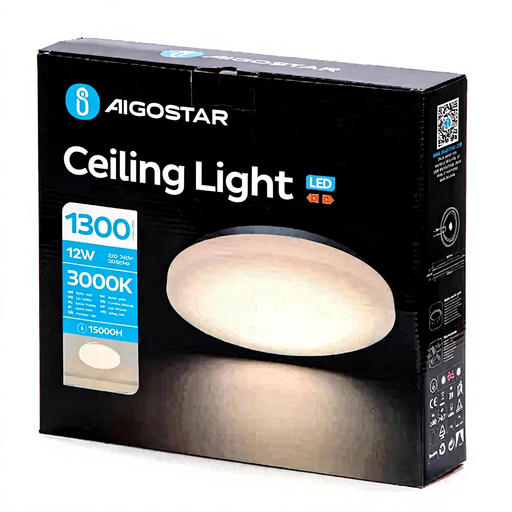
Why it suits this profile: A straightforward LED ceiling lamp for anyone looking for fixed, warm lighting without additional controls or complicated features.
The specifications clearly state 12 W, 1300 lumens, 3000 K and a diameter of 26 cm. This means you do not have to rely solely on marketing terms.
1300 lumens, 3000 K, a 120° beam angle and a stated lifespan of 15,000 hours.

Why it suits this profile: For anyone who wants to combine a slim design with multiple lighting settings in the living room, dining room or bedroom.
You can see the relevant details in advance: 16 W, 2000 lumens, a 29.1 cm diameter and IP20. According to the product description, the remote control provides five lighting settings.
Adjustable from 2200 K to 6500 K, dimming function, 2000 lumens and a height of 2.4 cm.
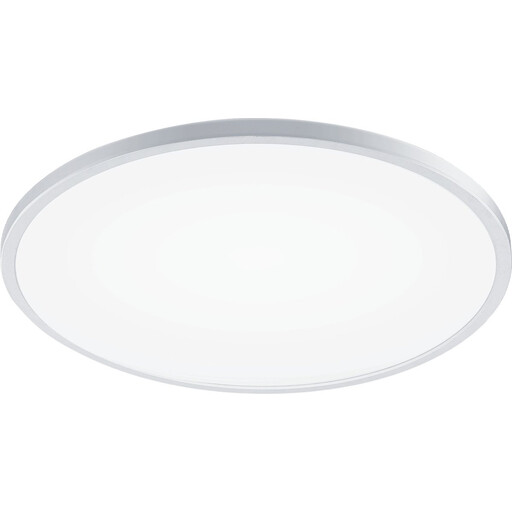
Why it suits this profile: A practical choice for larger indoor spaces or users who want to switch between atmospheric lighting and bright white light.
Here, the RGB option is combined with specific details about 2700 lumens, 24 W, a length of 42 cm and IP44. Do check that the dimensions suit your ceiling.
RGB+CCT, adjustable from 3000 K to 6500 K, 2700 lumens and IP44 according to the product specification.

Why it suits this profile: Ideal if you want to place a cordless table lamp on a desk, sideboard or dining table without needing a socket nearby.
The lamp states not only that it is cordless, but also specifies 2 W, 210 lumens, 3000 K, an 18650 battery and a three-stage touch dimmer.
Rechargeable battery, three brightness settings, 210 lumens and a compact size of 21.2 × 9 cm.
We have put together a complete, up-to-date list of products that fully meet these strict selection criteria and the applicable European safety regulations.
That depends on the room, its size and how you intend to use it. A table lamp for ambient lighting may be sufficient with a few hundred lumens. General lighting in a living room, dining room or office usually calls for a higher light output. As well as lumens, consider the beam angle: a wide 120° beam distributes light differently from directional lighting.
LED lighting generally uses little power, but the difference in cost is determined by the wattage and the number of operating hours. So compare the stated power, such as 1 W, 2 W, 12 W, 16 W or 24 W, and calculate the consumption using the formula above. With some models, a higher light output may be combined with a higher wattage.
The stated lifespan varies from product to product. The selected models, for example, list 15,000, 20,000 or 25,000 hours. This is a product specification, not a guarantee of a particular service life in every home. Also check whether the light source is replaceable. In several integrated models, it is not intended to be replaced by the user. According to the product information, the legal guarantee is at least two years under European consumer rules; additional rights may apply under national legislation.
