What should you look for when choosing?
First, work out how many rolls you'll actually eat or store. Then compare the preparation method and the label: a fresh individual roll, a pack of bake-off rolls and a pack of frozen rolls each require different planning.
| What to consider |
What to check when buying |
Who should pay particular attention? |
| Suitable quantity |
Check how many rolls there are and whether you can buy one individually. If you're buying a pack, check whether you can store the rest according to the label. |
If I usually eat one roll, I don't want the rest to go stale. For around 36% of consumers in small households, getting the right portion size comes first. |
| Storage and preparation |
Check whether the rolls are fresh, ready to bake or frozen, and read the preparation and defrosting instructions. |
Anyone who eats rolls irregularly will want to take them out of storage when needed. For around 29% of these consumers, convenient storage is the top priority. |
| Wholemeal and fibre |
Look for an explicit wholemeal description and compare fibre per 100 g, rather than relying on terms such as brown or multigrain. |
If fibre is the deciding factor for me, I want to compare the nutritional information for different varieties on the same basis. Around 21% of consumers put this first. |
| Gluten and allergens |
Read the current ingredients list, allergen information and any cross-contamination warning. If needed, check for an explicit gluten-free label. |
If you need to follow a specific diet or avoid certain allergens, the roll itself must be suitable, whatever the pack size. For around 14% of consumers, this check is the top priority. |
Brands compared
Compare specific varieties and their labels: pack sizes, ingredients and storage instructions can vary even within the same brand.
Albert Heijn
Worth considering if you're looking for an individual wholemeal roll or a specifically labelled gluten-free variety.
- AH's wholemeal roll is sold individually. Albert Heijn states that it contains 100% wholemeal flour and 7,1 g of fibre per 100 g.
- The gluten-free white rolls come in packs of two; according to AH's product page, they aren't suitable for home freezing.
Jumbo
Worth considering if you want to compare roll pack sizes and preparation methods.
- Jumbo offers, among other options, packs of four and brown frozen rolls.
- Jumbo says its brown frozen rolls must not be refrozen after defrosting.
PLUS
Worth considering if you want to compare packs of white and wholemeal multigrain bake-off rolls.
- PLUS states that its wholemeal multigrain rolls contain 56% wholemeal wheat flour and 7 g of fibre per 100 g; its white variety contains 2,7 g of fibre per 100 g.
- Both varieties mentioned need to be baked, so they aren't suitable if you're looking for rolls that are ready to eat.
ALDI
Worth considering if you want to buy a white roll individually.
- ALDI lists a white roll that is sold individually.
- Check the label in store if ingredients or allergens will affect your choice.
Dirk
Worth considering if you want to weigh up individual white or brown rolls against a pack of four white rolls.
- Dirk offers both individual rolls and a white variety in a four-pack.
- Before buying several rolls for different meals, read the preparation and storage instructions for the variety you've chosen.
Four-packs of rolls on Joybuy
This pack is an option if four rolls fit your meal plan. It isn't a substitute for choosing an individual roll if you're only buying for one meal.
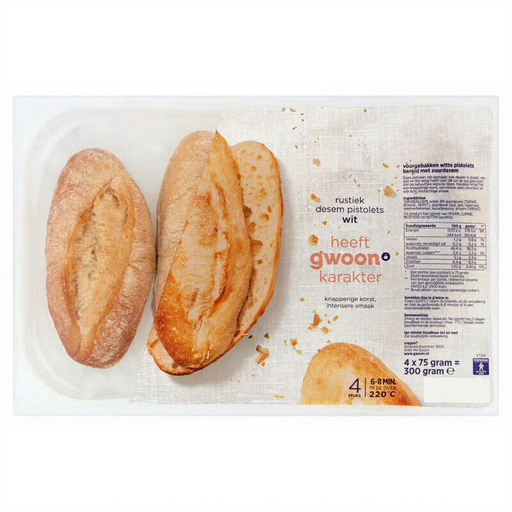 Image unavailable
g'woon rustic white rolls, 4 pieces
A pack for anyone who can use four rolls and has a plan for the rest.
g'woon's ingredient description lists wheat flour, sourdough made with wheat and spelt, and iodised salt. If you have allergen requirements, check the current label, and read the preparation and storage instructions before buying.
View on Joybuy
Frequently asked questions
Can rolls replace half a loaf?
Not always: rolls are particularly handy if you want to decide how many to have with each meal. With half a loaf, it still matters how much you use and whether you can store the rest properly; if you're buying rolls in a pack, check the specific storage instructions.
Can I freeze rolls for later?
It depends on the product. The Netherlands Nutrition Centre advises freezing bread in portions as soon as you buy it, but follow any product-specific instructions that differ. For example, AH says its gluten-free white rolls aren't suitable for home freezing.
Is a multigrain roll always wholemeal?
No, the name ‘multigrain’ alone doesn't mean a product is wholemeal. PLUS says its wholemeal multigrain rolls contain 56% wholemeal wheat flour; for other varieties, check the product name, ingredients and nutritional information.
Does every roll contain iodised salt?
Don't assume so. PLUS and g'woon list iodised salt in the ingredients of the varieties discussed here; check the current ingredients list for any other roll.
What should I look for if I need to avoid gluten or other allergens?
Check the ingredients, highlighted allergens and any cross-contamination warnings on the current packaging. If you need a gluten-free option, choose a product explicitly labelled gluten-free rather than relying on its colour or grain name.


