
Livraison le jour même et le lendemain

Qualité garantie

Débloquez vos offres de bienvenue: Livraison GRATUITE | Jusqu'à -80 % | 30 jours d'essai gratuits à JoyPlus
Téléchargez l'application
Disposable incontinence underwear can be handy for moderate to heavy urine loss, during the night or after childbirth. Yet it’s tricky to work out what you really need just from product packaging. Terms like “maximum absorbency”, “leak-proof” and “odour control” sound clear enough, but they don’t always tell you how a pair will perform in your daily situation.
Pay particular attention to these three common pitfalls:
Below we explain which features to check before you buy disposable incontinence underwear.
First, think about when you’ll need it. For on-the-go, the office or short trips, a daytime model may be enough. For longer wear, heavier urine loss or sleeping, a wider absorbent core with extra protection around the legs is more practical.
Product descriptions sometimes use terms like heavy absorbency, maximum absorbency or overnight. According to the product description for SUNKISS TrustPlus, certain models feature a double core with superabsorbent polymer, an extra-wide core and a quick-drying construction. These are verifiable design features. However, the actual wear time varies from person to person and situation to situation.
So a claim like “up to 12 hours” on the women’s model should be read as the manufacturer’s stated figure, not a guaranteed wear time. If you experience heavy fluid loss, changing sooner is wiser. The same goes for incontinence underwear for night-time: test first how the product suits your level of urine loss and sleeping position.
The absorbent core is only one part of leak protection. Check whether the pants have:
According to the product information, SUNKISS TrustPlus has inner leg gathers and a sag-resistant back panel. The men’s models are described with reinforced leak guards and a 357-degree elastic design. This can help with movement, but the fit remains crucial. A size that’s too loose can create gaps; a size that’s too tight can pinch and leak along the edges.
For long-term wear, soft, breathable materials are important. Some SUNKISS models are described as latex-free, lotion-free and fragrance-free. Other variants use lightweight, breathable pulp with FSC certification, according to the product description.
Odour control is also often prominently mentioned. According to SUNKISS’s own product information, an odour-locking layer is designed to trap or neutralise moisture and unpleasant smells. This is a claim from the brand; it’s not a guarantee that odours will disappear completely in all circumstances. Regular changing, proper disposal and keeping the packaging sealed remain important.
If you have sensitive skin, also check the ingredients and warnings on the label. Stop using if irritation occurs. The product is for external use only, intended for single use and must not be flushed.
Measure your waist and the widest part of your hips with a flexible tape measure. Compare these measurements with the size chart on the product page. Also consider your body shape:
If you’re a carer, it’s a good idea to order a smaller quantity before buying a large pack. That way you can assess the size, how easy it is to put on and change, without building up unnecessary stock.
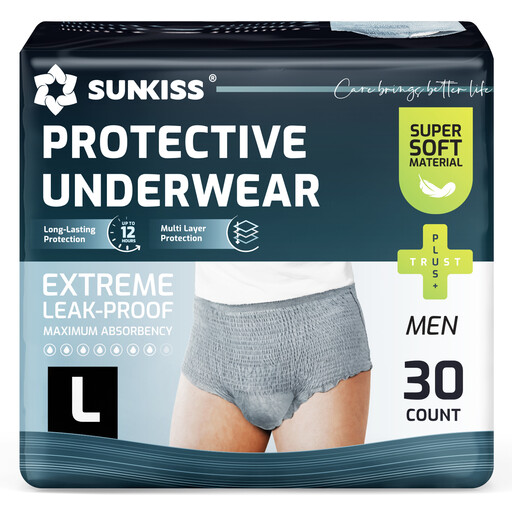
Why this fits the profile: A pack of 30 is practical for regular daytime use and makes it easier to compare the cost per pair.
The product description mentions an ergonomic men’s fit, reinforced leak protection and a 357-degree elastic design, so you’re not relying solely on the absorbency claim.
30 pairs per pack, breathable materials, absorbent core and, according to the brand description, odour-locking technology.
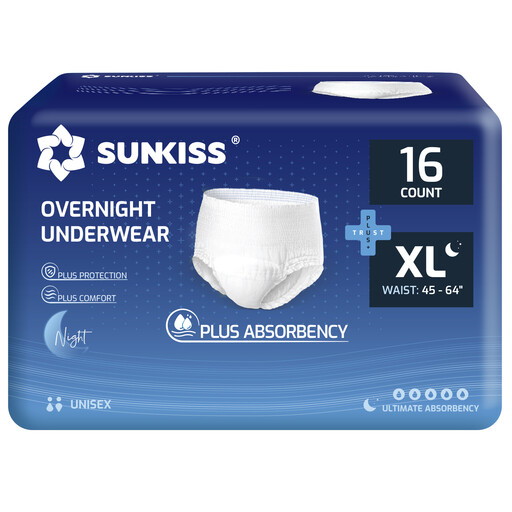
Why this fits the profile: This model is designed for night-time use and suits anyone who values wide coverage and an underwear-like fit.
The product information mentions an extra-wide double core, inner leg cuffs and a back panel that’s less prone to sagging. Do check the size chart for a good fit.
According to SUNKISS: heavy absorbency, quick-drying properties, odour control and latex-, lotion- and perfume-free fabric.
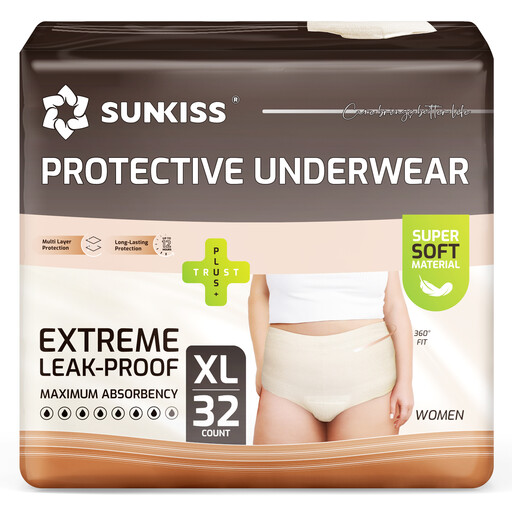
Why this fits the profile: A women’s model with a close fit can suit women who need extra coverage during the day or after childbirth.
The product description mentions 360-degree coverage, an elasticated waistband and an absorbent core. The stated wear time of up to 12 hours is a manufacturer’s claim, not a fixed guarantee.
32 pairs, lightweight FSC-certified pulp according to the product information, odour-locking technology and a women’s-specific fit.
We’ve put together a full, up-to-date list of products that fully meet these strict selection criteria and comply with current European safety regulations.
Put on disposable pull-ups like normal underwear: step into them and gently pull them up. Then check that the leg cuffs lie flat and the core is positioned correctly. When changing, the pants can be torn open at the sides if the product instructions allow it.
Use each pair once. Dispose of them with your regular household waste and do not flush them. Store unused pairs in a dry place, out of reach of children. If skin irritation persists or you have questions about urine loss, a doctor or healthcare professional can help you determine which protection is suitable.
It depends on the amount of moisture, the model and when you’re using it. A manufacturer might state a wear time of up to 12 hours, for example, but that’s not a universal guideline. Changing the pants as soon as they feel heavy or damp is more practical than waiting for the maximum claimed time.
A model with a wide core, inner leg cuffs and a sturdy waistband is generally designed for longer use. Check whether the product description explicitly mentions night-time use. For heavy incontinence, additional advice from a healthcare professional may be needed.
Calculate the price per pair and multiply it by the average number of pairs you use per day. A pack of 30 can work out more cost-effective for daily use, while a pack of 16 is handy for testing size and fit first. Don’t just look at the purchase price: a poorly fitting size can lead to extra usage through changing or leakage.
