
Livraison le jour même et le lendemain

Qualité garantie

Débloquez vos offres de bienvenue: Livraison GRATUITE | Jusqu'à -80 % | 30 jours d'essai gratuits à JoyPlus
Téléchargez l'application
Disposable incontinence underwear for adults looks just like regular underwear, but the differences between models lie mainly in fit, absorbent core and leak protection. Choosing the wrong product can lead to leaks, uncomfortable chafing or unnecessary expense.
This applies to people with light to heavy urine loss, nighttime incontinence and postpartum leakage. Carers and healthcare professionals also tend to focus on different aspects than simply the number of pants per pack.
Terms like “maximum absorbency” or “up to 12 hours” sound clear, but they don’t tell you everything about how the product actually performs. The level of protection you need depends on the amount of moisture, the time of use and your body position. A product designed for daytime use isn’t automatically suitable as an incontinence pant for the night.
So make sure you also check:
A claim about performance comes from the manufacturer. According to the product description from SUNKISS, certain models are designed for heavy absorbency and nighttime use; this is not a guarantee that every product will offer the same protection for every user.
A larger size doesn’t automatically give you more protection. If the leg openings don’t fit snugly, moisture can escape from the sides. A waist that is too tight, on the other hand, can feel uncomfortable when walking, sitting or sleeping.
Measure your waist and hip circumference and compare these with the size chart on the product page. Also pay attention to the difference between men’s models, women’s models and unisex incontinence pull-ups for adults. An ergonomic shape can improve the fit around the body, but the correct size remains the deciding factor.
A product with odour control doesn’t have to be fragranced. Some disposable models use a filter layer, an odour-blocking backsheet or materials that, according to the manufacturer, help to trap odours. That is different from completely removing odour.
If you are sensitive to fragrances, it’s better to look for a product description that explicitly states fragrance-free or perfume-free. Also check whether the material is latex-free and lotion-free if that is important for the user.
For daily use, light and breathable disposable incontinence pants are often practical. For more frequent or heavier urine loss, a wider core, quick-drying material and a double absorbent layer may be more suitable.
Note the difference between:
The label “heavy absorbency” describes the manufacturer’s product positioning. Always compare this label with the other construction features and the user’s situation.
An elastic waistband needs to be firm enough to keep the pant in place, but not tight. Flexible leg openings and internal leg cuffs help to improve the fit. For people who move around a lot, all-round elastic and a contoured core are particularly relevant specifications.
For incontinence underwear in larger sizes, it’s important not just to look at XL or XXL. Check the actual body measurements, the number of pieces and whether the same version is also available in other sizes.
Many models use cellulose pulp or FSC-certified pulp in the absorbent core. This tells you something about the stated raw material, but not automatically about the overall environmental impact of the product. Disposable incontinence underwear is intended for single use.
Throw used pants away with your general waste according to local disposal instructions. Do not flush them down the toilet. If skin irritation occurs, stop using the product and follow the safety information on the label. Products with a pH-balanced, breathable fabric are described as such by SUNKISS; this is not a medical effect or health promise.
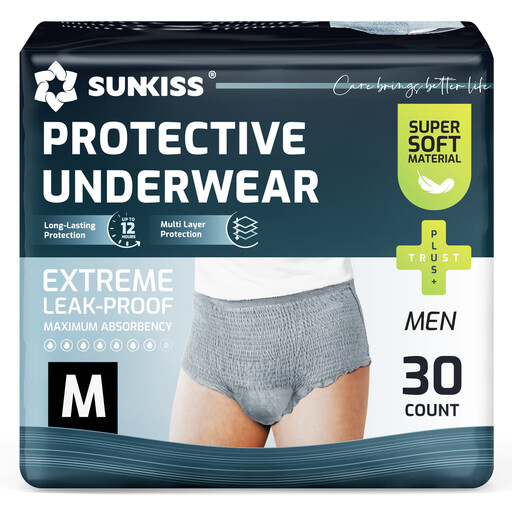
Why this fits the profile: A pack of 30 is practical for daily use and makes it easier to compare the cost per pant. The model is specifically shaped for men.
The product description mentions an ergonomic fit, reinforced leak protection and all-round elastic. Just be sure to check the sizing first.
30 pieces per pack, breathable FSC-certified pulp and Odor-Lock technology as stated by the manufacturer.
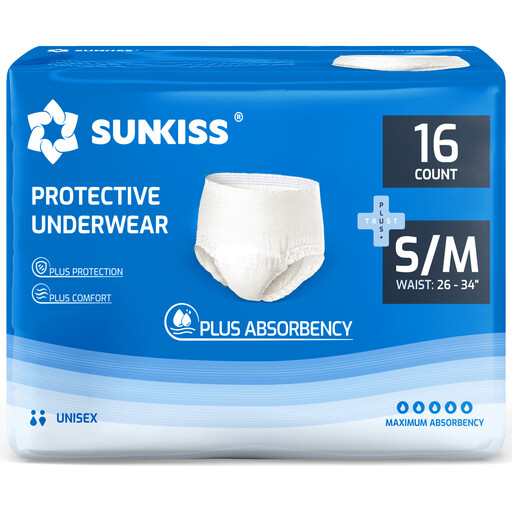
Why this fits the profile: This unisex model combines an underwear-like fit with an absorbent core and flexible leg openings. It can be used during the day or in the evening, depending on your personal needs.
The specifications mention anti-leak side barriers, a breathable fabric and three available sizes. This allows you to assess fit and protection together.
FSC-certified pulp, elastic waistband and, according to the product description, a filter layer for odour control.
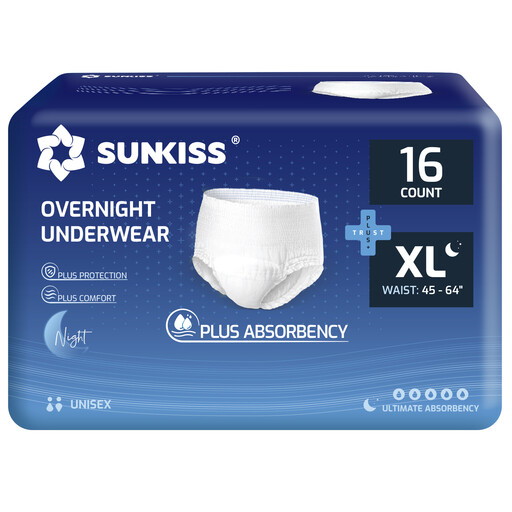
Why this fits the profile: This model is designed for nighttime use, postpartum care and heavier urine loss. The extra-wide core and internal leg cuffs meet the needs of users looking for more coverage.
According to SUNKISS, the construction includes a double core, a smooth backsheet designed to reduce sagging, and internal leg cuffs. Check the size before choosing a bulk pack.
Heavy-absorbency positioning, latex-free and fragrance-free fabric according to the product description, plus an extra-wide core.
We have put together a full, up-to-date list of products that fully meet these strict selection criteria and comply with current European safety regulations.
Step into the pant like you would with normal underwear and pull it up evenly. Then check that the absorbent core is centred properly and that the leg cuffs haven’t folded inwards. The waist should fit snugly without being tight. A pull-up is for single use only and should not be washed or reused.
Change the pant when it is saturated, after a bowel movement, or when it feels damp and uncomfortable. How long it lasts varies from person to person and situation to situation. A claim like “up to 12 hours” in a product description is a manufacturer’s claim and not a fixed duration of use for every user.
That depends on the absorbency class, the core width and the leak barriers. For nighttime, choose a model that explicitly mentions nighttime use, such as a version with a double core and internal leg cuffs. If leaks happen frequently, it’s a good idea to re-check the size, fit and product type.
