
Livraison le jour même et le lendemain

Qualité garantie

Débloquez vos offres de bienvenue: Livraison GRATUITE | Jusqu'à -80 % | 30 jours d'essai gratuits à JoyPlus
Téléchargez l'application
Disposable incontinence underwear for adults can make daily life easier, but not every style suits every situation. A pair for daytime use needs different features from overnight incontinence protection. Fit, absorbency and how you put them on all determine whether a product works well in practice.
Watch out for these common pitfalls:
The right size starts with the product’s size chart, not your usual clothing size. If possible, measure your waist and hip circumference, then check the recommended size on the product page. This is especially important with incontinence pants XL and XXLarge, because small differences in the leg opening can noticeably affect leak protection.
An ergonomic model for men may be shaped differently at the crotch compared to incontinence underwear for men and women. A unisex pair offers flexibility when several people in a household or care setting use different styles.
Pay attention to the following details:
For light urinary incontinence, a thinner daytime model may be sufficient. For heavier loss, long car journeys or a full working day, absorbent incontinence underwear with a wider core can be more practical.
For night-time use, a fast-drying core, extra-wide absorbency zone and raised leg cuffs are relevant specifications. Product descriptions sometimes use terms like maximum absorbency incontinence underwear or “heavy absorbency” for these. Treat that as a brand’s product specification, not a guarantee for every user. The protection you need depends on the amount of moisture, your body position and how often you can change.
For bedridden individuals, a model with adhesive tabs can be more convenient than pull-ups. A carer or family member can then put the product on without the wearer having to stand up fully.
Soft, breathable materials can improve wearing comfort. According to SUNKISS’s own product information, several models contain FSC-certified pulp, breathable fabrics and an absorbent core. That describes the composition; it’s not a medical claim.
Odour control is usually achieved with an odour-blocking layer or technology. According to SUNKISS’s own product information, certain models include an odour-lock or odour-control layer designed to help trap moisture and smells. The actual experience may vary depending on how you use it.
All the variants mentioned are for single use only. Dispose of them with your regular household waste and do not flush them down the toilet. Stop using them if skin irritation occurs and follow the instructions on the packaging. If incontinence symptoms persist or change, it’s wise to consult a healthcare professional.
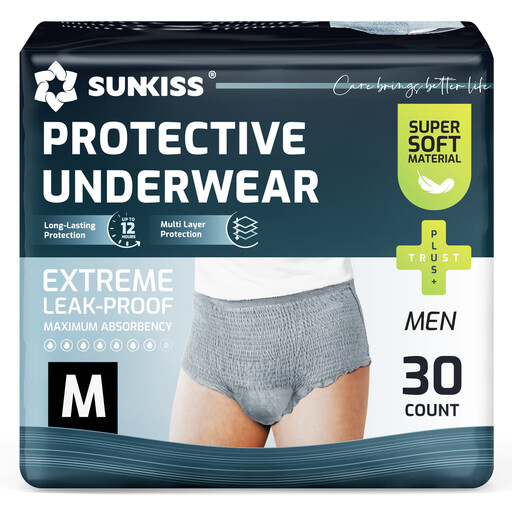
Why this fits the profile: A pack of 30 is practical for regular daytime use. The model is designed as incontinence pants for men and has an ergonomic fit.
The size Medium and the pack quantity are clearly stated. This means you can first check whether the size and daytime use suit you, without buying a large stock straight away.
According to SUNKISS, the model features an absorbent core, reinforced leak guards, a 357-degree elastic design and odour-lock technology.
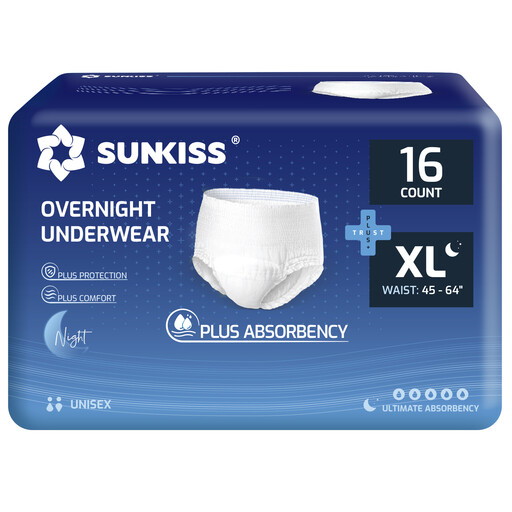
Why this fits the profile: This model is designed for day and night use and suits those who pay extra attention to material, core construction and freedom of movement.
The product information doesn’t just mention absorbency; it also specifies an extra-wide core, inner leg cuffs and a flexible fit. That makes comparison more concrete than relying on a marketing term alone.
According to SUNKISS, this model features a dual-core system, superabsorbent polymer, odour control and latex-, lotion- and fragrance-free fabric.
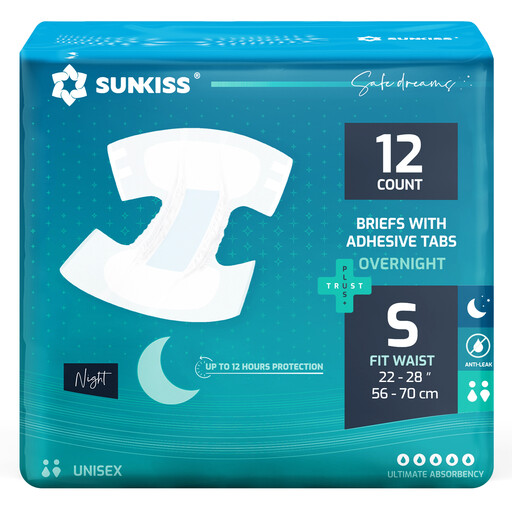
Why this fits the profile: The version with adjustable tabs is designed for overnight use, bedridden individuals and situations where a carer puts the product on.
You don’t have to rely solely on a pull-up. The adhesive tabs allow adjustment, and the wetness indicator tells you when a change is needed, according to the product description.
According to SUNKISS, this model features a dual-core system, leg cuffs, adjustable tabs and a wetness indicator. It’s an alternative to incontinence pants for intensive care.
We’ve put together a full, up-to-date list of products that fully meet these strict selection criteria and comply with current European safety regulations.
Step into the pants and pull them up evenly. Check that the absorbent core is centred properly and that the leg cuffs aren’t folded inwards. The waistband should fit snugly without digging in. For models with tabs, first position the product correctly, then fasten the strips symmetrically.
That depends on the amount of moisture, the product specification and the time of day. Change the pants as soon as they are saturated, leaking or feel uncomfortable. The product descriptions recommend changing regularly. A model designed for extended overnight use isn’t automatically suitable for wearing all day.
Compare the price per piece rather than just the pack price. Pull-ups are practical for independent use, while nappies with tabs may be a better fit for bedridden individuals or care provided by a family member. The most cost-effective choice therefore also depends on ease of use, how often you change and the amount of waste.
