
Vandaag of morgen in huis

Kwaliteit gegarandeerd

Welkomstaanbiedingen ontgrendelen: GRATIS bezorging | Tot 80% korting | Gratis 30 dagen JoyPlus-proefperiode
Download de app
An immersion blender might seem simple at first glance: motor on top, blade at the bottom, and you're ready to go. Yet models vary significantly in power, controls, accessories and ease of cleaning. A low purchase price can therefore turn out to be less appealing if you mainly want to make soup, smoothies, pesto or batter.
When comparing, don't just look at marketing copy. Instead, check the technical specifications, the contents of the box and any usage limitations. That way, you avoid paying for features you won't use, or choosing a hand blender that doesn't fit your cooking routine.
A higher wattage doesn't automatically mean you'll always get a finer result. The power mainly tells you about the electrical consumption and motor capacity. The shape of the blending foot, the blade, the speed control and the quantity of ingredients also play a role.
So check whether the stated power is nominal power or maximum power. Some models list both values. The ROUNY 4-in-1, for example, states a nominal power of 1000 watts and a maximum power of 1200 watts. That's useful information when you're looking for a powerful immersion blender for thicker mixtures.
An immersion blender with accessories may include a whisk, chopper, measuring jug or mixing beaker. The term "4-in-1" only means something when it's clear which parts are actually supplied.
For whipped cream or light batter, you'll need an immersion blender with a whisk. For herbs, nuts or small amounts of vegetables, an immersion blender with a chopper is more practical. If you only want to purée soup and smoothies, a standalone blending foot with a suitable mixing beaker is often sufficient.
Also check the contents of the box and the capacity. A 500 ml chopper is handy for small portions, but less suitable if you're cooking for a large family.
The motor unit should generally not be submerged in water. Removable parts can sometimes go in the dishwasher, but always check the manual and the maximum temperature. For the ROUNY accessories, for example, dishwasher use is stated as being below 60 °C.
Also pay attention to the maximum continuous usage time. The Braun MQ30202M and the ROUNY H1 state a guideline of a maximum of one minute of continuous use, followed by a pause. This is important when dealing with large quantities of soup or a thick mixture. Work in batches and let the motor cool down if the manual advises it.
For occasional puréeing of cooked vegetables, a model with 450 to 600 watts may be sufficient. If you regularly make pesto, sauces, smoothies and thicker mixtures, look at a model with 800 to 1000 watts.
An immersion blender with variable speed gives you more control than an appliance with just an on/off switch. Start with soft ingredients on a low setting and increase the speed gradually. A turbo function can be handy for short bursts, but it doesn't replace a suitable blade shape or the correct working technique.
A stainless steel immersion blender has a stainless steel foot or blade section. Stainless steel is practical for contact with food and is generally resistant to corrosion under normal use. Also look at the shape of the splash guard. A closed or well-shaped foot can reduce splashing, but won't prevent every spill.
Check whether the parts that come into contact with food are labelled as BPA-free. This doesn't automatically apply to every part of the appliance. The product information should clearly state which parts the claim relates to.
An electric hand blender with a long cable gives you freedom of movement around the hob, but a cable that's too short can be awkward. A non-slip handle, an easily reachable button and a simple attachment system make daily use more pleasant.
For hot soup, a sufficiently deep pan or mixing beaker is important. Place the blending foot into the ingredients first before switching on the motor. Move the immersion blender gently up and down and avoid letting the blade come above the surface; this will help limit splashing.
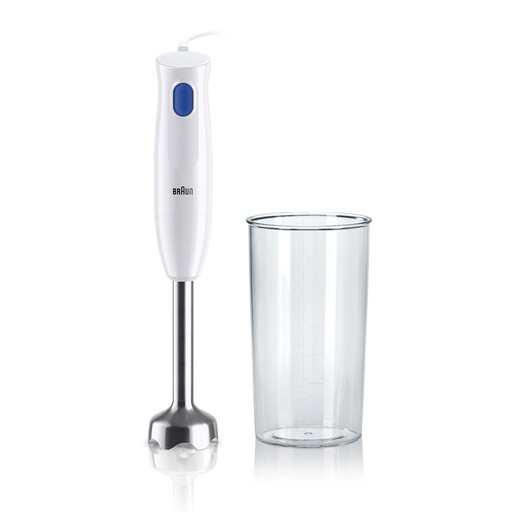
Why this fits the profile: The single-button operation is straightforward for anyone who mainly wants to prepare soup, sauces or smoothies without lots of settings.
The product information states 450 watts and a 600 ml BPA-free measuring jug. This means you can see upfront what you are and aren't getting.
450 watts, a 600 ml measuring jug and, according to the product data, a whisk and chopper as accessories.
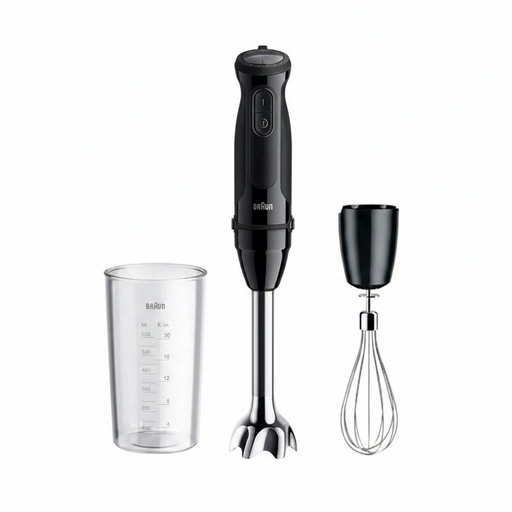
Why this fits the profile: This model is aimed at users who cook often and want to switch more precisely between soft and firm ingredients.
The specifications list 1000 watts, 21 speeds and BPA-free parts that come into contact with food. The features are therefore concrete and easy to compare.
1000 watts, 21 speeds, a 1.2-metre cable and removable parts that are dishwasher-safe according to the product information.

Why this fits the profile: The combination of blending foot, whisk, chopper and measuring jug suits home chefs who want to carry out several preparation tasks with one appliance.
The set separately lists a 700 ml mixing beaker and a 500 ml chopper. The maximum usage time of one minute is also stated.
Nominal power of 1000 watts, maximum 1200 watts, variable speed control, stainless steel blade and four listed accessories.
We've put together a full, up-to-date list of products that fully meet these strict selection criteria and the current European safety regulations.
Yes, many models can purée soup directly in the pan. Use a deep pan, keep the blending foot fully below the surface and follow the manual. Splashes of hot liquid can cause burns. If the manufacturer advises it, let the soup cool down slightly first.
That depends on your usage. For light tasks, 450 to 600 watts is often sufficient. For regular chopping, pesto, smoothies and thicker sauces, 800 to 1000 watts is a sensible choice. Always compare the wattage with the blade construction, speeds and maximum usage time.
It can be, especially if you want to purée, chop and whisk. Do work out which accessories you'll actually use. An immersion blender with a whisk and chopper takes up less space than multiple appliances, but separate parts can mean extra cleaning and storage.
