
Party host with peak-time demand
You want to be able to serve enough ice at busy times, so you compare the time per batch, the stated daily output and whether you can freeze ice in advance.


Choose an ice maker based on demand during your busiest party hours, not just its stated maximum output per 24 hours. A compact countertop model takes up less shared worktop space, while a higher output doesn’t mean you’ll have a ready supply of ice straight away. If you need ice ready in advance, plan for freezer space: the KitchenBrothers KB692/KB719/KB756 manual says the machine itself is not a freezer.
You want to be able to serve enough ice at busy times, so you compare the time per batch, the stated daily output and whether you can freeze ice in advance.
You share your worktop and pay attention to the appliance’s dimensions, how easy it is to move and how much space you’ll need to operate and clean it.
You want several people to be able to handle the water and ice, so you check the care instructions and how easy it is to access the basket and drain.
Best for: a shared worktop where space is the main constraint and you can top up the water between batches. DOMO lists dimensions of 31 × 23 × 32,5 cm and a 1,8-litre tank capacity for the DO9253IB.
Trade-off: a smaller tank may need refilling more often; remember to measure the space you’ll need while it’s in use.
Best for: a party where several guests may want ice close together, if you have room for a larger appliance. DOMO lists a 2,8-litre tank and a maximum output of 15 kg per 24 hours for the DO9247IB.
Trade-off: the stated daily output isn’t the same as having ice ready to serve; DOMO lists dimensions of 40,4 × 24,6 × 43 cm for this model.
Best for: a party where you need ice ready when guests arrive, or demand may briefly outpace the machine’s output.
Trade-off: you’ll need to prepare ahead and make room in the freezer. The KitchenBrothers KB692/KB719/KB756 manual recommends using the ice straight away or freezing it in a freezer bag.
Compare the time per batch and the stated output per 24 hours as separate figures: a daily maximum doesn’t tell you how much ice will be ready at a busy moment. KitchenBrothers lists 9 cubes every 8 minutes and a maximum of 12 kg per day for the KB692; DOMO lists around 9 cubes per cycle of approximately 8 minutes and a maximum of 15 kg per 24 hours for the DO9247IB.
| What to consider | What should you check? | Who should pay particular attention? |
|---|---|---|
| Ice at peak times | Compare the time per batch with the stated output per 24 hours; KitchenBrothers and DOMO list these separately for their respective models. | If guests are pouring drinks at the same time, I want to know how much ice each new batch produces and how long it takes. Around 36% of consumers prioritise having enough ice during peak hours. |
| Space and disturbance | Measure the space and check the dimensions of the exact model. Princess lists a carry handle and a noise level of 55 dB for the 283098; this is a manufacturer’s specification, not an independent measurement. | In a kitchen I share with housemates, I want to be able to position and use an appliance without unnecessarily blocking the worktop. Worktop space in a shared kitchen is the top priority for around 29% of consumers. |
| Keeping ice cold | Check whether the manual describes the basket as freezer storage. According to the KitchenBrothers KB692/KB719/KB756 manual, this appliance does not work as a freezer. | If I want ice ready before my guests arrive, I want to know where I can keep it safely chilled. Around 21% of consumers prioritise having ice ready before the party. |
| Cleaning | Read the instructions for the exact model and check whether the basket and drain are easy to reach. DOMO lists a self-cleaning programme and a drain for the DO9247IB. | When several housemates use the appliance, I want maintenance to be manageable and to know what needs cleaning after use. Around 14% of consumers give maintenance top priority. |
A maximum per 24 hours doesn’t mean that amount will be ready at the same time. The machine makes batches, and the KitchenBrothers KB692/KB719/KB756 manual says the appliance is not a freezer.
Compare the time per batch with expected peak demand, and freeze ice you’ve made in advance if needed.
Freezing ice in advance takes planning and freezer space.
A model with a larger tank may also take up more worktop space. The stated dimensions of the exact model will help you work out whether you’ll have enough room left.
Measure the available space and read the positioning instructions before you choose.
According to the Dutch government, the Netherlands has no fixed statutory guarantee period, and you are entitled to a product that is fit for purpose. An additional guarantee product does not replace that right.
Check what an extra plan actually covers; if something goes wrong, contact the seller.
These brands offer examples of models and specifications to compare with your own space, ice requirements and maintenance preferences. A brand name on this page is not a general recommendation and does not, by itself, say anything about availability.
The KB692 is a countertop model with Dutch-language instructions and a stated tank capacity of 2 litres.
The DO9253IB and DO9247IB models have different stated tank capacities and dimensions.
The 283098 is a countertop model worth comparing if portability and adjustable cube size matter to you.
A countertop model to compare if you’re looking for a portable ice maker.
This Joybuy selection features countertop models for making more ice during a party. For the exact model, check the information about materials that come into contact with water or ice and about electrical safety; a general statement on a product page does not independently establish that model’s compliance.
 No image available
Ideal if you want to make extra batches during a party and compare two ice cube sizes.
The product listing states a 1,3-litre tank, a maximum output of 12 kg per 24 hours and 9 ice cubes every 9 minutes. There are two ice sizes. The user information specifies at least 15 cm of clearance on all sides and an earthed socket; store ice in the freezer if needed.
 No image available
Ideal if you want to compare a self-cleaning function and two ice cube sizes for countertop use.
The product listing states 9 cubes every 9 minutes and a maximum output of 12 kg per 24 hours. The tank holds 2,2 litres. The instructions specify a stable, level surface, 15 cm of clearance on all sides and an earthed socket; they warn against using extension leads and multiway adaptors.
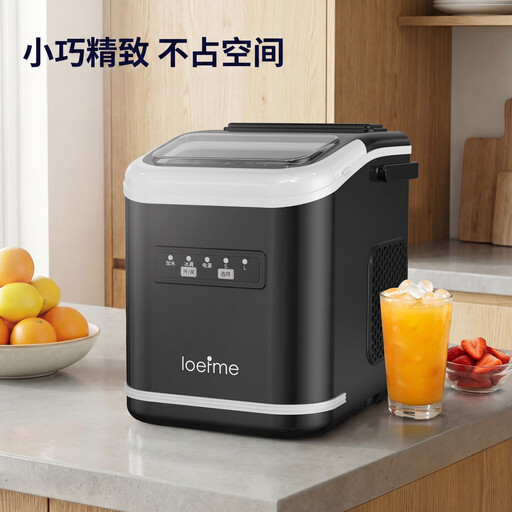 No image available
Ideal if you want to compare a more compact stated tank capacity and two ice cube sizes.
The product name states 9 ice cubes every 6–13 minutes, a maximum output of 12 kg per 24 hours, two sizes and an automatic cleaning function.
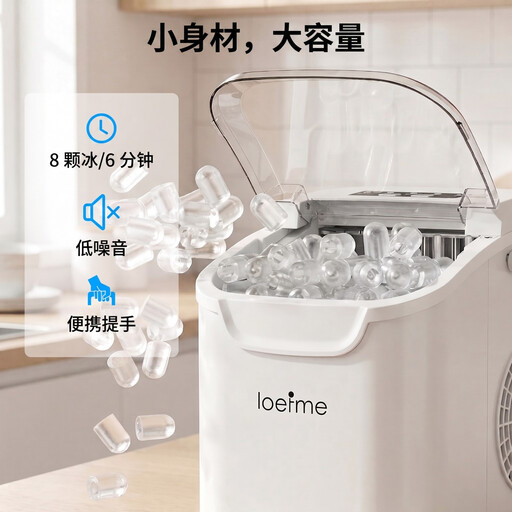 No image available
Ideal if you want to compare a smaller stated tank capacity for a shared worktop.
The product name states 9 ice cubes every 6–13 minutes, a maximum output of 12 kg per 24 hours, two sizes and an automatic cleaning function.
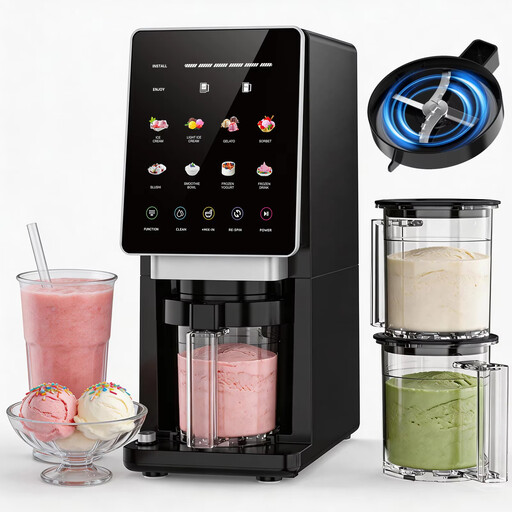 No image available
Ideal if you mainly want to compare operating programmes and cleaning features.
The product name lists 8 preset programmes and a self-cleaning function, as well as mixing and resume functions. The product name doesn’t state output or tank capacity.
Don’t assume you can. The KitchenBrothers KB692/KB719/KB756 manual says the appliance does not work as a freezer and recommends using the ice straight away or freezing it in a freezer bag. Check the manual for your exact model.
Treat these as separate manufacturer specifications, not as an amount that will be ready straight away. KitchenBrothers lists 9 cubes every 8 minutes and a maximum of 12 kg per 24 hours for the KB692; DOMO lists around 9 cubes per cycle of approximately 8 minutes and a maximum of 15 kg per 24 hours for the DO9247IB.
No. DOMO lists a self-cleaning programme and a drain for the DO9247IB, but you should also follow the cleaning and operating instructions for the exact model.
Materials that come into contact with water or ice intended for consumption must comply with Regulation (EC) No 1935/2004, as explained by the European Commission. Equipment covered by the EU Low Voltage Directive must meet the applicable electrical safety requirements; check the documentation for the exact model. The Dutch government explains that many consumer products on the EU market must carry a CE mark, but a general statement does not independently establish that a specific model complies.
No. According to the Dutch government, the Netherlands has no fixed statutory guarantee period; you are entitled to a product that is fit for purpose. If something goes wrong, contact the seller, even if the product also comes with a manufacturer’s guarantee.