
Host serving lots of drinks at once
Wants to have ice ready before friends arrive and compares batch size, basket capacity and the option to build up a supply in advance. Princess and DOMO list these features for specific models.


Start by working out how much ice you’ll need before and during the workshop, then compare the first batch, basket capacity, water reservoir and available worktop space. A stated production rate per 24 hours doesn’t mean that ice will all be ready at once. If you’re catering for lots of guests, you may need to start early, empty the basket or freeze some ice separately in advance. The performance figures quoted are manufacturer specifications for specific models, not results from comparative testing.
Wants to have ice ready before friends arrive and compares batch size, basket capacity and the option to build up a supply in advance. Princess and DOMO list these features for specific models.
Is looking for a compact appliance and is happy to top up the water more often or make ice in successive batches. Solis and CASO describe models with a 1-litre reservoir.
Looks for a removable basket, alerts when the tank is empty or the basket is full, and clear maintenance instructions. Solis, Klarstein and CASO list these features for specific models.
| What to consider | What should you check? | Who is this important for? |
|---|---|---|
| Enough ice at the right time | Compare the number of cubes per batch, cycle time and basket capacity; check whether you can freeze ice in advance. | If I’m serving several drinks in quick succession, I want to know whether there’ll be enough ice in time and whether I can build up a supply beforehand. Around 40% of consumers prioritise having enough ice when they need it. |
| Worktop space | Check the dimensions and whether you can access the reservoir and basket. | With a full worktop, I want to fit the machine in without constantly moving ingredients or cookware. Around 20% of consumers say worktop space is their main concern. |
| Fewer interruptions | Check the tank capacity, alerts for an empty tank or full basket, and how the basket is removed. | When cooking with friends, I don’t want to keep topping up the water or emptying a full basket. Around 30% of consumers prioritise having as few interruptions as possible. |
| Cleaning after use | Check the cleaning instructions, how easy the parts are to reach and whether there’s a self-cleaning function. | Afterwards, I want to know how to clean the tank and basket in line with the instructions. Around 10% of consumers prioritise easy maintenance. |
A production figure per 24 hours doesn’t tell you how much ice will be in the basket when the workshop begins. Batch size and basket capacity also affect when you can serve the ice.
Plan backwards from the first drink: compare the batches and basket capacity, and freeze any ice you make in advance separately if needed.
A short stated cycle time doesn’t, on its own, tell you how much ice you’ll have throughout the event. Tank capacity, basket size and alerts vary between models.
Compare the time per batch as well as what you’ll need to do to top up the water and remove ice from the basket.
A self-cleaning function doesn’t necessarily cover every maintenance step for the reservoir and the parts that come into contact with ice.
Before buying, read the instructions for the model you’re considering and check how easy it is to reach the reservoir and basket.
The 283069 could suit anyone who wants to build up a supply before an event. Princess lists a 2.8-litre tank and a basket capacity of 800 grams for this model.
The DO9253IB is designed for making batches during an event and for anyone who wants to freeze some ice in advance. DOMO lists a 1.8-litre tank and 9 cubes in 9 minutes.
The Ice Cube Express is an option for making successive batches. Solis lists a 1-litre tank and around 8 minutes for 8 cubes.
The Caldwell could suit anyone who values a removable basket and alerts. Klarstein lists a 1.3-litre tank and a basket capacity of 600 grams.
According to CASO, the IceChef Compact has a 1-litre tank, two ice sizes, a carrying handle and a removable basket.
This Joybuy selection features countertop ice makers for making batches during a cookery workshop. Product listings include details such as batch size, reservoir capacity and alerts. Compare these with your plans and the worktop space available.
 No image available
Could suit you if you want to make a first batch while cooking and find alerts useful.
The Joybuy product listing gives a figure of 8 cubes in 6–9 minutes, a 1.3-litre reservoir, two ice sizes and a 0.45 kg basket. It also lists alerts for a full basket and a low water level.
 No image available
Could suit you if you want to make batches and receive alerts when the tank is empty or the ice basket is full.
The Joybuy product listing gives a figure of 9 cubes in 9 minutes, a 2.2-litre reservoir and a stated output of 12 kg per 24 hours. It also lists self-cleaning and alerts for a full ice basket or empty tank.
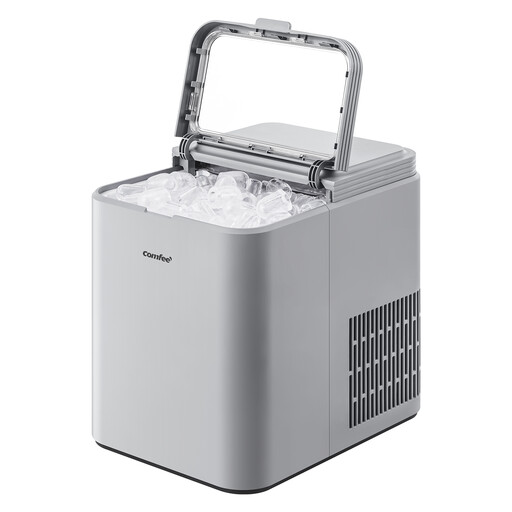 No image available
Could suit you if you want to serve a first batch and find a removable ice basket handy.
The Joybuy product listing gives a figure of 8 cubes in 6 minutes, a 1.3-litre tank and a removable 0.4 kg basket. It also lists two ice sizes, self-cleaning and an ice scoop.
 No image available
Could suit you if you want to make batches during the workshop and value alerts for the water level and a full basket.
The Joybuy product listing gives a figure of 9 cubes in 6 minutes and dimensions of 35 × 23 × 30 cm. It also lists two ice sizes, self-cleaning and indicators for the water level and a full basket.
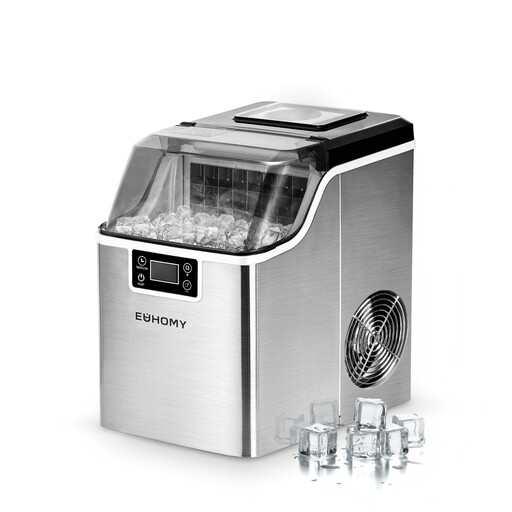 No image available
Could suit you if you want to compare batch sizes with how much ice you’ll need before and during the workshop.
The Joybuy product listing gives a figure of 24 cubes in 13 minutes, a 3.2-litre tank and a stated output of 24 kg per 24 hours. It also lists self-cleaning and an ice scoop with basket.
Not if you mean having 12 kg ready when guests arrive: the figure describes production over a day. DOMO and CASO list 12 kg per 24 hours for specific models; Solis lists around 12 kg per 24 hours. So also plan around batch size, cycle time and basket capacity, and freeze some ice separately in advance if needed.
Check the mains voltage on the rating plate and follow the positioning and safety instructions in the manual for your chosen model. The Princess manual, for example, warns against water near electrical connections; this guidance applies to that model.
No, don’t assume that: a self-cleaning function doesn’t necessarily cover every maintenance step. Solis and CASO list this feature for specific models; check the instructions for your chosen model to find out how to clean the reservoir and its components.
For online consumer purchases, there’s generally a statutory 14-day cooling-off period after delivery, with some exceptions. ACM ConsuWijzer also explains that statutory consumer rights apply through the seller if a product doesn’t meet reasonable expectations under normal use; there isn’t automatically one fixed time limit.
CE marking is required for electrical products covered by the relevant Dutch rules, according to the Netherlands Food and Consumer Product Safety Authority. Check which rules apply and the information for the specific model; CE marking isn’t a performance test for the amount or speed of ice production.