
The last-minute party host
You get home shortly before your guests arrive and want to know how quickly the first usable batch will be ready.


Choose a machine with a short first cycle if you need ice quickly for the first drinks after your evening class. For a longer party, also consider its output and the capacity of the ice basket. DOMO states that the DO9253IB makes nine cubes in nine minutes, while Princess says the 283069 makes up to nine cubes in ten minutes. If you want to make ice before your class, you’ll need separate freezer space: hourly or daily output isn’t the same as the amount of ice ready at any one time.
You get home shortly before your guests arrive and want to know how quickly the first usable batch will be ready.
You’ll be serving drinks all evening and want to plan for production, refilling the water and emptying the ice basket.
You make ice before your class and store it separately, so you don’t have to rely on a full basket when you get home.
| What to consider | What should you check? | Who is this important for? |
|---|---|---|
| First batch | Compare both the stated time and the number of cubes per cycle. DOMO says the DO9253IB makes nine cubes in nine minutes; Princess says the 283069 makes up to nine in ten minutes. | If I want to serve the first drinks soon after class, I want to know how many cubes will be ready in time. Around 28% of consumers prioritise the speed of the first batch. |
| Keeping up with demand during the party | Compare output per hour or per day with the capacity of the ice basket. CASO states that the IceChef Pro makes approximately 500 g per hour; Klarstein lists an 0.8 kg ice basket for the Icemeister 2G. | If guests are having drinks throughout the evening, I want to know whether I’ll need to empty the basket or top up the water while the party is going on. Around 22% of consumers prioritise a continuous supply of ice. |
| Stocking up in advance | Check whether you have the time and freezer space to store batches separately. DOMO lists this as an option for the DO9253IB. | If I’m out during class, I want to be able to make ice in advance and store it separately. Around 22% of consumers prioritise building up a stock beforehand. |
| Space and noise | Measure the available space and follow the model’s placement instructions. Klarstein states that the Icemeister 2G operates at less than 55 dB; this is a manufacturer’s specification, not a measure of how disruptive the appliance will sound at your party. | If the appliance is on a worktop next to where people are chatting, I want to take both the available space and the noise into account. Around 17% of consumers consider the space it takes up and how it might affect conversations. |
| Cleaning | Check whether the basket and drain are easy to access, and read the cleaning instructions for the exact model. DOMO lists a removable basket and drainage opening for the DO9220IB. | After the party, I want to be able to empty and clean the parts without missing any maintenance steps. Around 11% of consumers let maintenance requirements influence their choice. |
A stated daily output doesn’t tell you how much ice will be in the basket at any one time. For the Icemeister 2G, Klarstein lists an 0.8 kg ice basket as well as a production figure per 24 hours.
Compare cycle time, output and basket capacity separately, and think about where you’ll store any ice you’ve made in advance.
Princess says the 283069 makes up to nine cubes per ten-minute cycle. That may help with the first batch, but it doesn’t mean there’ll be enough ice ready for the whole evening.
Think about when you’ll be serving drinks and whether you want to make and store extra batches in advance.
A removable basket makes emptying the ice easier, but it doesn’t clean the machine for you. H.Koenig warns in the instructions for its KB12 that insufficient cleaning can lead to mould and bacteria.
Read the manual for the exact model before buying, and allow time after use to clean and dry the specified parts.
The 283069 is worth considering if a timer and a choice of cube sizes suit your plans.
The DO9253IB is worth a look if you want to make batches before your class and store them separately.
The IceChef Pro is worth considering if you want to factor in a stated hourly ice output.
The Icemeister 2G is a model to compare for basket capacity, choice of cube sizes and stated noise level alongside its output.
These picks are countertop ice makers. Compare the first batch with the stock you’ll need for the rest of the party.
 No image available
An option to compare if you want to consider both a quick first batch and output throughout the day.
The product title lists two ice sizes, 12 kg per 24 hours, a 1.3-litre reservoir and a first batch in 6–9 minutes. The ice basket holds 0.45 kg; this isn’t the same as the output over 24 hours.
 No image available
The stated batch time makes this model worth considering if you want to make a first batch when you get home.
The product title lists 120 W, two ice sizes, nine cubes in nine minutes, up to 12 kg per 24 hours, a 2.2-litre reservoir and a self-cleaning function.
 No image available
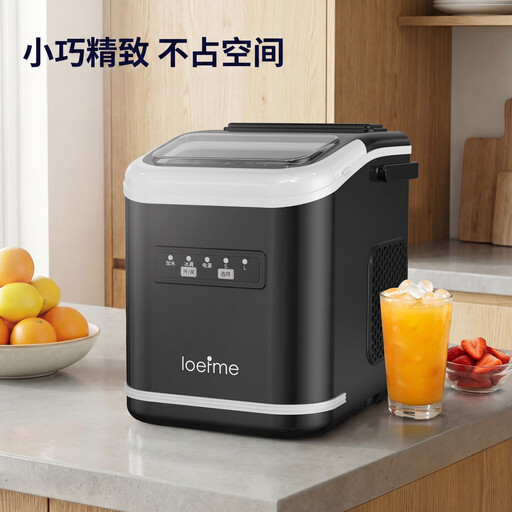
An option to compare the stated first batch with daily output when planning drinks.
The product title lists nine cubes every 6–13 minutes, up to 12 kg per 24 hours, two ice sizes, a 1.4-litre reservoir and an automatic cleaning function.
 No image available
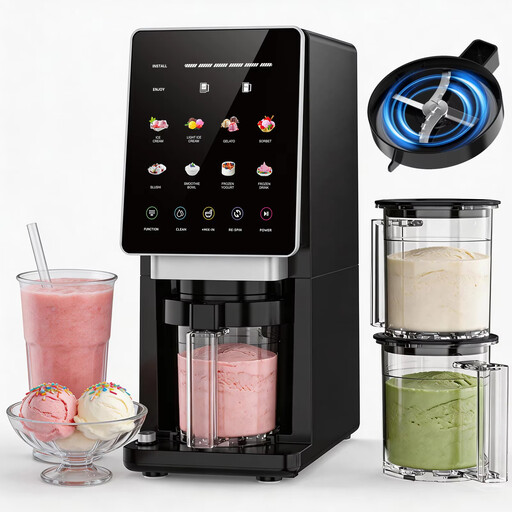
Consider this model if you’re looking for a countertop machine with several preset programmes and their functions suit your needs.
The product title lists eight programmes, a self-cleaning function, and mixing and restart functions.
 No image available
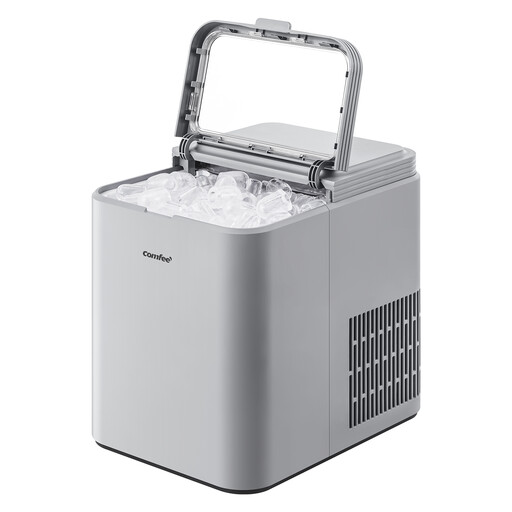
An option to compare the first batch with the amount of ice you can collect at any one time.
The product title lists eight cubes in six minutes, up to 12 kg per 24 hours, a 1.3-litre reservoir, self-cleaning, and an ice scoop and basket. The ice basket holds 0.4 kg; this isn’t the same as the output over 24 hours.
No. This figure describes output over a 24-hour period, not the capacity of the ice basket. For example, Klarstein lists an 0.8 kg ice basket for the Icemeister 2G, so consider this capacity separately from the stated output.
Yes, if you have time to make batches and space to freeze them separately. DOMO lists this as an option for the DO9253IB. Make sure you also follow the usage and cleaning instructions for the model you choose.
Follow the manual for the exact model. For the KB12, H.Koenig instructs you to unplug the machine, wash the basket, rinse and dry the parts, and empty the appliance, among other steps. These instructions don’t automatically apply to other brands or models.
For electrical equipment placed on the market in the Netherlands, Business.gov.nl describes the applicable safety requirements, including CE marking and an EU declaration of conformity from the responsible economic operator. The European Commission also sets out the rules for materials that come into contact with food. Check the documentation for the exact model: a model name or sales description alone doesn’t confirm that an individual product meets all applicable requirements.
No. According to the Dutch government, the Netherlands has no fixed statutory guarantee period; your right to a product that works as it should depends, among other things, on its expected lifespan. If there’s a problem, contact the seller. A manufacturer’s guarantee is additional.