
Occasional ice user
If you fancy an unexpected cold drink, you’ll want to know how much ice the first cycle produces and how long the manufacturer says it takes.


For a few cold drinks at a time, the machine’s dimensions and the amount of ice produced in its first cycle are often more useful points of comparison than its stated 24-hour output. A larger reservoir can be handy if you’re making ice for longer, but it also takes up more worktop space. You’ll also need to allow for refilling, cleaning and freezing ice separately if you want to build up a supply. Manufacturer figures are not independent performance tests.
If you fancy an unexpected cold drink, you’ll want to know how much ice the first cycle produces and how long the manufacturer says it takes.
You’ll want to check in advance that a countertop model will fit in the available space, with enough room to remove the ice basket.
If you also make ice for guests, you’ll want to consider the reservoir capacity, how often you need to refill it and where to store any extra ice.
Start by comparing the amount of ice per cycle and the machine’s dimensions. Then check whether the reservoir and maintenance requirements suit how often you make ice.
| What to consider | What should you check? | Who is this important for? |
|---|---|---|
| First batch of ice | Compare the stated cycle time and number of cubes for the exact model. DOMO says the DO1132IB takes around 7 minutes to make 8 cubes, while its technical specifications state 8 minutes. Treat this as manufacturer information, not a measured guarantee. | If you’re making a few cold drinks on the spur of the moment, you’ll want to know when the first batch might be ready. Around 33% of consumers prioritise the speed of the first batch. |
| Worktop space | Measure the space available and compare it with the machine’s dimensions. Also check that you can remove the basket and have room to fill the machine. | If you have a fixed, limited space, the key thing is whether the machine will fit there while in use. Around 27% of consumers prioritise worktop space. |
| Emptying and cleaning | Check whether the machine has a removable ice basket, a drainage opening or a cleaning programme, and read the manual for the exact model. | If you want to empty and maintain the machine easily after use, compare the cleaning steps in advance. Around 20% of consumers prioritise ease of maintenance. |
| Making several batches | Compare the reservoir capacity, cubes per cycle and machine dimensions. A stated daily output does not mean that the machine has that amount of ice ready to use. | If you’re making ice for guests or several drinks in a row, it’s useful to know how often you’ll need to refill the water and where to store extra ice. Around 20% of consumers prioritise being able to make ice for longer periods. |
A stated daily output doesn’t tell you how much ice will be ready after the first cycle. DOMO explains that you can freeze the cubes made by the DO9253IB to build up a supply.
For spontaneous drinks, compare the stated first-cycle time and the number of cubes. To build up a supply, allow for consecutive cycles and separate freezer space.
Building up a supply in advance takes extra time for several cycles and space in the freezer.
A programme doesn’t replace the maintenance instructions for the specific machine. For example, the DOMO DO1108IB manual explains that you should switch off the appliance, unplug it and empty it before cleaning. These instructions apply to that model.
Before buying, check how to empty the machine and access its parts. Once you’ve bought it, follow the manual for your exact model.
Allow time to empty and clean the machine as instructed in the manual.
A larger reservoir can mean a larger machine. According to the manufacturer, the DOMO DO9253IB has larger dimensions than the DO1132IB.
Compare capacity in litres, machine dimensions and cubes per cycle together, based on the space you have and the number of glasses you want to make ice for at once.
The DO1132IB and DO9253IB countertop models have different reservoir capacities, so you can compare them against the space available on your worktop and how you plan to use them.
The KB1000760 is a countertop model with a 1.6-litre reservoir. Compare its stated cycle details with the dimensions and maintenance instructions for the specific model.
The manufacturer’s catalogue lists the PR409IB with a 0.8-litre reservoir. This may be worth comparing if you’re considering a smaller reservoir.
These models are designed for making ice on your worktop, with options for a first batch, different ice sizes and larger or smaller water reservoirs.
 Image unavailable
An option to consider if you want to compare the stated first-cycle time and choice of ice sizes.
According to the product information, this model makes 8 ice cubes in 6–9 minutes and has a 1.3-litre reservoir and two ice sizes.
 Image unavailable
An option to consider if you want to compare a larger reservoir and the stated output per cycle.
The product title lists 120 W, 9 cubes in 9 minutes and a 2.2-litre reservoir. The product information also mentions a self-cleaning function and an alert when the basket is full or the water tank is empty.
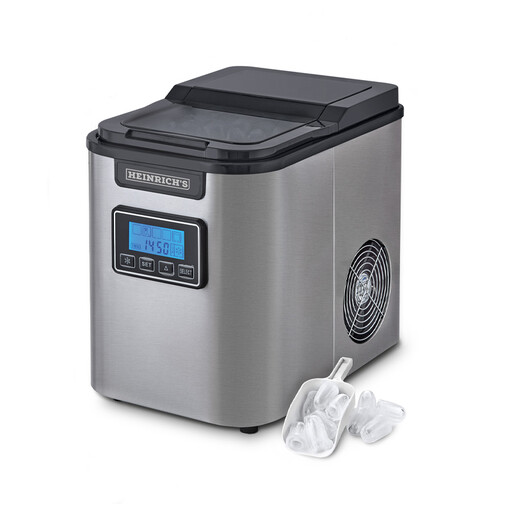 Image unavailable
An option to consider if you want to compare a larger reservoir and more choice of ice sizes.
The product title lists 120 W, 9 cubes in 9 minutes and a 2.2-litre reservoir. The product information also mentions three ice sizes and a self-cleaning function.
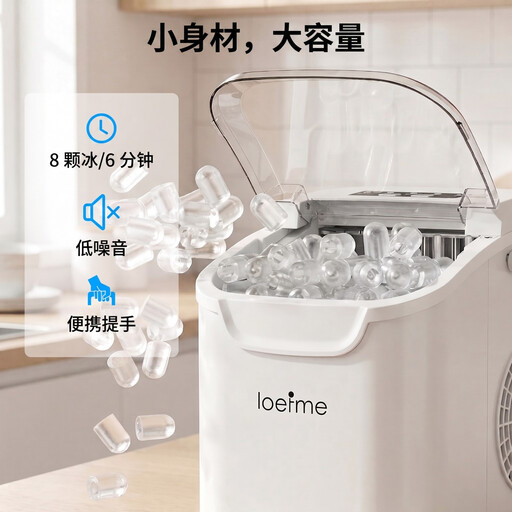 Image unavailable
An option to consider if you want to compare a small reservoir and two ice sizes.
The product information lists a 0.8-litre reservoir, 9 cubes per cycle in 6–13 minutes, two ice sizes and a self-cleaning function.
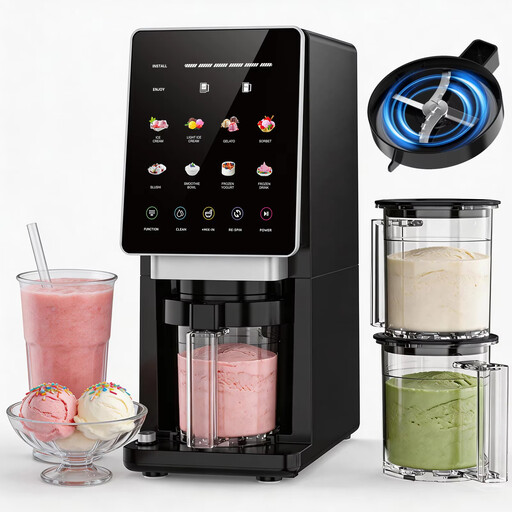 Image unavailable
An option to consider if you want to compare the listed programmes and cleaning features as well as its ice-making function.
The product title lists 8 preset programmes, a self-cleaning function, a mixing function and a resume function.
Don’t assume that the stated daily output is ready and waiting for you. DOMO explains that you can freeze the cubes made by the DO9253IB. Check how to empty the basket on your machine and follow the hygiene instructions in the manual.
According to the DOMO DO1108IB manual, switch off the appliance, unplug it and remove the ice cubes before cleaning. For another model, use its accompanying manual.
The Netherlands Food and Consumer Product Safety Authority states that CE marking is compulsory for electrical products. Check the marking and product details for the specific model. As the European Union explains, a CE marking is not proof that a product has undergone independent testing.
You don’t need an extended warranty to benefit from your statutory rights. ACM ConsuWijzer explains that if a product breaks too soon under normal use, the seller is responsible for providing an appropriate solution. Consider whether an extended warranty offers anything beyond your statutory protection.
For a standard online purchase as a consumer, ACM ConsuWijzer says you generally have a statutory cooling-off period of up to 14 days after delivery. Exceptions apply, so check the information for the specific purchase.