Who is a countertop model suitable for?

Anyone who wants to serve a few drinks quickly

If you’re making a small batch of fruit drinks shortly before serving, focus on how much ice the first cycle produces. The stated amount per 24 hours doesn’t tell you how many cubes you’ll get straight away.

Anyone short on worktop space

If you have a small worktop, the machine’s external dimensions and the space needed to empty the ice basket are important. The tank capacity also helps you work out when you’ll need to refill it.

Anyone who wants to understand maintenance before buying

If you’ll only use the machine occasionally, it’s useful to know before you buy how to clean the reservoir, ice basket and drain, as set out in the manual.

What should you look for when making small batches of ice?

What to consider What to look for Who is this important for?
First batch Compare the number of cubes per cycle and the cycle time for the exact model. Daily capacity is measured over a different period. If you’re filling a few glasses just before serving, you’ll want to know how much ice the first batch produces. Around 33% of consumers say the first batch is their top priority.
Space and refilling Measure the space available and compare the external dimensions and tank capacity of the model you’re considering. If you have limited worktop space or want to know how often you’ll need to add water, the size and tank capacity matter. Around 27% of consumers put worktop space at the top of their list.
Cleaning and materials Check the manual for instructions on cleaning the reservoir, ice basket and drain. Also check the documentation on materials that come into contact with water and ice for consumption. If you only use the machine occasionally, you’ll want to know in advance which parts need maintenance and what documentation you can refer to. Around 27% of consumers make easy maintenance their top priority.
Ice size Check how many size settings the exact model has. More settings don’t, in themselves, tell you anything about the batch size. If you want to match the ice size to different glasses, the available settings are worth considering. Around 13% of consumers put this choice first.

Common buying mistakes

  • Confusing daily output with ice that’s ready straight away

    An amount per 24 hours doesn’t tell you how many cubes the first cycle produces. For small batches, the difference could mean waiting for extra cycles.

    If the first batch isn’t enough, another cycle will take extra time.

    Work out how many cubes you need for the glasses you’re filling, then compare that with the stated output and cycle time for the exact model.

  • Assuming a self-cleaning function replaces all maintenance

    A cleaning function doesn’t automatically tell you which parts still need to be emptied or cleaned by hand. The KitchenBrothers manual covers maintenance and self-cleaning separately.

    Allow time to empty and clean the machine according to the manual.

    Read the manual for the exact item number and check the instructions for the reservoir, ice basket and drain.

  • Taking a CE mark as proof that all ice-contact materials are compliant

    The Netherlands Food and Consumer Product Safety Authority explains the CE requirements for electrical products where the rules apply. A CE mark alone doesn’t prove that materials in contact with food comply with the relevant EU rules.

    For the exact model, check both the applicable electrical product documentation and the information on food-contact materials. The European Commission refers to Regulation (EC) No 1935/2004 for this.

Brands to compare

Salora

For the ICE12B, Salora states that the first batch contains 8 cubes and takes 6–9 minutes, depending on the size selected.

  • Salora lists a 1,3 L reservoir, external dimensions of 213,4 × 295,9 × 270 mm and an ice basket capacity of 0,45 kg.
  • The stated 12 kg per 24 hours isn’t the amount available straight away; product specifications aren’t independent measurements.

KitchenBrothers

For model KB692, KitchenBrothers lists a 2 L tank and 9 cubes per 8-minute cycle.

  • The product information lists a removable ice basket and a drain plug. A manual is available for item KB1000692.
  • Refer to the manual for cleaning instructions for this model. Stated speed and noise information aren’t independent test results.

Princess

Princess describes model 283069, item 01.283069.01.001, as having an LCD screen and adjustable ice sizes.

  • The manufacturer lists three sizes, up to 9 cubes in 10 minutes, a 2,8 L tank and an 800 g ice basket.
  • The declaration of conformity names this exact model for, among other things, the Low Voltage Directive. This alone doesn’t demonstrate compliance with the rules for food-contact materials.

Ariete

For the Ice Machine 0651/00, Ariete lists two ice sizes and a 1,4 L tank.

  • The manufacturer lists 9 cubes every 6–10 minutes and a self-cleaning function.
  • This information relates to the Ice Machine 0651/00. Don’t confuse this model with an Ariete machine for ice cream.

Joybuy products for making small batches of ice

This selection includes countertop models for anyone who wants to make small batches of ice. Compare the stated output per cycle, tank capacity and cleaning instructions. For the exact model, also check the documentation on electrical safety and materials that come into contact with water and ice for consumption.

Salora ICE12B ice maker

Salora ICE12B

The stated first-batch output can help you decide whether this model is suitable for a small round of drinks.

Salora lists 8 cubes in 6–9 minutes, two ice sizes and a 1,3 L reservoir.

The stated external dimensions are 213,4 × 295,9 × 270 mm; the ice basket capacity is 0,45 kg.

Joybuy
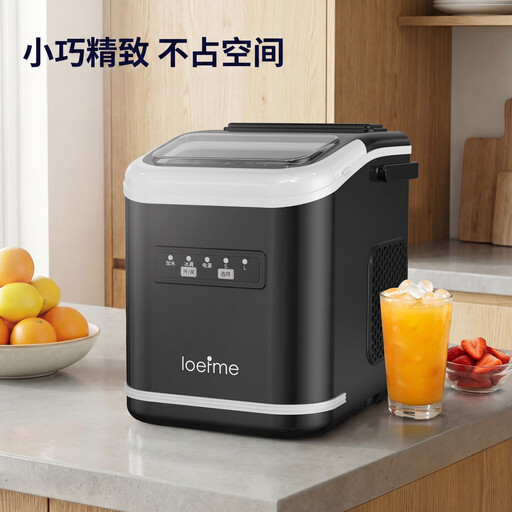
LOEFME 12/K ice maker, black

LOEFME 12/K

The stated output per cycle is a useful point of comparison if you want to make a small batch for a few drinks.

The product title lists 9 cubes every 6–13 minutes, two sizes (S/L), a 1,4 L tank and an automatic cleaning function.

The title also lists a daily capacity of 12 kg; this isn’t the same as the output of a single cycle.

Joybuy
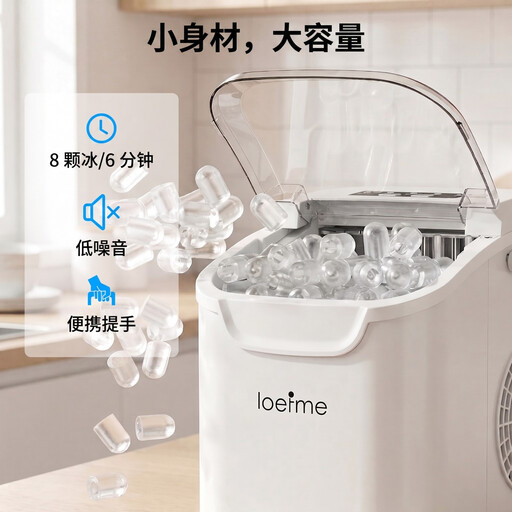
LOEFME 12/Q ice maker, white

LOEFME 12/Q

The smaller stated tank capacity may be relevant if you want to choose a tank size that suits how you use the machine.

The product title lists 9 cubes every 6–13 minutes, two sizes (S/L), a 0,8 L tank and an automatic cleaning function.

The title also lists a daily capacity of 12 kg; this doesn’t tell you how many cubes the first cycle produces.

Joybuy
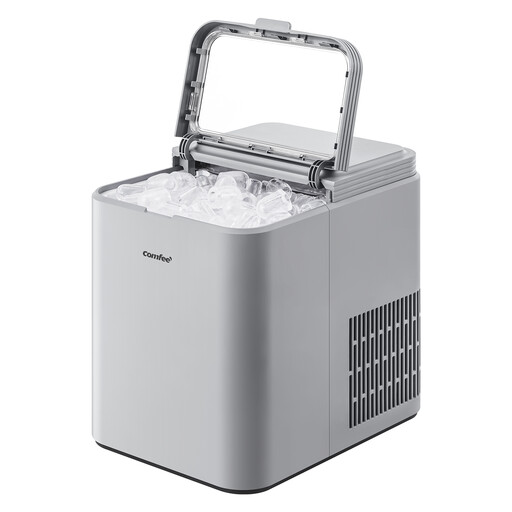
Comfee RCI12GY1EU(E) ice maker

Comfee' RCI12GY1EU(E)

The stated output and cycle time are useful if you mainly want to know how much ice you can get from a small first batch.

The product title lists 8 cubes in 6 minutes, a 1,3 L tank and a self-cleaning function.

The product information lists small and large sizes, an ice scoop and a basket.

Joybuy

CONOPU countertop ice maker

CONOPU ice maker

The stated output per cycle makes this model easy to compare with other machines for small batches.

The product title lists 9 cubes in 6 minutes and two ice sizes.

The product information lists a 1,5 L tank, a self-cleaning function, a basket and a scoop.

Joybuy

Frequently asked questions

Should I focus mainly on the amount of ice produced in 24 hours?

Not if you want to fill a few glasses shortly after switching the machine on. Also compare the stated number of cubes per cycle and the cycle time for the exact model, as daily capacity is measured over a different period.

Is a cleaning function enough to maintain the machine?

Don’t assume that it is. Follow the manual for the exact item number for instructions on the reservoir and other parts. The KitchenBrothers manual covers maintenance and self-cleaning separately.

What water can I use for fruit drinks?

The Netherlands Nutrition Centre generally describes Dutch tap water as safe to drink, with exceptions such as old lead pipes. Also follow your machine’s water and usage instructions, and check your water supply if a warning applies to your address.

What safety information should I check for an ice maker?

For the exact model, check the applicable electrical product documentation and information on materials that come into contact with water or ice for consumption. The Netherlands Food and Consumer Product Safety Authority explains the CE requirements for electrical products where those rules apply; for food-contact materials, the European Commission refers to Regulation (EC) No 1935/2004.

What can I do if an appliance I bought online is faulty?

According to the Dutch Government, if a product is faulty, the seller must provide a solution. The Netherlands has no fixed statutory guarantee period; a manufacturer’s guarantee is separate from this legal right. In many cases, distance purchases come with a 14-day cooling-off period.
