First, measure the space you have available, then compare how much ice a machine makes in its first cycle: the daily output won’t tell you how many cubes will be ready for your first iced coffee. A larger water tank can be useful if housemates take turns making ice, but it won’t solve a lack of space. Also consider emptying and cleaning the machine, and whether you’ll need to freeze any leftover ice. The stated cycle times are figures provided by the manufacturer, not independent test results.
Who is an ice maker suitable for?
Student with limited worktop space
If you make iced coffee regularly but share a worktop, the machine’s external dimensions and the space needed to fill and empty it are important things to consider. Salora and KitchenBrothers provide model details such as dimensions and tank capacity to help you make that decision.
Spontaneous iced coffee maker
If you don’t want to plan ahead for ice, compare the stated output and time for the first cycle with the number of drinks you need to make at once. Salora, KitchenBrothers and Princess provide these cycle specifications, but they are still figures supplied by the manufacturers.
Sharing the cost and upkeep
If you’re thinking of buying an appliance with housemates, consider how often it will be used, who will clean it and where you’ll store the ice. The Government of the Netherlands explains that the retailer is your point of contact if a product is faulty, and that the Netherlands does not have a fixed statutory two-year guarantee period.
What should you look for when choosing one?
| What to consider |
What should you check? |
Who is this important for? |
| Worktop space |
Measure the available width, depth and height, and leave enough room to fill and empty the appliance. Salora lists the ICE12B dimensions as 213,4 × 295,9 × 270 mm. |
If I share a workspace, I want the machine to fit without blocking the rest of the worktop. Around 31% of consumers put available space first. |
| First batch of ice |
Compare both the stated cycle time and the number of cubes. Salora states that the ICE12B makes 8 cubes in 6–9 minutes; KitchenBrothers states that the KB1000719 makes 9 in 8 minutes. |
If you want to make one or more iced coffees on the spur of the moment, focus on the first batch rather than just the daily output. Around 25% of consumers prioritise the first batch. |
| Whether an extra appliance is worthwhile |
Think about how often you need ice unexpectedly, whether housemates will share the cost and use, and whether there’s room in the freezer to make ice in advance. |
If I have a usable freezer compartment, I want to weigh up whether making ice on demand is worth the extra space and upkeep. Around 25% of consumers prioritise this balance of cost and use. |
| Cleaning and storing ice |
Check the instructions for the specific model and find out how to empty the ice basket and maintain the machine. For the DO9200IB, DOMO recommends storing made ice in a freezer bag for later use. |
In a shared kitchen, I want to know who will empty and clean the machine, and where any leftover ice will go. Around 19% of consumers prioritise maintenance and arrangements for storing ice. |
Common purchasing mistakes
-
Confusing daily output with the first batch
A maximum output in kilograms per 24 hours doesn’t tell you how many cubes will be ready for one drink.
For your needs, compare both the number of cubes per cycle and the stated cycle time.
-
Choosing a larger tank without measuring
Tank capacity and the amount of worktop space needed are two different things. A larger tank doesn’t automatically mean the appliance will fit where you want it.
Measure the space, and allow room to use and maintain the machine too.
On a shared worktop, an appliance that’s too large can take up space your housemates need.
-
Assuming self-cleaning means no other maintenance is needed
A self-cleaning function doesn’t necessarily replace all the maintenance steps in the manual.
Read the instructions for the specific model and, in a shared kitchen, agree who will empty and clean the machine.
Without an agreement, the cleaning may end up being left to the last person who used the machine.
-
Confusing the manufacturer’s guarantee with your statutory rights
The Government of the Netherlands says there is no fixed statutory two-year guarantee period in the Netherlands. If a product is faulty, the retailer is your point of contact.
Keep your proof of purchase and check whether any extra guarantee adds anything to your statutory rights.
Brands to compare
Salora
The ICE12B is worth considering if dimensions and tank capacity are important in a small kitchen.
- Salora states that the ICE12B has a 1,3-litre tank and makes 8 cubes in 6–9 minutes. The manufacturer also gives a maximum output of 12 kg per 24 hours.
- These are figures provided by the manufacturer; they don’t prove how quickly or quietly the appliance will work in your kitchen.
KitchenBrothers
According to KitchenBrothers, the KB1000719 has a 2-litre tank. Compare its capacity with the space you have and how you plan to use it.
- KitchenBrothers states that it makes 9 cubes every 8 minutes. A Dutch-language manual is available for this model.
- The manufacturer lists a drain plug and removable ice basket. Claims about quiet operation or energy efficiency are not independent test results.
DOMO
According to DOMO, the DO9200IB offers two ice sizes and provides advice on storing made ice.
- DOMO states that it makes 9 cubes every 8 minutes, with a maximum output of 12 kg per 24 hours.
- For ice you want to use later, DOMO recommends taking it out of the ice basket and storing it in a freezer bag.
Princess
The Princess 283069 has three adjustable ice sizes and a 2,8-litre water tank.
- Princess states that it makes up to 9 cubes in 10 minutes and has an 800-gram ice basket.
- Measure the external dimensions yourself: a description such as ‘compact’ doesn’t tell you whether the appliance will fit on your worktop.
Ice makers at Joybuy
These Joybuy products are worktop models for making ice for iced coffee. Focus on comparing their dimensions, first batch and maintenance features.
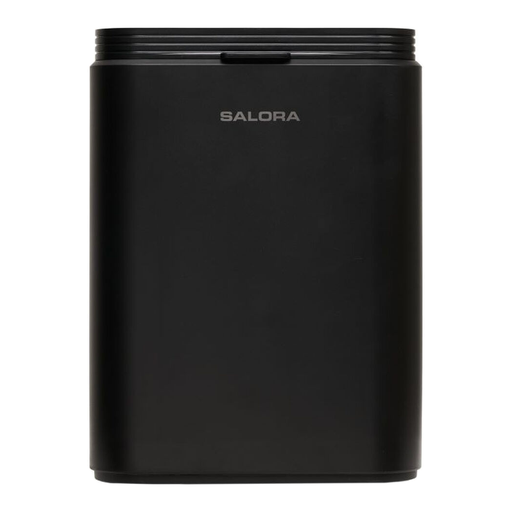 No image available
Salora ICE12B ice maker
An option to compare if the space you have and the output of the first cycle are important to you.
Salora states that it makes 8 cubes in 6–9 minutes, has a 1,3-litre tank and measures 213,4 × 295,9 × 270 mm. The title lists two ice sizes.
View at Joybuy
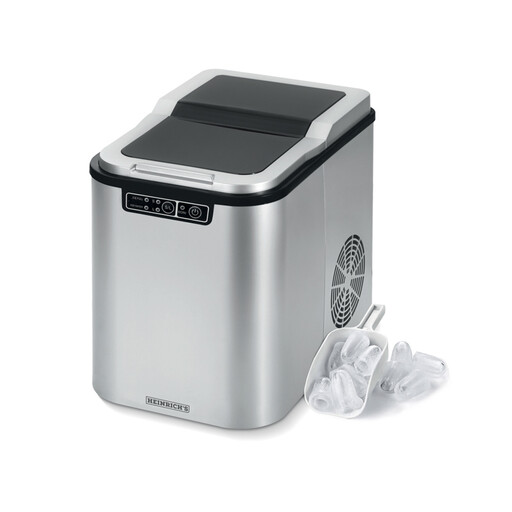 No image available
120W ice maker with 2,2-litre tank
An option to compare if you make several drinks one after another and want to take tank capacity into account.
The product name lists 9 cubes per 9-minute cycle, a maximum output of 12 kg per 24 hours, two ice sizes and a self-cleaning function.
View at Joybuy
 No image available
Teendow KF-2501U1 ice maker
A worktop model to compare if you want to take a self-cleaning function into account.
The product name lists 8 programmes and self-cleaning, mixing and restart functions. Check the manual for this model’s maintenance steps.
View at Joybuy
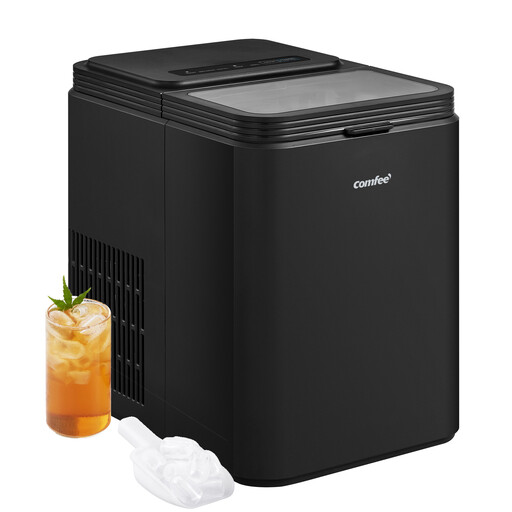 No image available
COMFEE' RCI12BL1EU(E) ice maker
An option to compare if you want to weigh up a small tank against the output of the first cycle.
The product name lists 8 cubes in 6 minutes, a 1,3-litre tank, two ice sizes and a self-cleaning function.
View at Joybuy
 No image available
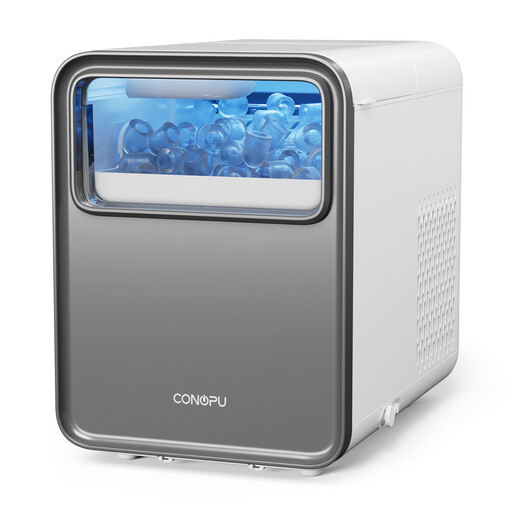
CONOPU worktop ice maker
An option to compare if you want to consider dimensions and cleaning features when making your choice.
The product name lists two ice sizes and a self-cleaning function. The stated dimensions are 35 × 23 × 30 cm.
View at Joybuy
Frequently asked questions
Does 12 kg of ice per 24 hours mean I’ll have ice quickly for my first coffee?
No. The daily output doesn’t tell you how many cubes will be ready in the first cycle. Also compare the stated number of cubes and cycle time: Salora says the ICE12B makes 8 cubes in 6–9 minutes. This is a figure provided by the manufacturer, not an independent real-world test.
Can I leave made ice in the machine for later?
Follow the instructions for the specific model. For the DO9200IB, DOMO recommends taking made ice out of the ice basket and storing it in a freezer bag.
Who can help if an ice maker bought online doesn’t work properly?
If a product is faulty, the Government of the Netherlands says the retailer is your point of contact for a solution. The Netherlands does not have a fixed statutory two-year guarantee period; a manufacturer’s guarantee is in addition to your statutory rights. When you buy online from a business, you’ll generally also have a 14-day cooling-off period.
Which Dutch product safety requirement is relevant?
According to the Netherlands Food and Consumer Product Safety Authority, CE marking is mandatory for electrical products sold on the Dutch market. CE marking does not prove that an individual model has been independently tested.


