
Spontaneous host
You only start making ice once you get home and want to know when you can pour the first drinks. KitchenBrothers and CASO list cycle times and quantities per cycle for each model.


Choose based on when you need the ice. If you want drinks ready soon after you get home, look at the time and quantity of the first cycle. For a longer get-together, tank capacity, ice basket size and how often you need to refill also matter. Compare the specifications for the exact model, measure the space available on your worktop, and consider cleaning and how to store ice made in advance. A stated production capacity per 24 hours doesn’t mean that much ice will be ready straight away.
You only start making ice once you get home and want to know when you can pour the first drinks. KitchenBrothers and CASO list cycle times and quantities per cycle for each model.
You’re expecting several rounds of drinks, so you’ll want to consider refilling, continuous production and the space in the ice basket. Compare these specifications separately for the model you’re considering.
You want to use the machine while you have guests over, then move it or put it away. In that case, dimensions, weight and cleaning are important considerations.
Best if: you’ll only get home shortly before your guests arrive and need the first batch quickly.
Consider: a short cycle doesn’t tell you how much ice is available at once or how long the machine can keep producing it.
Best if: you want to keep making ice while your guests are there and refill the water less often.
Consider: a larger tank doesn’t mean a larger ice basket or higher production.
Best if: you want to move or put the machine away after use.
Consider: a smaller tank may mean more frequent refills. Check the dimensions of the exact model.
| Concern | What should you check? | Who is this important for? |
|---|---|---|
| Time until the first batch | Check both the cycle time and the number of cubes per cycle for the exact model. Manufacturer specifications aren’t based on tests conducted under identical conditions. | If you want to pour drinks as soon as you get home, you’ll want to know when the first batch could be ready. Around 33% of consumers say their main buying concern is getting the first batch. |
| Ice for several rounds | Compare the tank capacity, stated production and ice basket capacity separately. | For a longer get-together, you’ll want to estimate how often you’ll need to refill the water and how much ice the basket can hold. Around 27% of consumers prioritise having enough ice for several rounds. |
| Space and storage | Measure the space available and check the dimensions, weight and whether the model has a handle. | If you’re short on worktop space or want to put the appliance away afterwards, the space it takes up matters a lot. Around 20% of consumers say space is their main buying concern. |
| Cleaning after use | Check the manual for instructions on accessing and cleaning the ice basket, filter and drain. | If you want to put the machine away after your get-together, you’ll want to know what maintenance is involved. Around 20% of consumers put easy maintenance above other buying concerns. |
A figure in kilograms per 24 hours describes production over a full day. Manufacturers also provide separate cycle times, so that daily amount won’t be ready as soon as you get home.
For your first drinks, check the cycle time and the number of cubes per cycle. Allow extra time if you want to make ice in advance.
The official maintenance instructions for the H.Koenig KB12 also describe manual steps, including cleaning the basket, filter and drain.
Follow the manual for your specific model and check that the parts you need to clean are easy to reach.
The water tank holds water for making ice; the ice basket collects the cubes. For example, CASO lists a 2.2-litre tank and a removable 1.3-litre ice basket for the IceChef Pro.
Compare the tank, ice basket and production rate as separate specifications.
The models listed offer different trade-offs between tank capacity and ease of storage.
The IceChef Compact and IceChef Pro offer a choice between a smaller and a larger tank.
Princess says the 283069 is designed for entertaining at home.
The KB12 is worth considering if you’re looking at digital controls and want to check the maintenance instructions in advance.
These ice makers are designed for home use. Their specifications include details about the first cycle and, where stated, tank capacity for a longer get-together. Check that the exact model carries the required CE marking: according to the Netherlands Food and Consumer Product Safety Authority, it is mandatory for electrical consumer products. A CE marking is not an independent safety assessment.
 No image available
The stated cycle information can help you plan when you’ll need the first ice cubes.
The product name lists 8 ice cubes in 6–9 minutes, two ice sizes, a 1.3-litre reservoir and stated production of 12 kg per 24 hours.
The instructions recommend emptying any remaining water from the reservoir and wiping the inside after use.
 No image available
The stated tank capacity is worth considering if you want to make several rounds of ice while entertaining and refill the water less often.
The product name lists 9 cubes in 9 minutes, two ice sizes, a 2.2-litre water tank and stated production of 12 kg per 24 hours.
The name also mentions a self-cleaning function. Follow the instructions for the exact model when carrying out maintenance.
 No image available
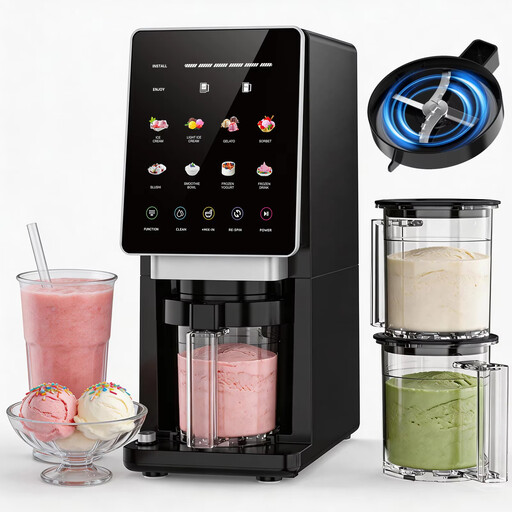
This model is worth considering if you’re looking for a countertop ice maker.
The product name lists eight pre-programmed programmes and a self-cleaning function.
 No image available
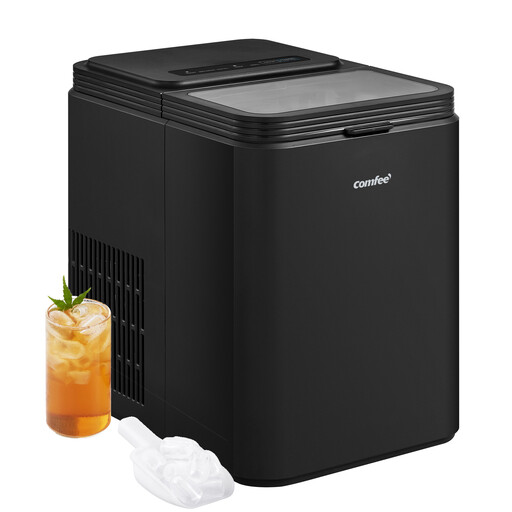
The stated first-cycle time is a useful point of comparison if you want to make ice quickly after getting home.
The product name lists 8 cubes in 6 minutes, two ice sizes, a 1.3-litre tank and stated production of 12 kg per 24 hours.
The product name also mentions a self-cleaning function, an ice scoop and an ice basket.
 No image available
The stated cycle time can help you estimate when the first batch could be ready for your guests.
The product name lists 9 cubes in 6 minutes, two sizes and stated daily production of 26.5 lb. The product description lists a 1.5-litre tank, dimensions of 35 × 23 × 30 cm and a weight of 6.9 kg.
The product description recommends removing the ice cubes promptly once the cycle has finished.
No. That’s the stated production over a 24-hour period, not the amount in the first batch. If you need ice straight away, also compare the cycle time and number of cubes per cycle for the model you’re considering.
Follow the manual for the exact model. For the H.Koenig KB12, the manufacturer instructs you to disconnect the power, wash and rinse the removable basket, clean the water filter and drain any remaining water. Don’t assume these specific steps apply to another appliance.
Not necessarily. According to the Dutch government, you’re entitled to a product that works properly when you buy it, and the seller must provide a solution if something goes wrong. The Netherlands doesn’t have a fixed legal warranty period of two years, so consider whether any extra cover offers rights that genuinely go beyond your existing ones.
According to the Netherlands Food and Consumer Product Safety Authority, electrical consumer products must carry a CE marking. This is the manufacturer’s declaration that the product meets the relevant European requirements; it isn’t proof that each individual appliance has been independently tested. Check the marking and product information for the exact model.