
Cook with limited worktop space
You want to make ice for fruit drinks but have little room on your worktop. The appliance’s dimensions and access to the basket and drain matter more to you than a high daily output.


For fruit drinks in a small kitchen, a countertop model is only suitable if both the appliance and the space needed for the basket and drain fit on your worktop. Then compare the number of ice cubes per cycle with how many glasses you want to make. A high daily output figure doesn’t tell you how much ice is ready straight away, and you’ll also need freezer space if you want to keep ice for later. The cycle and tank figures quoted are manufacturer specifications from DOMO, not independent performance tests.
You want to make ice for fruit drinks but have little room on your worktop. The appliance’s dimensions and access to the basket and drain matter more to you than a high daily output.
You make several fruit drinks in a row, so you’re looking at the first cycle, the water tank and how you collect the ice between cycles.
You want to get the ice ready before mixing the drinks, and you have freezer space to store it. A machine that makes ice on demand isn’t automatically the most convenient way for you to store it.
| What to consider | What should you check? | Who is this important for? |
|---|---|---|
| Worktop space | Compare the length, width and height with the space available. Also check how much clearance the model needs and whether you can still reach the basket and drain. | If my worktop is cramped, I want to know whether the appliance will fit and whether it’ll be easy to empty. Around 36% of consumers put worktop space first. |
| Ice while serving | Compare the number of cubes per cycle and the stated cycle time with the water tank capacity; check these figures for the same model. | If I’m serving several glasses in a row, I want to know how much ice one cycle makes, not just the daily maximum. Around 29% of consumers prioritise an immediate supply of ice. |
| Cleaning and emptying | Check that the basket and drain are accessible, and follow the care instructions for the model you choose. | I want to be able to empty and clean the appliance easily after use, without struggling to reach any parts. Around 21% of consumers prioritise easy maintenance. |
| Storing ice for later | Check whether you have freezer space and how to remove the basket from the appliance. | If I make ice in advance, I want to have it ready for serving and will need space in the freezer. Around 14% of consumers prioritise preparing ahead. |
The maximum output over 24 hours and the yield from one cycle are two different measures. If you’re making a few drinks one after another, the cycle tells you more about how much ice you can expect at that point.
Compare the number of cubes per cycle and the cycle time with how many glasses you want to fill in quick succession.
When you’re serving consecutive glasses, a long wait between cycles can slow down serving.
Length and height matter too. Parts such as the basket and drain also need to remain accessible when the appliance is on your worktop.
Measure the length, width and height, then check the manual to see how much clearance your chosen model needs.
A collection basket isn’t the same as a freezer. For the DO9200IB, DOMO recommends transferring the ice from the basket to a freezer bag if you want to store it.
Before serving, decide where you’ll put the ice and check how to remove the basket from the appliance you choose.
The DO9220IB, DO9253IB and DO9247IB countertop models offer different dimensions and tank capacities to compare if you have limited worktop space.
The Princess 283069 is worth comparing if adjustable ice sizes and a timer matter more to you than having the smallest possible appliance.
The HENDI 271568 countertop model is a useful comparison if you’re looking for a larger ice reserve and have plenty of worktop space.
This selection features countertop ice makers. Focus on comparing the stated dimensions, the clearance needed for ventilation and the number of cubes per cycle with your kitchen and serving plans.
 No image available
An option if you want to make ice for fruit drinks and can set aside the clearance it needs on your worktop.
The product title lists two ice sizes, the first batch in 6–9 minutes, a 1,3-litre reservoir and an output of 12 kg per 24 hours.
According to the product information, leave at least 15 cm of clear space all around for ventilation.
 No image available
A good fit if you make several glasses in a row and want to compare models with a self-cleaning function.
The product title lists 9 ice cubes every 9 minutes, a 2,2-litre tank, two ice sizes and an output of 12 kg per 24 hours.
 No image available
A countertop model to consider if you want to compare different pre-programmed settings and self-cleaning.
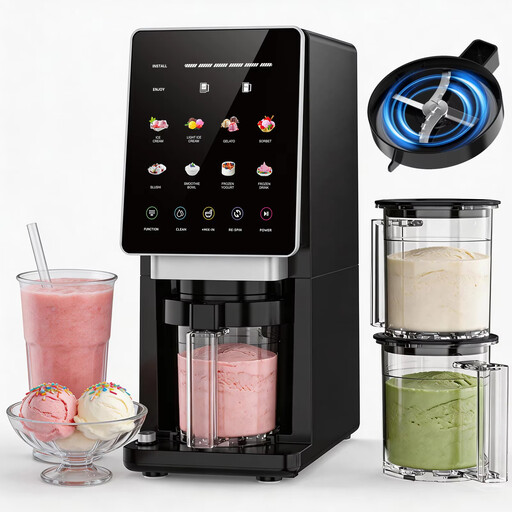
The product title lists 8 pre-programmed programmes, a self-cleaning function, a mixing function and a restart function.
 No image available
A model to compare if a compact design and a first batch of ice while you’re getting ready are important to you.
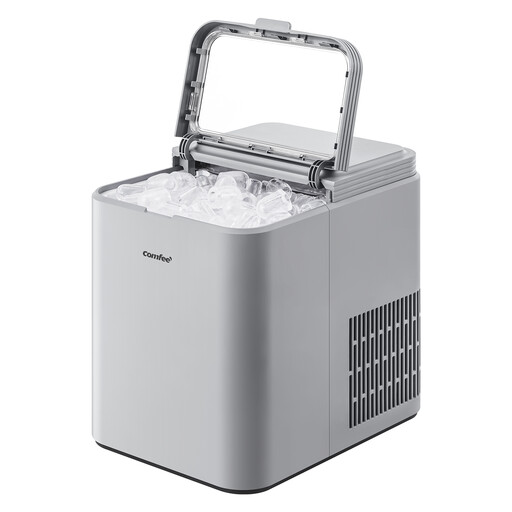
The product title lists 8 ice cubes in 6 minutes, a 1,3-litre tank, self-cleaning and an output of 12 kg per 24 hours.
The stated dimensions are 295,7 × 213 × 295 mm. The product information also mentions a removable basket.
 No image available
An option if you want to include two ice sizes and a self-cleaning function in your comparison.
The product title lists 9 ice cubes in 6 minutes, an output of 26,5 lbs per day and two ice sizes.
The product information also mentions a basket and scoop.
No. For the models listed, DOMO says to fill the tank with water. Make the ice cubes according to the manual and add fruit or juice to your drink. Check the manual for your own model before using any other liquid.
The RIVM describes Dutch tap water as safe to drink. You should also follow the instructions for your specific model: the product page for the DOMO DO9220IB mentions spring water, so check the manual to see what’s recommended for that model.
For the DO9200IB, DOMO says you can remove the basket and put the cubes in a freezer bag. The product page for the DO9253IB also mentions freezing the ice for later. Check how to remove the basket if you have a different model.
According to the Dutch government, purchases made remotely from a business usually come with a 14-day cooling-off period; exceptions and the circumstances of the purchase also matter. You’re also entitled to a product that meets legal requirements, and you can contact the seller if it doesn’t.
In the EU, electrical equipment covered by the Low Voltage Directive must meet conformity requirements, including the applicable CE rules. EUR-Lex gives the voltage range for alternating current as 50 to 1.000 V. A CE marking on its own is not an independent test of the product in use or confirmation that every individual model is compliant.