
The host serving drinks throughout the meal
You’re serving several rounds of fruit coolers and want to keep topping up your ice supply. So, check the stated time and quantity per cycle.


Choose based on when you plan to serve the drinks. If you’re filling several glasses at once, making and storing ice in advance matters more than having a fast first cycle. If you’ll be serving drinks in rounds during the meal, look at how much ice each cycle produces. Also compare the ice basket with the water tank, measure your available worktop space and check how the machine should be cleaned. Times and capacities are figures supplied by manufacturers, not measurements of how much ice you’ll need for your meal.
You’re serving several rounds of fruit coolers and want to keep topping up your ice supply. So, check the stated time and quantity per cycle.
You’re preparing several glasses at the same time and want to make a supply of ice in advance. Compare the ice basket capacity, and make room in the freezer if you plan to store ice ahead of time.
Your worktop is already busy during the meal. Measure the space available and consider whether you can position, empty and clean the machine without getting in the way of serving.
First decide whether you want to make ice in batches or have it ready in advance. Then compare the ice basket and water tank capacities, cleaning requirements and the space available on your worktop.
| What to consider | What to look for | Who should prioritise this? |
|---|---|---|
| Ice per cycle | Compare both the stated cycle time and the number of cubes produced per cycle. A capacity per 24 hours isn’t the same as having ice ready to serve straight away. | If you’re serving drinks in rounds during the meal, you’ll want to know how much ice you can get each time. Around 33% of consumers say a continuous supply of ice is their top priority. |
| Ice ready to serve | Compare the ice basket with the water tank, and consider whether you can transfer ice you’ve made earlier to the freezer. | If you’re filling several glasses at once, having enough ice ready at the right time is important. Around 27% of consumers prioritise having enough ice ready before the meal. |
| Cleaning | Check the manual to see how to empty and clean the machine. A rinse programme doesn’t explain by itself how to maintain all the parts. | If you want to be able to empty and clean the machine easily after the meal, ease of maintenance matters. Around 20% of consumers say this is their top priority. |
| Worktop space | Measure the space and compare it with the dimensions of the exact model. Leave room to use the lid and ice basket, too. | If there’s little worktop space left during the meal, you’ll want a machine that’s practical to position and use. Around 20% of consumers put limited worktop space at the top of their list. |
The stated quantity per 24 hours and the capacity of the ice basket don’t tell you how much ice will be ready at once for your guests.
Plan for the number of glasses you want to serve at the same time. Compare the quantity per cycle with the basket capacity, and make ice in advance if needed.
The water tank holds water; the ice basket shows how much ice it can hold. They’re separate parts with different capacities.
Check both capacities for the exact model and work out how much ice you’ll need when it’s time to serve.
A programme that rinses the machine with water describes one function; it doesn’t automatically cover maintenance of every part.
Before you buy, check the manual for the exact model for instructions on emptying and cleaning it.
Worth considering if you’re looking for a worktop model to make ice for drinks. The features listed apply to individual models.
Worth considering if water tank and ice basket capacity are important when planning drinks for several people.
Worth considering if you’re looking for a worktop model with a choice of ice sizes and a rinse programme.
These product picks are for making ice on the worktop for drinks at a shared meal. In particular, compare the stated quantity per cycle, water tank, ice basket and cleaning features with your serving plans.
 Image unavailable
Could suit you if you want to make ice in batches while serving; plan the quantity around the portions you need.
Listed features: 8 ice cubes in 6–9 minutes, two ice sizes, a 1,3-litre tank and 12 kg per 24 hours.
 Image unavailable
Could suit you if you want to make ice in batches and are looking for a self-cleaning function; check that the stated batch size suits your serving plans.
Listed features: 9 ice cubes in 9 minutes, two sizes, a 2,2-litre water tank, 12 kg per 24 hours and a self-cleaning function.
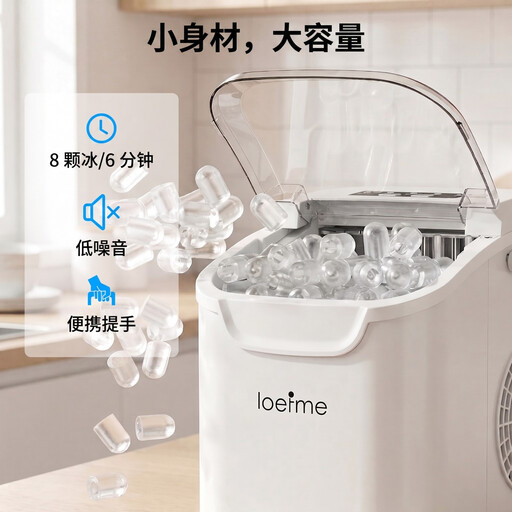 Image unavailable
Could suit you if you want a choice of ice sizes; if you’re preparing several glasses at once, bear the stated quantity per cycle in mind.
Listed features: 9 ice cubes in 6–13 minutes, S and L sizes, a 0,8-litre tank, 12 kg per 24 hours and automatic cleaning.
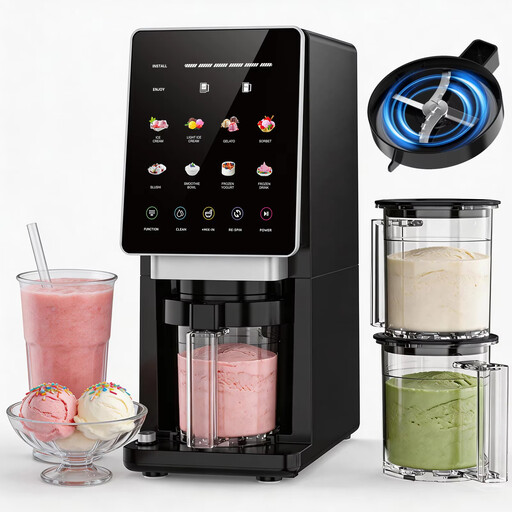 Image unavailable
Could suit you if you’re looking for a worktop model with preset programmes and a self-cleaning function.
The product name lists 8 presets, self-cleaning, and mix and resume functions.
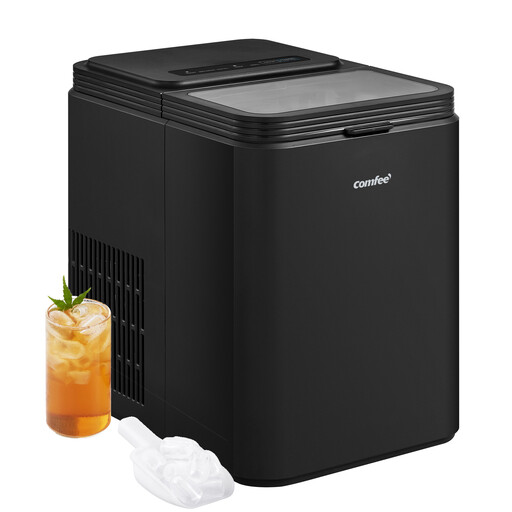 Image unavailable
Could suit you if a first batch of ice and a choice of ice sizes are important; compare the cycle time with the number of glasses you want to fill at once.
Listed features: 8 ice cubes in 6 minutes, two sizes, a 1,3-litre tank, a removable 0,4 kg basket, a scoop and a self-cleaning function. Output of 12 kg per 24 hours is also listed.
Not necessarily. For serving, compare the quantity per cycle with the capacity of the ice basket. You can make and store ice in advance if needed; DOMO says that ice cubes from the DO9200IB can be transferred to a freezer bag.
Yes. Follow the instructions for cleaning and emptying the exact model. ProfiCook describes the PC-EWB 1253 programme as rinsing with clean water; that doesn’t mean no further maintenance is needed.
No. Any manufacturer’s warranty is in addition to your statutory rights. According to ACM ConsuWijzer, the seller must resolve a problem if a product breaks during normal use sooner than you could reasonably have expected.
Electrical equipment is subject to applicable EU product rules, including CE marking where required. The European Union explains that a CE mark is a declaration by the manufacturer, not an independent quality mark. Applicable rules for food-contact materials, including Regulation (EC) 1935/2004, also apply to parts intended to come into contact with water or ice for consumption. Check the information for the specific model.