
Host with little time to prepare
Want to serve the first drinks with ice shortly before your friends arrive? Compare the time and quantity for the first cycle, not just the stated daily output.


Start by deciding when you want to serve the first drinks, then consider whether the machine can keep making ice throughout the evening or whether you’d prefer to store ice in advance. Check the output per cycle, the ice basket and the water tank: a stated output per 24 hours doesn’t tell you how much ice will be ready when your guests arrive. Also check the model’s dimensions and cleaning instructions.
Want to serve the first drinks with ice shortly before your friends arrive? Compare the time and quantity for the first cycle, not just the stated daily output.
If you want to serve several rounds during the meal, check the ice basket and water tank, and consider whether you can store ice in the freezer in advance.
If the machine needs to fit next to your food preparation area, compare its external dimensions and check how to care for it after use.
| What to consider | What should you look for? | Who is this important for? |
|---|---|---|
| First drinks | Compare both the time and the number or weight of ice cubes per cycle. Allow for extra cycles if you need more. | If I need ice for the first drinks shortly before guests arrive, I look at the output of the first cycle. Around 36% of consumers prioritise that first batch above all else. |
| Enough for several rounds | Compare the capacity of the ice basket and water tank separately. Also consider whether you have space in the freezer to store ice in advance. | If you want to serve several rounds during the meal, consider the available supply and refilling. Around 29% of consumers prioritise having a continuous supply of ice. |
| Worktop space | Measure the space available and compare the width, depth and height of the exact model. | If I have little worktop space left while cooking, I want to know whether the appliance will fit in the available space. Around 21% of consumers make worktop space their top priority. |
| Cleaning up afterwards | Check the manual for instructions on draining water, cleaning parts and using any self-cleaning function. | If you want to tidy up quickly after your guests leave, check the care instructions for the model you’ve chosen. Around 14% of consumers put easy maintenance first. |
A stated quantity per 24 hours doesn’t tell you how much ice will be ready for the first drinks. Manufacturers also list output per cycle or a separate basket capacity.
Plan the first round based on the stated output per cycle, and allow for extra cycles if you need more ice.
Planning several cycles in advance can take extra preparation time. Storing ice you’ve made ahead also takes up freezer space.
The water tank holds the water used to make ice, while the basket collects the ice produced. These are separate measurements, as with the Princess 283069.
Compare both specifications separately before deciding how often you’ll need to refill the tank or remove the ice.
The KitchenBrothers KB1000692 manual describes the self-cleaning function alongside other care and cleaning instructions.
Follow the full manual for the model you buy, even if the appliance has a self-cleaning function.
After use, you’ll still need time to empty the appliance and follow the other cleaning steps.
The KB1000692 is worth considering if you want to compare a 2-litre water tank and the output per cycle.
Model 283069 gives you separate stated capacities for the water tank and ice basket to compare.
The DO9220IB is an option to consider if you want to compare the stated time to make the first batch, the dimensions and the removable ice basket.
The white Ice Cube Express type 8510 has stated dimensions and an initial output in grams for you to compare.
This selection includes worktop ice makers for anyone comparing first-cycle output, ice supply throughout the evening, available space or maintenance.
 No image available
Could be a good fit if you want to consider the stated cycle time and choice of ice sizes for the first drinks.
The product name lists two ice sizes, a capacity of 12 kg per 24 hours, a stated cycle time of 6–9 minutes and a 1.3-litre water tank.
 No image available
Could be a good fit if you want to compare the stated output per cycle and a larger water tank for serving several rounds of drinks.
The product name lists 9 ice cubes in 9 minutes, a capacity of 12 kg per 24 hours, two ice sizes and a self-cleaning function.
 No image available
Could be a good fit if you want to take a self-cleaning function and two ice sizes into account when choosing an ice maker for the first round.
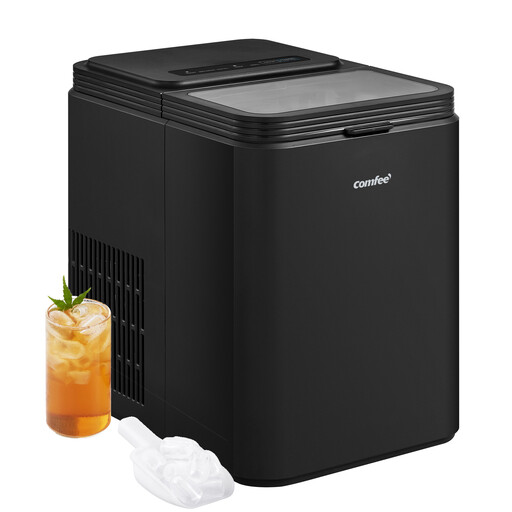
The product name lists 9 ice cubes every 6–13 minutes, a capacity of 12 kg per 24 hours, two ice sizes and a 0.8-litre water tank.
 No image available
Could be a good fit if you’re looking for a worktop model and want to compare its controls and cleaning features.
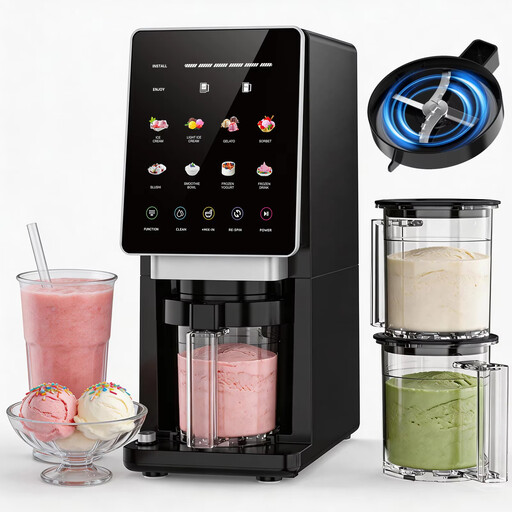
The product name lists 8 pre-programmed programmes, a self-cleaning function, and mixing and restart functions.
 No image available
Could be a good fit if you want to compare the stated first-cycle output and tank capacity for serving several rounds of drinks.
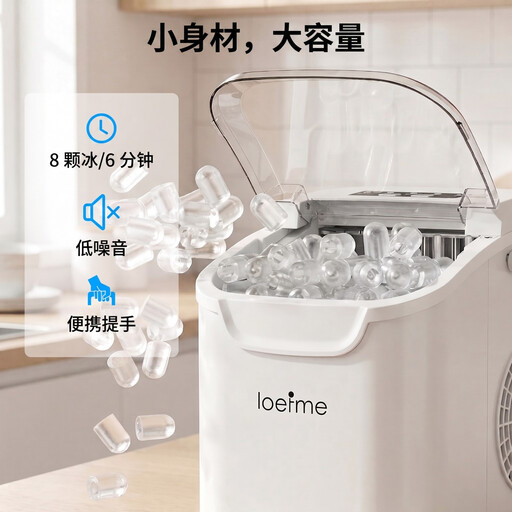
The product name lists 8 ice cubes in 6 minutes, a capacity of 12 kg per 24 hours, a 1.3-litre water tank and a self-cleaning function.
Not necessarily. That figure describes the stated output over 24 hours, not the amount ready when your friends arrive. Compare the output of the first cycle and make several batches in advance if needed.
If you want to build up a supply in advance, store the ice you’ve made in the freezer. For model DO9200IB, DOMO recommends transferring the ice from the basket to a freezer bag. Don’t automatically apply this model-specific instruction to a different appliance.
Empty and clean the appliance according to the manual for the exact model. The KitchenBrothers KB1000692 manual has separate steps for maintenance, cleaning and self-cleaning; don’t skip the other steps just because the appliance has this function.
That depends on the model and the applicable EU rules. The EU Low Voltage Directive applies to equipment with a rated voltage of 50–1.000 V AC or 75–1.500 V DC. Equipment within its scope must meet the applicable requirements and carry a CE marking. CE is the manufacturer’s declaration of conformity, not automatically a certificate issued by an independent EU body.
No. According to ACM ConsuWijzer, your statutory rights depend on how long the product should reasonably be expected to work properly, in addition to any manufacturer’s or retailer’s guarantee. If it breaks down sooner under normal use, the retailer is responsible for providing an appropriate solution at no cost to you.