
A first batch of ice, quickly
You get home after class and want to know when you can pour your first glasses. PRIMO, DOMO and KitchenBrothers state cycle times for their named models; these are manufacturer figures, not independent test results.


Want to pour a few fruit drinks quickly after class? Compare the stated time and number of ice cubes per cycle; the 24-hour output doesn’t tell you how much ice is ready straight away. If you’re making several batches, the water tank capacity and emptying the basket matter too. Before you buy, check the cleaning instructions and documentation for the exact model.
You get home after class and want to know when you can pour your first glasses. PRIMO, DOMO and KitchenBrothers state cycle times for their named models; these are manufacturer figures, not independent test results.
You’re making fruit drinks for several people and want to allow for refilling, starting new cycles and an ice basket that fills up. DOMO says the DO9253IB alerts you when the water reservoir is empty or the basket is full; check which features are included with the model you’re considering.
You want to put the appliance somewhere practical and clean it according to the instructions after use. Check the dimensions and cleaning guidance for the exact model; PRIMO, for example, states that the PR407IB is not dishwasher-safe.
| What to consider | What to look for | Who is this important for? |
|---|---|---|
| Wait time for the first batch | Compare the stated number of cubes per cycle and the time in minutes per cycle. Treat manufacturer figures as claims, not measured performance. | If I want to pour a few glasses as soon as I get home from class, I focus on the first batch. This is the top priority for around 36% of consumers. |
| Several batches | Check the reservoir capacity, cycle time and guidance on a full basket separately; daily output isn’t the same as ice ready to use straight away. | If I’m making drinks for several people in a row, I look at refilling and restarting the machine. Around 29% of consumers prioritise producing successive batches. |
| Cleaning | Read the instructions for the exact model and check which parts are removable or dishwasher-safe. | If I want to maintain the appliance easily after use, I check how to clean each part. Maintenance is the main priority for around 21% of consumers. |
| Worktop space | Measure the space available and compare it with the stated length, width and height of the exact model. | If I have limited worktop space, I want to know whether the appliance will fit. Around 14% of consumers prioritise the space available. |
A stated output over 24 hours doesn’t tell you how much ice one cycle produces. If you only look at daily capacity, you may still have to wait for several cycles before you can pour your first drinks, or make ice in advance.
For ice you want to use straight away, compare the stated time and number of cubes per cycle; treat daily capacity as a separate specification.
Allow for extra waiting time if one cycle isn’t enough for the drinks you want to make.
Cleaning instructions can differ from one part to another. PRIMO states that the PR407IB is not dishwasher-safe, even though this model is listed as having a removable tub.
Check the manual for the exact model and follow the cleaning instructions for each part.
A sales page or a similar model name doesn’t, on its own, confirm that the documentation applies to the exact version. In the Netherlands, CE marking is compulsory for electrical equipment covered by the applicable rules. The European Commission states that food-contact materials must comply with the relevant European rules, including Regulation (EC) No 1935/2004.
Before buying, check the full model designation, product documentation and relevant markings and information from the seller.
The PR407IB is a useful point of comparison for a countertop model with a stated reservoir capacity of 1.6 litres. PRIMO also lists the dimensions and replacement parts for this model.
The DO9253IB is worth considering if you want to compare a 1.8-litre reservoir and the option to make ice in advance.
The black model reviewed, with a 2-litre reservoir, is a useful point of comparison if you want to run several cycles without refilling straight away.
These models are worth comparing for their stated cycle times, reservoir capacities and countertop features. For the exact model, check the product documentation, applicable markings and instructions for parts that come into contact with water or ice.
 No image available
The stated time for the first batch may suit anyone who wants ice quickly for a few drinks after class.
The product name lists 8 ice cubes in 6–9 minutes, a 1.3-litre reservoir and 2 ice sizes. The stated daily output is 12 kg per 24 hours.
Check that the available space allows for the stated minimum clearance of 15 cm on all sides for ventilation.
Before buying, check the documentation and markings for this exact version.
 No image available
The larger stated tank capacity may be useful if you want to make several batches; reservoir capacity doesn’t indicate how much ice is in stock.
The product name lists 120 W, 9 ice cubes every 9 minutes, 12 kg per 24 hours, two ice sizes and a self-cleaning function.
Before buying, check the documentation and markings for this exact version.
 No image available
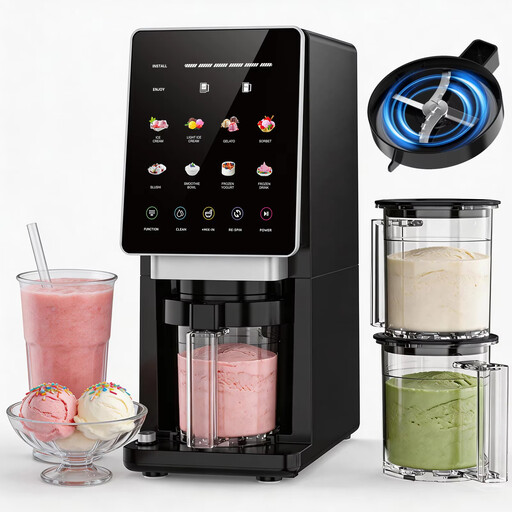
This countertop model can be included in a feature comparison, but the product name doesn’t state a cycle time or reservoir capacity.
The product name lists 8 preset programmes and a self-cleaning function.
Before buying, check the documentation and markings for this exact version.
 No image available
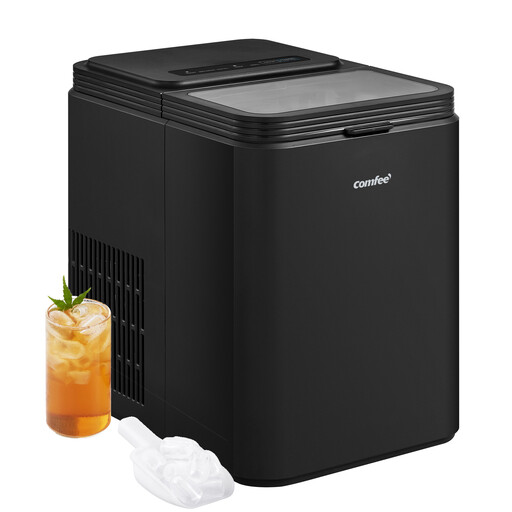
The stated cycle time and tank capacity are useful if you want to make a first batch after class and perhaps run another cycle afterwards.
The product name lists 8 ice cubes in 6 minutes, a 1.3-litre tank, two ice sizes and a self-cleaning function. The stated daily output is 12 kg per 24 hours.
Before buying, check the documentation and markings for this exact version.
 No image available
The stated cycle time is useful if you want to compare how quickly the first ice cubes are ready, according to the product name.
The product name lists 9 ice cubes in 6 minutes, two sizes and a self-cleaning function. The stated daily output is 26,5 lbs.
Before buying, check the documentation and markings for this exact version.
That’s the stated output over a 24-hour period, not the amount in the first batch. If you want to use the ice straight after class, also check the number of cubes per cycle and the stated cycle time.
Don’t treat the production specification as a storage specification. DOMO says you can freeze ice made in advance separately for the DO9253IB; follow the instructions for the model you’re using.
Follow the manual for the exact model and check which parts are removable or dishwasher-safe. PRIMO lists a removable tub for the PR407IB, but states that this model is not dishwasher-safe.
According to the Dutch government, when you buy at a distance you generally have 14 days to change your mind, although exceptions apply. Before buying, check the seller’s information about the product and the cooling-off period.
According to the NVWA, CE marking is compulsory in the Netherlands for electrical equipment covered by the applicable rules. The European Commission states that materials that come into contact with food must comply with the applicable European rules, including Regulation (EC) No 1935/2004. These general rules don’t confirm that a specific model being sold complies with them.