
The last-minute host
You need ice shortly before your friends arrive, so the first things you check are the time to the first batch and the number of cubes per cycle.


Choose based on how long it takes to make the first batch and how much ice you can build up before your guests arrive: a stated daily output doesn’t tell you how much ice is ready in the basket at any one time. Also compare basket capacity, the space it takes up on your worktop and how much cleaning it needs. If you need a larger supply, make ice in advance and store it separately in the freezer. Manufacturers’ cycle-time and output figures are not directly comparable.
You need ice shortly before your friends arrive, so the first things you check are the time to the first batch and the number of cubes per cycle.
You can get started earlier, but want enough ice for several drinks at once when your guests arrive. Basket capacity and available freezer space are important here.
You want a machine that fits on your worktop while it’s in use, and is practical to store and clean afterwards.
Start with the time to the first batch and how much ice you can store at once. Then check whether the machine will fit and whether its care requirements suit the way you plan to use it.
| Buying consideration | What should you look for? | Who is this important for? |
|---|---|---|
| Time to the first batch | Compare the stated cycle time with the number of cubes per cycle, and read the conditions in the instruction manual. | If I only need ice shortly before my guests arrive, I want to know how quickly the first batch can be ready. Around 36% of consumers prioritise the speed of that first batch. |
| Ice ready to serve | Check the basket capacity separately from output per cycle and per 24 hours, and allow for preparation time too. | If I’m serving drinks to several guests at once, I want to be able to build up enough ice before they arrive. Around 29% of consumers prioritise how much ice is available at that point. |
| Worktop space | Measure the space available and compare it with the external dimensions of the exact model. | If I have limited worktop space, the machine needs to fit there comfortably while it’s in use. Around 21% of consumers consider available worktop space the most important factor. |
| Cleaning and storage | Check the instruction manual, the drainage opening and which parts need to be cleaned by hand. | If I want to clean and put the machine away quickly after a get-together, I want to know what maintenance is involved. Around 14% of consumers prioritise ease of maintenance. |
A stated output per 24 hours isn’t the same as the amount of ice that fits in the basket at any one time.
Plan around the cycles, basket capacity and when your guests are due to arrive.
The capacity of a water tank and the amount of ice in the basket are two different figures. For example, Princess lists a 2.8-litre water tank and an 800-gram ice basket for the Princess 283069.
Don’t compare litres of water directly with grams of ice storage; check both figures separately.
For models KB692, KB719 and KB756, the KitchenBrothers manual warns that ice will melt if left in the machine for too long.
Use the ice promptly or follow the model-specific instructions for transferring it to the freezer.
The KB1000757 is a compact model for anyone who wants to make the first batches without using up too much worktop space.
The DOMO DO9247IB is designed for anyone who can run several cycles before a get-together.
The PR407IB is an option for anyone looking for a manually filled model with a scoop.
The Princess 283069 is worth considering if you want to choose the size of your ice cubes and a timer is important to you.
The Ice Volcano 2G is a dispenser option for anyone who wants to dispense ice directly into glasses.
These models are designed to make ice on your worktop, with features including a focus on the first batch, adjustable ice sizes and building up a supply for a get-together. Before buying, check that the exact model carries the required CE mark; a visible mark is not an independent test.
 No image available
Its stated cycle time may suit anyone who wants to make the first cubes quickly before their guests arrive.
Product details list two ice sizes, eight cubes in 6–9 minutes and a 1.3-litre water tank.
The product description mentions a removable 0.45 kg basket and a scoop. The stated 12 kg per 24 hours is daily output, not the amount of ice ready to serve.
 No image available
Its stated cycle time is useful if you want to make the first batch of ice before your guests arrive.
The product name lists nine cubes in nine minutes, two ice sizes, a self-cleaning function and a 2.2-litre water tank.
The stated output of 12 kg per 24 hours doesn’t tell you how much ice fits in the basket at any one time.
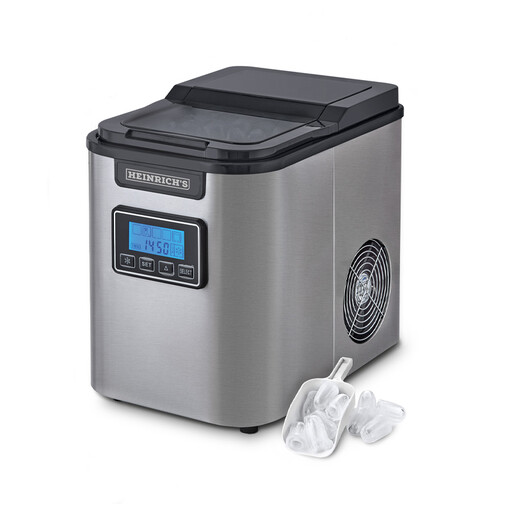 No image available
The three stated ice sizes may be useful if you want cubes to suit different drinks.
The product name lists nine cubes in nine minutes, a self-cleaning function and a 2.2-litre water tank.
The stated output of 12 kg per 24 hours doesn’t tell you how much ice is ready straight away.
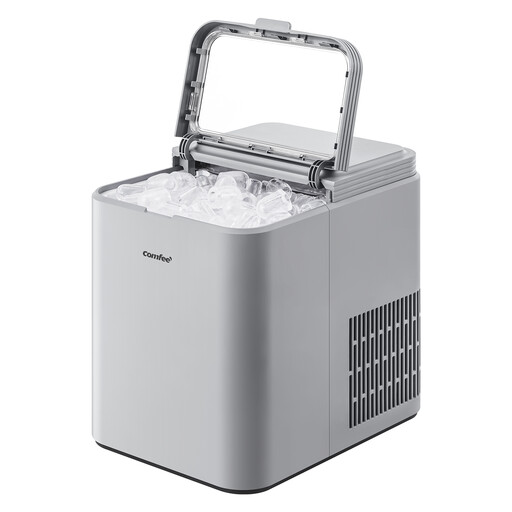 No image available
Its stated time to the first batch may suit anyone who needs ice shortly before guests arrive.
The product name lists eight cubes in six minutes, two ice sizes, a self-cleaning function and a 1.3-litre water tank.
The product description mentions a removable 0.4 kg basket and a scoop. The stated 12 kg per 24 hours isn’t the amount of ice in the basket.
 No image available
Its stated cycle time may be useful if you want to have ice ready for the first drinks before your guests arrive.
The product name lists nine cubes in six minutes, two ice sizes and a self-cleaning function. The product description mentions a 1.5-litre water tank and a basket with a scoop.
The stated daily output is 26.5 lb; this doesn’t tell you how much ice is ready to serve.
No. That’s a stated output over 24 hours, not the capacity of the collection basket. To find out how much ice is ready to serve, check the basket capacity and consider how much you may have made and stored separately before your guests arrive.
Take it out of the machine and store it separately in the freezer if you want a larger supply. The KitchenBrothers manual warns that ice melts if left in models KB692, KB719 and KB756 for too long; follow the model-specific instructions for your own machine.
Don’t assume so. Check the care instructions for the exact model; the KitchenBrothers manual covers maintenance and cleaning separately from operation. You should also follow general food-safety guidance when keeping kitchen equipment clean.
No. For electrical equipment covered by the relevant EU rules, the manufacturer uses the CE mark to indicate that the product complies with those rules. The European Commission explains that there is no central EU body issuing a general CE certificate; check the information for the exact model.
For a standard online purchase, ACM ConsuWijzer says you generally have a 14-day cooling-off period, which ends 14 days after delivery. Your statutory guarantee applies separately from any manufacturer’s guarantee if, under normal use, a product doesn’t do what you could reasonably expect.