What should you look for when buying?
First decide how much ice you want to be able to take at once, then check the first cycle, and finally make sure the appliance suits your worktop and how often you’ll use it.
| What to consider |
What to look for when buying |
Who is this important for? |
| Enough ice for several drinks |
Compare the collection basket’s capacity with the output per 24 hours; these are different figures. |
If I’m serving several rounds of drinks over lunch, I want to know how much ice will be ready at once and when I’ll need to empty the basket. Around 36% of consumers prioritise having enough ice for successive drinks. |
| A first batch in a hurry |
Consider the stated time alongside the number of cubes per cycle; manufacturer figures are not comparative test results. |
If guests unexpectedly ask for ice, I want to know how long the first batch will take and how many cubes I’ll get. Around 29% of consumers prioritise the speed of that first batch. |
| Space and cleaning |
Check the dimensions and tank capacity of the specific model, and read the instructions for emptying and cleaning it. |
If worktop space is limited, or I want to be able to empty and clean the machine easily after lunch, these practical considerations matter. Around 21% of consumers name space or maintenance as their main concern. |
| A machine for occasional use |
Weigh up making ice regularly against buying it ready-frozen, the freezer space available and the upkeep an appliance requires. |
If I only need ice now and then, I want to know whether I need an appliance for those occasions. Around 14% of consumers prioritise the cost of buying a machine for occasional use. |
Ice makers at Joybuy
This selection includes countertop ice makers, including models with a stated first cycle for making ice while you’re serving. Compare the cycle time, collection capacity and practical dimensions for your lunch. Check the CE marking on the appliance you choose: according to the Netherlands Food and Consumer Product Safety Authority, this is required for products covered by the Dutch Commodities Act Decree on Electrical Equipment.
 No image available
Salora ICE12B
Worth comparing if you want to make a first batch while serving and weigh the basket capacity against the total output.
Salora lists eight ice cubes in six to nine minutes, depending on the size, two sizes, a 1,3-litre tank and a 0,45 kg basket. The stated output is 12 kg per 24 hours; this is not the amount that will be in the basket at once.
According to the instructions, allow for an earthed socket and at least 15 cm of clearance around the appliance.
View at Joybuy
 No image available
120 W ice maker, 2,2 l
A model to compare if you want to weigh the stated first cycle and tank capacity against your lunchtime ice needs.
The product name lists 120 W, nine ice cubes in nine minutes, a stated output of 12 kg per 24 hours, two ice sizes, a self-cleaning function and a 2,2-litre water tank.
View at Joybuy
 No image available
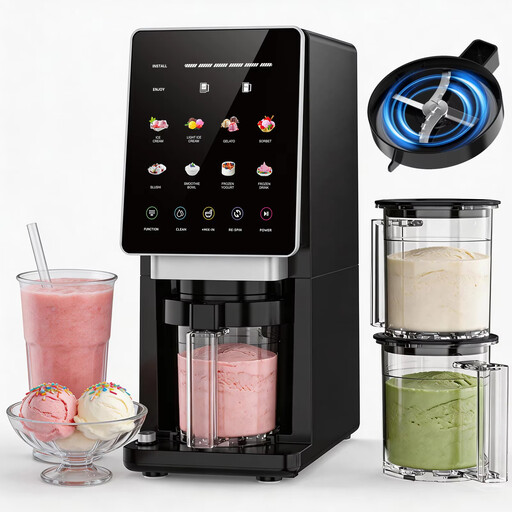
Teendow KF-2501U1
Worth comparing if you’re looking for a countertop model with pre-set programmes and a self-cleaning function.
The product name lists eight pre-set programmes, a self-cleaning function, and mixing and resuming functions.
View at Joybuy
 No image available
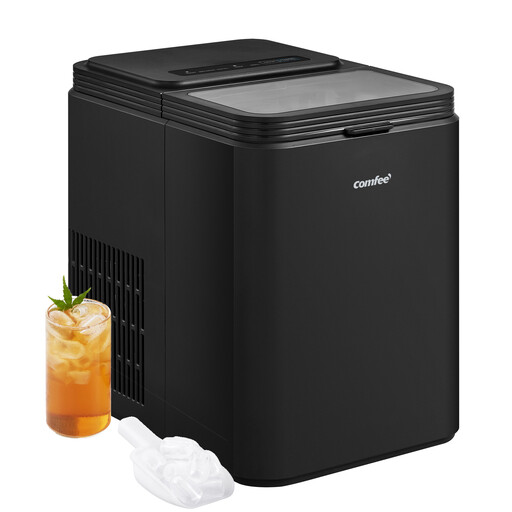
COMFEE' RCI12BL1EU(E)
Worth comparing if you want to make a first batch while serving and a removable basket is important to you.
The product name lists eight ice cubes in six minutes, a stated output of 12 kg per 24 hours, a 1,3-litre tank, two sizes, a self-cleaning function, and a scoop and basket.
According to the instructions, allow for an earthed socket and at least 15 cm of clearance around the appliance.
View at Joybuy
 No image available
CONOPU ice maker
Worth comparing if you want a countertop machine and the first cycle is important for serving.
The product name lists nine bullet-shaped ice cubes in six minutes, two sizes and a daily output of 26,5 lb. The product description gives a 1,5-litre tank and dimensions of 35 × 23 × 30 cm.
The product listing recommends removing the ice cubes as soon as the cycle is complete.
View at Joybuy
Frequently asked questions
Does 12 kg of ice per 24 hours mean I’ll have 12 kg ready for lunch?
No. That’s the stated output over 24 hours, not the capacity of the basket. Salora separately lists a 0,45 kg basket for the ICE12B; compare both figures for your lunch.
Can I make ice in advance?
Yes. DOMO says you can freeze the ice made by the DO9253IB. Bear in mind that you’ll need freezer space and time to transfer the ice from the basket; the daily output isn’t the same as the amount available straight away.
Does a self-cleaning function take care of all the cleaning?
Don’t assume that it does. Klarstein lists automatic cleaning for the IceCraft, but you should also consult the manual for instructions on emptying and manual maintenance. For example, PRIMO says the PR403IB is not dishwasher-safe.
Who should I contact if my ice maker develops a fault?
If a product develops a fault too soon under normal use, the seller is responsible for offering an appropriate solution, according to ACM ConsuWijzer. The statutory guarantee in the Netherlands is not set at exactly two years for every appliance; what you could reasonably expect from the product is what matters.
Which CE rules apply to an electric ice maker in the Netherlands?
According to the Netherlands Food and Consumer Product Safety Authority, CE marking is required for products covered by the Dutch Commodities Act Decree on Electrical Equipment. The low-voltage rules mentioned apply, among other things, to a rated AC voltage of 50 to 1.000 V; Salora lists an input voltage of 220–240 V for the ICE12B. Check the marking on the specific appliance.


