
Last-minute host
Your friends are due just after you get home, and you want to know when the first usable batch will be ready – not just how much ice a machine can make in a day.


If you need ice quickly after an evening class, compare the stated time to the first ice cubes and how many cubes each cycle produces. Daily capacity doesn’t tell you how much ice will be ready straight away. Then match the ice basket capacity, refilling and worktop space to the number of rounds of drinks you’re planning and the space in your kitchen. Manufacturer specifications are not the results of a like-for-like practical test.
Your friends are due just after you get home, and you want to know when the first usable batch will be ready – not just how much ice a machine can make in a day.
You’re expecting several rounds of drinks and want to plan ice production, water levels and when to remove ice from the basket.
You have limited worktop space and want to be able to move, empty and clean the appliance after use.
Start with when you need the first ice cubes. Then compare how much ice you can collect for subsequent rounds, as well as the space and maintenance the appliance requires.
| What to consider | What should you look for? | Who is this important for? |
|---|---|---|
| First batch | Compare the stated time with the number of ice cubes per cycle. Don’t treat manufacturer specifications as like-for-like measurements. | If I’m welcoming guests as soon as I get home from class, I want to know how much ice might be ready for the first drinks. Around 38% of consumers prioritise the first batch. |
| Subsequent rounds of drinks | Check the output per cycle, the water reservoir capacity and how much ice the basket can hold separately. | When there are several rounds of drinks, I want to know whether I’ll need to refill the water and remove ice from the basket. Around 31% of consumers prioritise having enough ice for subsequent rounds. |
| Positioning and storage | Compare the exact model’s external dimensions with your worktop and check the positioning instructions. | With limited space, I want to know in advance where the appliance can go and whether I can put it away after use. Around 16% of consumers prioritise positioning and storage. |
| Emptying and cleaning | Check whether the ice basket is removable, how to drain the water and what cleaning the manual recommends. | After a late evening, I want to be able to empty and put the appliance away without a complicated cleaning routine. Around 15% of consumers make maintenance their top priority. |
Kilograms per 24 hours and the time until the first ice is made answer different questions. A high daily capacity doesn’t tell you how much ice will be available for the first drinks.
Plan around the first batch and subsequent cycles, not just the daily capacity.
An ice basket isn’t automatically a freezer. For the DO9200IB, DOMO recommends transferring a larger quantity of made ice from the basket to a freezer bag.
Check the storage instructions for your exact model, and make sure you have freezer space if you want to make ice in advance.
A similar model name doesn’t guarantee that the product number or dimensions are the same. The manufacturer’s page for the CASO IceChef Compact lists different dimensions and weights.
Compare the full model or product number and check the external dimensions of the version on offer before ordering.
The DO9220IB is worth comparing if you want to get started quickly and value a removable basket and drainage opening.
The 283069 is worth comparing if you’re looking for a larger water reservoir, adjustable ice cube size and a timer.
The IceChef Compact is worth comparing if a handle, removable ice basket and self-cleaning function are important to you.
These Joybuy products are worktop ice makers. Compare the stated time and output per cycle, water tank and features that suit your preparation and cleaning routine.
 No image available
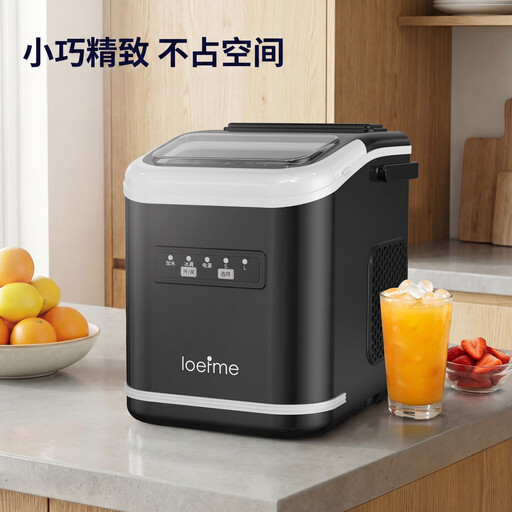
An option to compare if you want to plan for the first ice cubes after getting home and choose between two cube sizes.
The product description lists 8 ice cubes in 6–9 minutes and a 1,3-litre water reservoir. The title mentions two sizes, 12 kg per 24 hours and the matt black colour.
 No image available
An option if you want to compare stated output per cycle, two sizes and a self-cleaning function.
The title lists 9 ice cubes in 9 minutes, a production capacity of 12 kg per 24 hours and a 2,2-litre water reservoir. It also mentions two ice cube sizes and a self-cleaning function.
 No image available
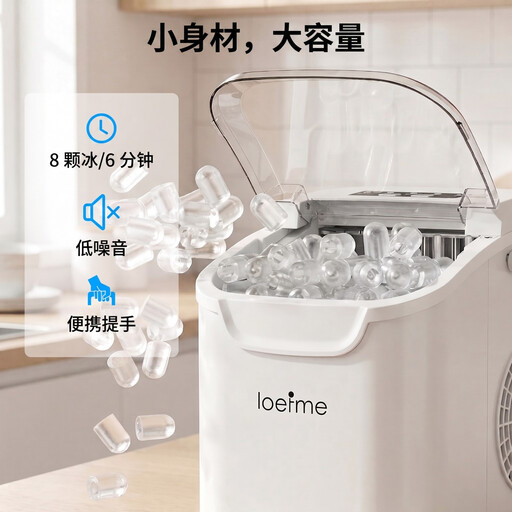
An option if you want to compare two ice cube sizes and automatic cleaning with the cycle time.
The title lists 9 ice cubes per 6–13 minutes, a 1,4-litre water reservoir, two sizes (S/L) and automatic cleaning. The version is described as black.
 No image available
An option to compare if you’re looking for two ice cube sizes and an automatic cleaning function.
The title lists 9 ice cubes per 6–13 minutes, a 0,8-litre water reservoir, two sizes (S/L) and automatic cleaning. The version is described as white.
 No image available
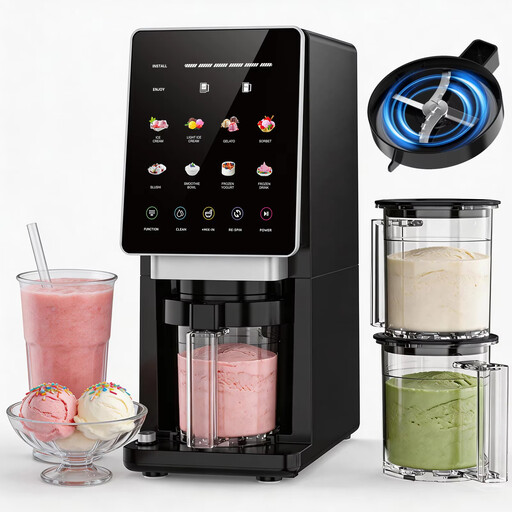
An option if you want to compare a worktop model with several preset programmes and extra features.
The title lists 8 programmes, a self-cleaning function, mixing and restarting. The model is also described as suitable for use on the worktop and on the go; check that this version is right for your intended use.
No. That’s the stated production over a full day, not the amount made in the first cycle. For your guests, compare the time and output per first cycle, and consider when you’ll need subsequent batches.
Don’t assume the basket works as a freezer. For the DO9200IB, DOMO recommends transferring a larger quantity of made ice from the basket to a freezer bag. Check your model’s manual and make sure you have freezer space if you want to build up a supply in advance.
Remove any leftover ice, empty the appliance and follow the cleaning instructions for the exact version. DOMO says the DO9220IB has a drainage opening; CASO lists a removable ice basket and self-cleaning function for the IceChef Compact. These features don’t replace the model-specific maintenance instructions.
In the Netherlands, the seller is responsible if a product is faulty despite being used normally. According to ACM ConsuWijzer, a free repair or replacement may be appropriate and, in some cases, you may be entitled to a refund. A manufacturer’s warranty doesn’t automatically limit your statutory rights.
For electrical appliances, the Dutch government’s Ondernemersplein explains manufacturers’ responsibility for applicable safety requirements and CE marking. Materials that come into contact with food are subject to Dutch and European food-contact material regulations, as explained by the Netherlands Food and Consumer Product Safety Authority. A listing in an online shop does not, by itself, prove that a specific item meets all the requirements.