
Vandaag of morgen in huis

Kwaliteit gegarandeerd

Welkomstaanbiedingen ontgrendelen: GRATIS bezorging | Tot 80% korting | Gratis 30 dagen JoyPlus-proefperiode
Download de app
If you're into competitive gaming, you know that every millisecond counts. A mouse that doesn't respond fast enough can be the difference between winning and losing. However, the gaming mouse market is saturated with marketing jargon and specs that often confuse more than they clarify. Before you invest in a new mouse, it's crucial to know what to look for and which common pitfalls to avoid.
Many gamers fall into the following traps:
A good lightweight gaming mouse offers a balance between weight, performance, and durability, without relying on exaggerated marketing claims.
To avoid making a bad purchase, it's helpful to understand a few key specifications. These determine how the mouse performs when it really counts.
For a fast FPS gaming mouse, low weight is essential. A lighter mouse allows you to react faster, correct your aim more smoothly, and reduces fatigue during long gaming sessions. A weight of around 50-60 grams is often considered ideal. Pay attention to the build quality. A solid, closed shell offers more durability and protection against debris than an open honeycomb design, without being significantly heavier.
The sensor is the heart of the mouse. A good sensor ensures accurate tracking without acceleration or stuttering. But an often-overlooked spec is the polling rate. This number, expressed in Hertz (Hz), indicates how often the mouse reports its position to the computer. The standard is 1000Hz (1000 times per second). An 8000Hz gaming mouse, like the HyperX Pulsefire Haste 2, reports its position 8000 times per second. This reduces latency from 1 millisecond to 0.125 milliseconds, resulting in noticeably smoother cursor movement.
With a wired gaming mouse, the cable is a crucial component. A stiff, heavy cable can create drag and impede your movements, partially negating the advantage of a lightweight mouse. Look for a mouse with a flexible, light cable, often referred to as a "paracord" or, in HyperX's case, a HyperFlex 2 cable. Combined with smooth 100% PTFE feet (also known as 'skates'), this ensures minimal friction, making the mouse feel almost wireless.
Based on the criteria above, we have selected a product that meets the needs of a specific group of users.
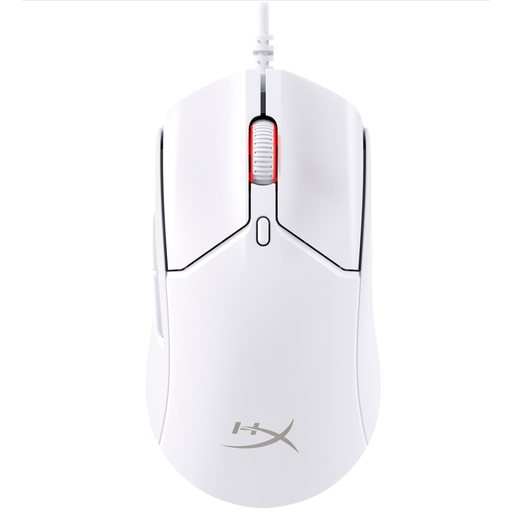
Why This Fits Their Persona: This mouse is designed for speed and precision. Its low weight and high polling rate are ideal for fast-paced FPS games where reaction time is crucial. The symmetrical shape makes it suitable for various grip styles, on both PC and consoles like the PS5.
The Pulsefire Haste 2 has a solid, closed shell weighing just 53 grams, thus avoiding the "honeycomb" trap. The focus is on the 8000Hz polling rate and the precise sensor, not just a high DPI number.
Extremely low latency: The 8000Hz polling rate provides a response time of 0.125 ms.
Lightweight and durable: A solid 53-gram shell with no holes, featuring switches that HyperX rates for a 100-million-click lifespan.
Anyone looking to buy a HyperX gaming mouse will find the Pulsefire Haste 2 to be a model focused on pure performance. The combination of low weight, a high polling rate, and a thoughtful design makes it a compelling option for serious gamers.
We have compiled a complete, up-to-date list of products that meet these selection criteria and applicable regulations.
Yes, the Pulsefire Haste 2 is compatible with PC/PS5, PS4, Xbox Series X|S, and Xbox One. You can plug it in and use it directly. However, keep in mind that advanced customisation options, such as setting macros and RGB lighting via the HyperX NGENUITY software, are only available on PC. It's also possible that consoles may not fully support the 8000Hz polling rate and will default to a lower standard.
A standard gaming mouse has a polling rate of 1000Hz, meaning it reports its position 1000 times per second (every 1ms). A mouse with an 8000Hz rate does this 8000 times per second (every 0.125ms). This results in smoother cursor rendering on your screen and faster registration of your movements and clicks. For most users, the difference is subtle, but in competitive scenarios, this reduced latency can provide a small but noticeable advantage.
The HyperFlex 2 cable is designed to minimise the drawbacks of a wired gaming mouse. The cable is made from a lightweight and highly flexible paracord material. The goal is to keep the cable's drag and weight as low as possible, so it doesn't pull or snag during fast mouse movements. Many users report that it feels almost like playing with a wireless mouse.
