
Learning a tune with limited space
You want to practise a hymn tune and first check whether an 88-key piano will fit in the space available, or whether a shorter keyboard will do. Model dimensions from Casio, Yamaha and Korg can help you compare.


If you mainly want to learn a hymn tune, a keyboard with fewer keys may be enough, provided the tune and any accompaniment fit within its range. If you also want to practise piano technique or pieces with a wider range, compare digital pianos with 88 weighted keys and measure whether the complete set-up will fit. For the model you’re considering, check the pedal and headphone connections and consult the product documentation.
You want to practise a hymn tune and first check whether an 88-key piano will fit in the space available, or whether a shorter keyboard will do. Model dimensions from Casio, Yamaha and Korg can help you compare.
As well as the tune, you want to practise touch, playing with both hands and a wider range of notes. The specifications from Yamaha, Casio and Korg give you a basis for comparing the keyboard and the space required for each model.
You sometimes want to listen through headphones instead of using the built-in speakers, so you check the connection on the exact model. Roland, Korg and Casio describe connections or features that you can check for each model.
Choose this option: if you want to practise piano technique or pieces with a wider range as well as the tune, and the complete set-up will fit.
Bear in mind: the keyboard and set-up may take up more space than a shorter keyboard.
Choose this option: if you mainly want to practise the hymn tune and its notes fit within the smaller range.
Bear in mind: its range and keyboard action are not the same as those of an 88-key weighted digital piano.
This guide is for shoppers who want to practise a hymn tune and need to weigh up the space available against the keyboard and the way they want to practise.
| What to consider | What to look for when buying | Who should prioritise this |
|---|---|---|
| Will it fit in the space? | Measure the available width and depth, and allow room for the music rest, stand and seating. Casio lists a depth of 232 mm for the CDP-S110BK; Yamaha lists 268 mm for the P-145BT without the music rest, while Korg lists 336 mm for the B2+, including protruding parts but excluding the music rest. | If space is limited, I want to know whether the complete set-up will fit, not just how deep the instrument is. Shoppers who put available space first account for around 36%. |
| Can I practise piano technique? | Compare the number of keys and the action on the exact model. Yamaha lists 88 GHC keys for the P-145BT and 61 FSB keys for the CK61; Korg lists 88 NH keys for the B2+. | If I want to move on to piano technique after learning the tune, a weighted keyboard matters more than a smaller range. Around 29% of shoppers prioritise this learning need. |
| Can I practise with headphones? | Check the connection and the plug required for the exact model. Korg lists a PHONES connection for the B2+; Roland says the FP-10 can be used with headphones and has built-in speakers. | In a shared space, I want to be able to listen without always using the built-in speakers. Around 21% of shoppers prioritise practising quietly. |
| Are the practice features enough? | Check whether the model includes a metronome and the pedal you want. Casio lists a metronome and an SP-3 damper pedal for the CDP-S110 family; Korg lists a damper pedal for the B2+. | If I mainly want to learn one tune, I’m looking for simple practice features and want to know what’s included. Around 14% of shoppers prioritise getting started practically. |
A shallow cabinet doesn’t tell you whether the width, music rest and playing space will fit together.
Measure the whole area where you’ll play and compare the dimensions of the exact model, including the parts you want to use.
The standalone Korg B2+ and the B2+SP bundle differ in what’s included; Yamaha lists a three-pedal unit as an optional extra.
Check the package contents and compatibility before assuming a pedal or stand is included.
A socket means you can use headphones, but it doesn’t mean they’re included.
Check the connection, the plug required and the package contents for the version you’ve chosen.
The CDP-S110BK is worth comparing if cabinet depth is important to you.
The P-145BT is a portable digital piano with 88 GHC keys; the CK61 is a shorter stage keyboard for a different learning goal.
The B2+ is a standalone digital piano with 88 NH keys; the B2+SP is the version supplied with a stand and three pedals.
The FP-10 is a portable digital piano with 88 keys to compare if you also want to practise with headphones.
These products are 61-key keyboards for anyone mainly looking to practise a hymn tune; check that the tune and any accompaniment fit within the keyboard’s range. The Dutch government states that electronic devices offered for sale in the EU must carry a CE mark. Check the product documentation for the exact model and the power supply included.
 No image available
Suitable for practising tunes when the piece fits within the range of 61 keys.
The product information lists a metronome, music stand and headphone socket.
 No image available
Could be a good fit if you’re looking for a keyboard with fewer keys and the tune falls within its range.
The product name lists a stand, stool, music stand, three-step learning mode, 300 tones, 300 rhythms, LCD screen and USB-MIDI.
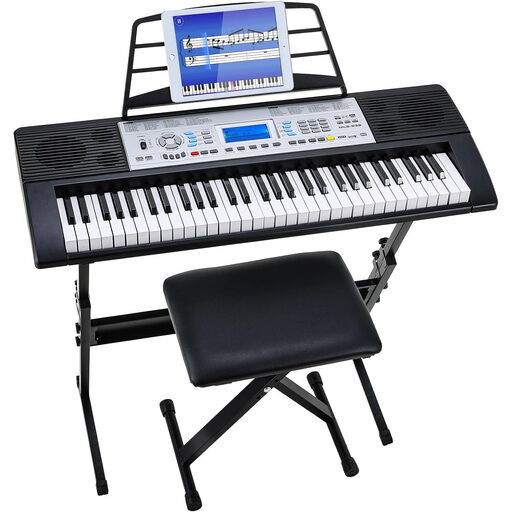 No image available
A shorter keyboard may suit practising a tune if the notes you need fit within 61 keys.
The product name lists a stand, stool, three-step learning mode, 500 tones, two speakers and an LCD screen.
Not necessarily, as long as the tune and any accompaniment fit within the range of a shorter keyboard. If you also want to practise piano technique on a weighted keyboard, compare 88-key digital pianos; the Yamaha CK61 has a different keyboard action.
Measure the available width and depth, and check whether there’s room for the music rest, stand and seating. Manufacturers’ measurements may exclude parts such as a music rest; Korg explicitly states that this is excluded for the B2+.
That depends on the connection on the version you choose and the plug required. Korg lists a PHONES connection for the B2+, while Roland says the FP-10 can be used with headphones; also check whether headphones are included.
First, check what your arrangement or lessons require. Casio lists an SP-3 damper pedal with the CDP-S110BK, and Korg lists a damper pedal with the B2+; the three-pedal unit for the Yamaha P-145BT is optional, while the Korg B2+SP is supplied with a stand and three pedals.
The Dutch government states that electronic devices offered for sale in the EU must carry a CE mark. Check the documentation for the version you’re actually buying, including the power supply; this general rule doesn’t confirm that a specific product meets all applicable requirements.