
Vandaag of morgen in huis

Kwaliteit gegarandeerd

Welkomstaanbiedingen ontgrendelen: GRATIS bezorging | Tot 80% korting | Gratis 30 dagen JoyPlus-proefperiode
Download de app
A hydraulic car jack is useful for changing a tyre, carrying out maintenance in the garage or dealing with an emergency at the roadside. But a high load capacity alone doesn’t guarantee that a jack is suitable for your car. The minimum and maximum lifting heights, the surface you use it on and how you support the vehicle are just as important.
Many buyers focus mainly on the large number on the packaging. This can lead to three common mistakes:
Before you buy, check your car’s specifications. If you’ll be working underneath the vehicle, use suitable jack stands.
A 3-tonne jack is suitable for many cars, SUVs and MPVs, depending on the vehicle’s actual weight and lifting points. A 6-tonne jack or 10-tonne jack may be more suitable for a pick-up, light lorry or commercial vehicle.
Bear in mind that a jack usually doesn’t lift the vehicle’s entire weight at once. Even so, its capacity must be well above the load at the lifting point in question. Check your car’s handbook and the maximum permissible weight. Never use a jack above its stated capacity.
The minimum clearance height determines whether you can get the jack under your car. A low-profile jack with a minimum height of around 85 to 90 mm is suitable for some sports cars and lowered vehicles. A standard garage jack may be too high.
The maximum lifting height must then be sufficient to:
A hydraulic car jack with a range of 150–530 mm offers different possibilities from a model with a range of 85–380 mm. Always compare these measurements with your vehicle’s lifting points.
A steel trolley jack is generally designed for stability and regular use in a garage. An aluminium car jack may be easier to move around. A bottle jack has a compact vertical design and is often practical for vehicles with high ground clearance, but it needs a firm, level surface.
Product information may include markings such as CE and EN 1494. These are important details to check, but also make sure that documentation, capacity information and instructions are available for the specific model. According to the product descriptions for the TCE models mentioned, certain versions are CE- and/or EN 1494-certified. Check the supplied information before use.
Only use a hydraulic jack on a hard, level surface. Put the car in Park or first gear, apply the handbrake and place wheel chocks on the opposite side.
A safe approach:
A hydraulic car jack for changing tyres isn’t necessarily suitable for extended maintenance work. Use jack stands for their intended purpose, and never put any part of your body underneath a vehicle supported only by a jack.
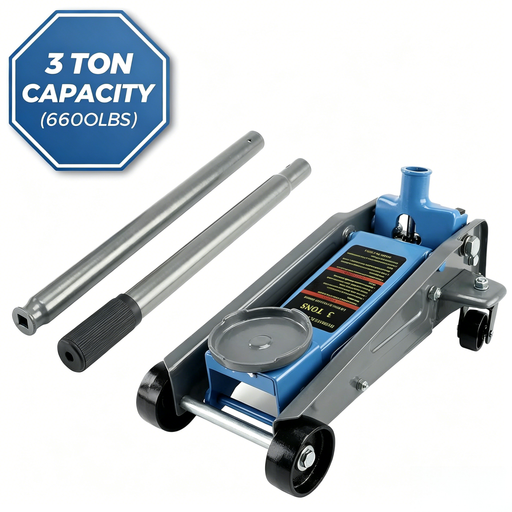
Why it suits this type of user: This 3-tonne trolley jack is designed for use in a home garage and has a lifting range of 135 to 460 mm, making it suitable for many cars and SUVs. Its wheels help you position it on a level floor.
The specifications give both the load capacity and the full lifting range. This lets you check in advance whether 135 mm is low enough for your car.
Stated capacity of 3 tonnes, steel construction, two large wheels and two 360° swivel castors.
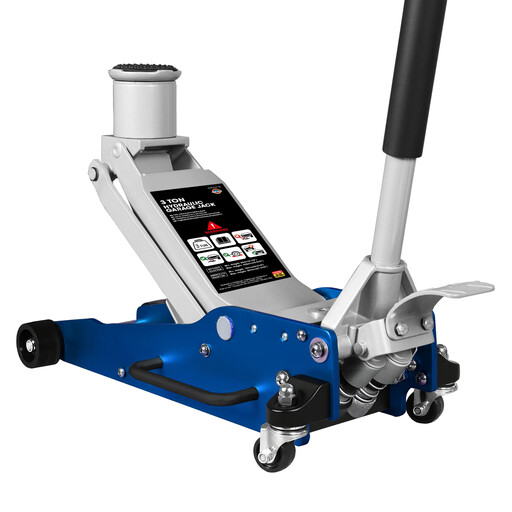
Why it suits this type of user: This model combines a low clearance height with an aluminium alloy body and a double-pump system. It’s a good fit for drivers of sports cars, SUVs, MPVs or vans who want to move their jack around more often.
The 85 mm minimum height reduces the risk of the jack not fitting under a low vehicle. The product description also mentions EN 1494 and CE certification; check the supporting documentation.
Stated capacity of 3 tonnes, lifting range of 85–465 mm, aluminium housing and height extension up to 541 mm.
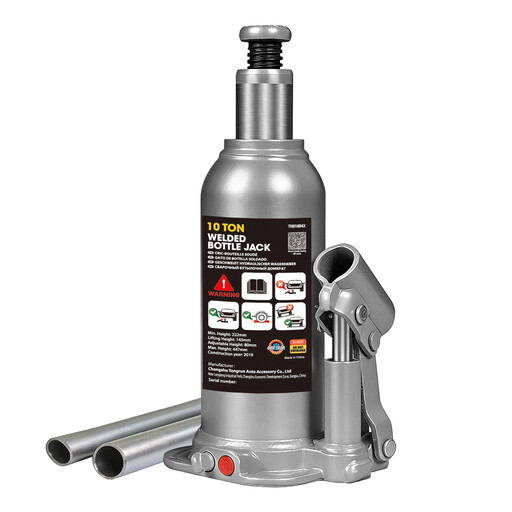
Why it suits this type of user: This bottle jack is designed for heavy vehicles such as lorries, buses and construction vehicles. It’s suitable for a workshop that needs a vertical jack for heavier loads.
The 10-tonne capacity and vertical design clearly distinguish this model from compact car jacks. Still, check that the base and lifting height are suitable for your vehicle.
Stated capacity of 10 tonnes, adjustable screw for height adjustment, forged steel base and safety overload valve, according to the product description.
We’ve put together a complete, up-to-date list of products that meet these strict selection criteria and current European safety requirements.
First, check the vehicle’s weight, lifting points and ground clearance. A 3-tonne trolley jack may suit many SUVs, but a high-riding SUV may need a bottle jack with a greater vertical lifting range. Don’t rely solely on “suitable for SUVs” in the title; compare the exact minimum and maximum lifting heights.
Its lifespan depends on the load, storage, maintenance and whether it’s used on a level surface. Keep the cylinder clean, prevent rust and never use the jack above its stated capacity. Have the hydraulic fluid and seals checked if the jack lowers slowly or doesn’t lift properly. A leaking jack must no longer be used for lifting.
A pneumatic air jack can lift a vehicle quickly when you have a suitable compressor and a stable surface. According to the product description, the LARBANKE 5-Tonne Triple-Bag Pneumatic Air Jack has a lifting range of approximately 150 to 400 mm and pneumatic operation. Before buying, check the required air pressure, connections, vehicle compatibility and instructions. You’ll also need jack stands when carrying out work on the vehicle.
