
Vandaag of morgen in huis

Kwaliteit gegarandeerd

Welkomstaanbiedingen ontgrendelen: GRATIS bezorging | Tot 80% korting | Gratis 30 dagen JoyPlus-proefperiode
Download de app
A hydraulic car jack is useful for changing a tyre, carrying out car maintenance or making an emergency repair. Yet many motorists buy a model that is not suitable for their vehicle. A jack that is too low will not fit under an SUV, while a bottle jack that is too tall will not fit under a lowered car. The maximum lifting capacity is also often confused with the weight that can safely rest on a single support point.
As Joybuy Product Recommendation Officer, I filter the most important product specifications and potential purchasing pitfalls. This helps you compare more effectively without relying solely on marketing copy.
A 3-ton car jack may seem suitable for many vehicles, but lifting capacity is only one factor. Also check:
A jack for an SUV or van often needs a greater range than a model for a compact car. Never lift a vehicle on a slope or on a soft surface. Always use suitable axle stands after lifting.
A low-profile jack with a minimum height of, for example, 85 to 90 mm is practical for sports cars and lowered vehicles. That does not automatically mean the jack will lift high enough for a van. Always check both values: the minimum and maximum lifting height.
A long extension arm or height adjuster can be useful, but check whether it is included as standard. On some models, the handle components shown may vary between production batches.
A hydraulic car jack is designed for lifting, not for supporting a vehicle while you work underneath it for an extended period. Hydraulic pressure can decrease over time. Therefore, place the vehicle on axle stands with a suitable lifting capacity before carrying out maintenance. Never allow anyone to work beneath a car supported only by a jack.
Do not choose a model that can only just handle the vehicle’s weight. The load on the jack is not always evenly distributed during lifting, and you usually do not lift the entire car. A 3-ton garage jack may be suitable for many cars, SUVs and MPVs, provided the jacking points and height are compatible.
For heavy commercial vehicles, a heavy-duty jack or bottle jack with a higher rated capacity is the more logical choice. However, a 6-ton or 10-ton model is larger and less suitable for an ordinary boot.
A horizontal hydraulic jack, also known as a trolley jack, rolls underneath the vehicle and is practical on a level garage floor. A bottle jack operates vertically and takes up relatively little space, but it needs to be positioned securely and directly beneath the jacking point.
Pay attention to these ranges:
Steel generally provides a robust construction, but it also makes a garage jack heavier. An aluminium car jack is easier to transport and may be a good option for home use, a track day or roadside breakdowns. With a lightweight model, check the stated lifting capacity and the dimensions of the base.
For products in this selection, EN 1494 is listed for certain hydraulic jacks and axle stands. Some models also mention CE certification. Treat this as a product specification provided by the seller; when purchasing, check the current product page, technical documentation and supplied safety instructions. According to TCE’s product description, the models mentioned are fitted with safety valves or overload protection. This is a brand or product claim and does not replace correct use.
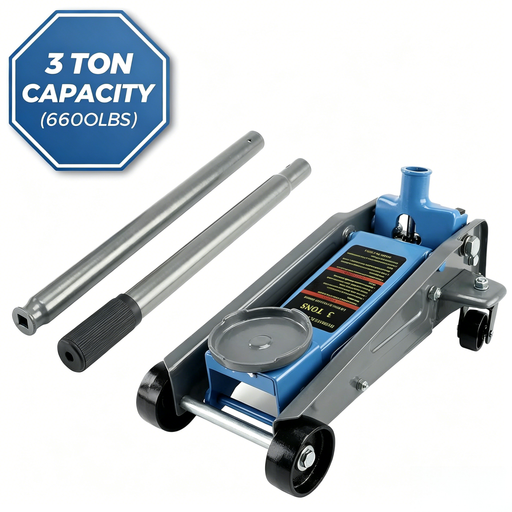
Why it suits this profile: This hydraulic garage jack offers a 3-ton lifting capacity and a lifting range of 135 to 460 mm. This makes it suitable for many cars and various SUVs in a home garage.
The stated range includes both the low and high positions. However, check the available clearance on your vehicle beforehand.
Steel construction, two large wheels and two 360° swivel castors; lifting height of 135–460 mm.
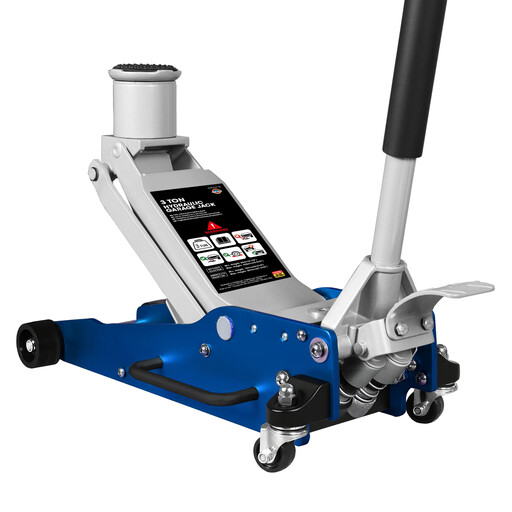
Why it suits this profile: The aluminium design combines a low entry height of 85 mm with a 3-ton lifting capacity. According to the product description, the height adjuster extends the range up to 541 mm.
The specifications state the standard height and the range with the height adjuster separately. This makes its practical use clearer.
Aluminium housing, dual pump, 85–465 mm lifting height and EN 1494 and CE mentioned by the seller.
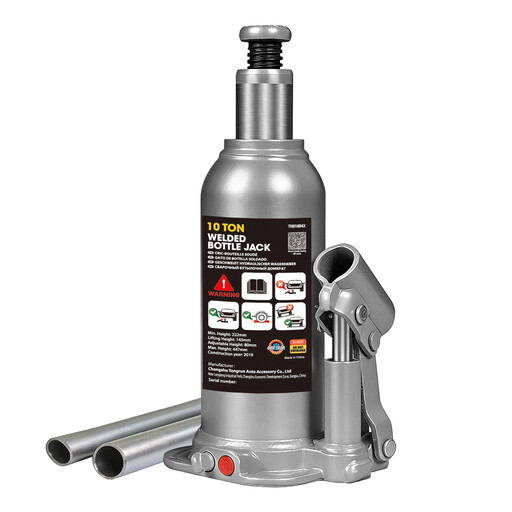
Why it suits this profile: For workshops, breakdown services and vehicles such as buses, heavy trucks and construction machinery, a vertical bottle jack with a 10-ton lifting capacity is a targeted choice.
The model is not presented as a universal jack: its vertical design and 222–448 mm height require a suitable jacking point and a level surface.
Forged steel base, chrome-plated piston rod, adjustable overload protection and a stated 10-ton lifting capacity.
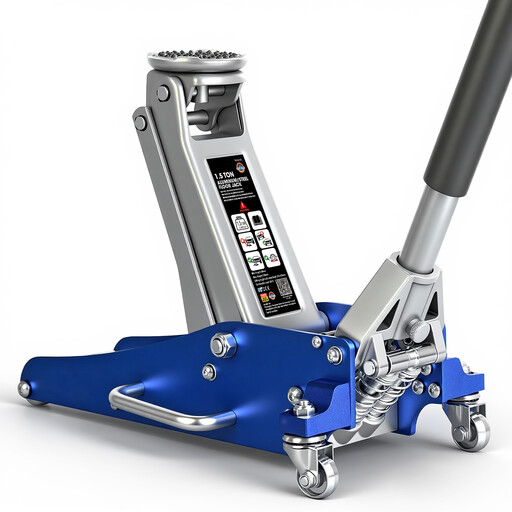
Why it suits this profile: With a stated weight of approximately 14.3 kg, an entry height of 90 mm and a range up to 358 mm, this aluminium car jack is aimed at home use, track days and emergency tyre changes.
The lower lifting capacity makes it clear that this model is not intended for heavy SUVs, vans or commercial vehicles.
Approximately 14.3 kg, dual pump, 90–358 mm lifting height and EN 1494 and CE mentioned by the seller.
We have compiled a complete, up-to-date list of products that fully meet these strict selection criteria and the applicable European safety regulations.
A scissor jack is compact and is often supplied as standard with a car. For occasional tyre changes, this may be sufficient, but pumping is usually slower and stability depends heavily on the surface and jacking point. A hydraulic car jack is often more practical in a garage or workshop.
A pneumatic jack uses compressed air and, according to LARBANKE’s product description, can lift a vehicle in a matter of seconds. This is particularly useful for garages and breakdown services with a suitable compressor. Without a compressed-air system, a hydraulic model is easier to use. With a pneumatic jack, also check the hose, connections, maximum lifting height and surface.
Its exact service life cannot be determined in advance. Frequency of use, maximum load, storage and maintenance all have an impact. A jack that leaks oil or lowers under load must not be used again until it has been inspected or replaced.
First check the vehicle’s weight, the original jacking point and the minimum ground clearance. A model with a range starting at around 135 mm may be suitable for certain SUVs, while higher vehicles may benefit from a bottle jack. Always check the maximum lifting height and use axle stands.
A CE reference on a product page is a relevant product specification, but also check the accompanying documentation and safety instructions. Several TCE models mention EN 1494 alongside CE. Only use the jack within its stated capacity and intended application.
A manually operated hydraulic jack does not use electricity or compressed air. Running costs therefore generally remain limited to maintenance, any hydraulic oil and replacement wear parts. A pneumatic jack can work faster, but it requires a compressor and a suitable compressed-air supply.
