
Vandaag of morgen in huis

Kwaliteit gegarandeerd

Welkomstaanbiedingen ontgrendelen: GRATIS bezorging | Tot 80% korting | Gratis 30 dagen JoyPlus-proefperiode
Download de app
Dry skin does not automatically call for a heavy cream. When buying hydrating skincare, people often focus only on words such as “intensive”, “72 hours” or “natural”. This can result in a product that does not feel comfortable, does not suit their skin type or ends up unused in the bathroom.
The right choice starts with three questions: what will you use the product for, how does your skin feel and which ingredients suit your preferences? With these basics in mind, you can compare a body lotion, face cream or moisturiser much more effectively.
A claim such as 48, 72 or 100 hours of hydration does not mean that you will not need to apply the product for several days. The stated duration usually comes from a specific test carried out under particular conditions. According to NIVEA’s own information, the 72-hour claim for the Express Body Lotion is based on an instrumental test involving 42 volunteers. For the Repair & Care Body Lotion, the brand refers to a test involving 44 participants after a single application.
Therefore, use texture, your skin’s needs and how often you intend to apply the product as your main selection criteria. Showering, washing, cold weather and dry air can make your skin feel dry again.
A product described as suitable for all skin types may feel comfortable for one person but too rich or too light for another. Oily or combination skin often benefits more from a gel texture, an oil-free formula or a fast-absorbing lotion. Dry or very dry skin may feel more comfortable with glycerine, shea butter, petroleum-derived ingredients or a richer cream.
Fragrance is not necessarily a problem, but a fragranced formula is not always practical for sensitive skin. Check the ingredients list for parfum and common fragrance allergens such as linalool, limonene, citronellol or benzyl alcohol. If you are looking for a fragrance-free moisturiser, it is better to choose a product that states this explicitly in its specifications.
A body lotion is designed for larger areas of skin and is often sold in 250 to 400 ml packaging. A face cream or moisturiser generally has a finer texture and is formulated for the face and neck. Do not automatically use body lotion on your face; fragrance, alcohol or a richer base may feel less comfortable there.
Pay attention to the packaging too. A pump bottle is convenient for everyday use on the body. A 30 to 75 ml tube or pot is more practical for a face cream that you apply in the morning and evening.
A fast-absorbing lotion or gel is ideal if you want to get dressed or apply make-up immediately after use. A non-greasy formula can be pleasant for oily or combination skin. A rich lotion containing shea butter, mineral oils or petroleum-derived ingredients may be better suited to dry skin, but it may take longer to absorb fully.
The words “gel”, “gel-cream” and “lotion” provide an initial indication, but the ingredients list and product description remain decisive.
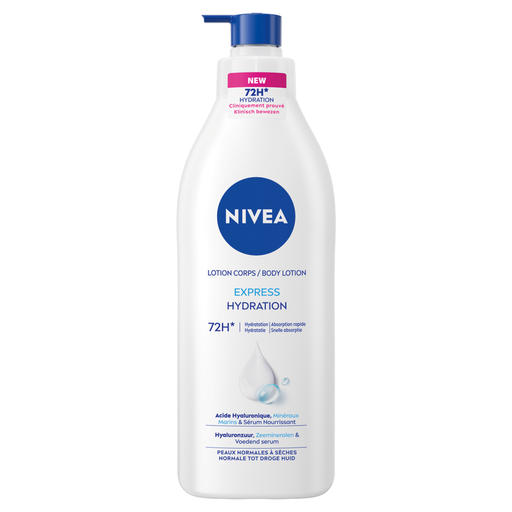
Why it suits this profile: A body lotion for daily use on normal to dry skin, with a practical pump and 400 ml capacity.
The product information describes an ultra-light, non-greasy formula that absorbs quickly. The 72-hour claim is linked to a stated instrumental test, rather than being a general guarantee.
400 ml, pump bottle, glycerine and sodium hyaluronate. Please note: the ingredients list includes fragrance and fragrance allergens.

Why it suits this profile: A compact face cream with a gel-cream texture for anyone seeking a lightweight, fragrance-free moisturiser.
The specifications describe an oil-free, alcohol-free and fragrance-free formula. The 100-hour hydration claim remains a brand claim and should be treated as an indication.
According to the product information, suitable for dry, very dry, combination and oily skin; contains glycerine and sodium hyaluronate, among other ingredients.
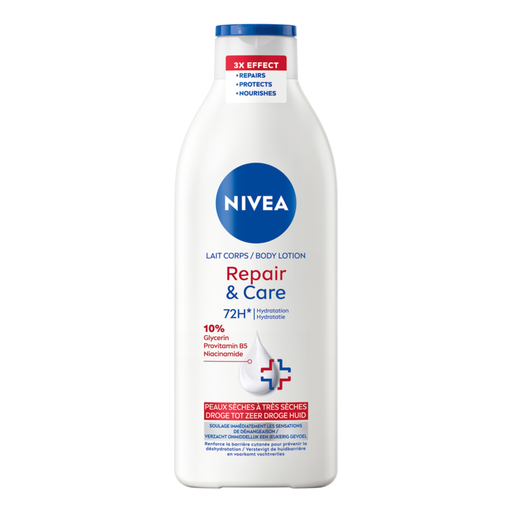
Why it suits this profile: Designed for dry to very dry skin and suitable for daily use all over the body.
The product description specifies a 10% glycerine complex, niacinamide and provitamin B5. According to NIVEA’s own research, the 72-hour claim is based on a test involving 44 participants.
Non-greasy, fast-absorbing texture; 400 ml packaging; designed for dry and very dry skin. However, the formula does contain fragrance.
We have put together a complete, up-to-date list of products that fully meet these strict selection criteria and the applicable European safety regulations.
Apply body lotion to clean skin, preferably after showering while your skin is not yet completely dry. Massage it in gently and, with a richer formula, wait until it has absorbed before getting dressed. For your face, a small amount is usually sufficient on cleansed skin. Follow the instructions on the packaging.
Stop using the product if you experience irritation, redness or a burning sensation. If you have sensitive skin, you may wish to test a small amount on a limited area first. Cosmetics are intended for external use and are not a substitute for medical advice.
Look for glycerine, hyaluronic acid, shea butter or other moisturising and soothing ingredients. A lotion or cream with a richer texture may feel more comfortable than a watery gel. For very dry skin, a product clearly described as offering intensive care is a more logical choice than a lightweight moisturiser designed for oily skin.
Fragrance-free products can be a practical choice if you want to avoid fragrances. However, this does not guarantee that a product will suit everyone. Check the full ingredients list, follow the instructions and stop using the product if irritation occurs.
Check the expiry date or the open-jar symbol on the packaging, such as 12M or 24M. Keep the packaging tightly closed, at room temperature and away from direct sunlight. A change in smell, colour or texture is a reason to stop using the product.
