For a hummus workshop, your choice mainly depends on the portion size for each batch, the workspace available and how many parts you want to clean between batches. A compact food processor suits smaller workspaces; a model with a larger bowl may be better for preparing food as a group, but the stated bowl capacity doesn’t tell you how much hummus you can actually make at a time. For a small batch, a hand blender you already own may also be enough.
Who is this choice relevant to?
Workshop leader for a group
You’re making several batches and want to decide whether one larger bowl or multiple rounds of preparation would work better. The stated bowl capacity and the blade supplied are more relevant here than wattage alone. Bosch and KitchenAid provide bowl and blade specifications for specific models.
Leader of small cooking groups
You want participants at separate workstations to blend small batches, so you’re considering the space available and the usable capacity of a compact bowl. Kenwood lists a 1.3 l bowl for the MultiPro Go FDP23.140GY, with separate stated capacities for dry ingredients and liquids.
Workshop leader using different recipes
You’re making different dishes or batches one after another and want to clean the blades, bowls and lids between uses. Check which parts are dishwasher-safe for the exact model, according to the manufacturer.
What should you look for when choosing?
Compact food processor
A good fit when: small groups are making modest quantities at separate workstations and storage space matters.
Bear in mind: the stated bowl capacity isn’t necessarily the amount of hummus you can make in one batch.
Food processor with a larger bowl
A good fit when: you want to blend larger batches for more participants and have enough workspace and storage.
Bear in mind: a larger stated bowl capacity doesn’t guarantee a particular hummus yield; measure the space for the appliance too.
A hand blender you already own
A good fit when: you’re making a small amount and don’t need another appliance.
Bear in mind: choose a mixing jug and method to suit your portion; the Netherlands Nutrition Centre recommends both a food processor and a hand blender for hummus.
| What to consider |
What to look for when buying |
Who is this important for? |
| Quantity per batch |
Plan your recipe and the number of batches; compare the stated usable capacity and dimensions of the exact model. |
If I’m preparing food for several participants at once, I want to know how much the instructions say I can make in one batch. Around 31% of consumers prioritise batch size. |
| Blending and texture |
Check whether the model has a chopping or multi-purpose blade and what controls are available. |
If I want to blend the ingredients and adjust the texture, I focus mainly on the blade and controls. Around 31% of consumers say this is their main consideration. |
| Cleaning between batches |
Check the cleaning instructions for the bowl, blade, lid and accessories of the exact model. |
When making different dishes one after another, I want to be able to clean the parts thoroughly between batches. Around 23% of consumers prioritise cleaning. |
| Workspace and storage |
Measure the space for the complete appliance and check how the accessories are stored. |
If my workshop table or storage space is limited, I want to know in advance whether the appliance will fit. Around 15% of consumers put available space first. |
Pitfalls to avoid
-
Assuming the stated bowl capacity equals the amount of hummus per batch
A 1.3 l bowl doesn’t mean you can blend that volume of ingredients at once. For the Kenwood MultiPro Go FDP23.140GY, the manufacturer separately states a capacity of 0.75 l for dry ingredients and 0.75 l for liquids.
Plan your batches according to the instructions for the exact model, and look beyond the largest capacity figure.
A smaller usable capacity may mean you need to make more batches.
-
Confusing a food mixer for baking with a food processor that has a chopping blade
The Dutch Consumers’ Association distinguishes between food mixers designed for baking and food processors for tasks such as chopping and mixing. The Netherlands Nutrition Centre recommends blending for hummus.
Check the parts supplied and the stated blending function before relying on the appliance’s name.
-
Assuming every part is dishwasher-safe
Manufacturers may provide cleaning instructions for each part or state that parts are generally dishwasher-safe.
Check the instructions for the bowl, blade, lid and every accessory included with the model you’re considering.
Parts that need to be washed by hand mean extra cleaning between batches.
Brands to compare
Bosch
The MultiTalent 3 MCM3501M is a food processor with a 2.3 l bowl, a universal blade and a pulse function.
- Bosch says the accessories can be stored in the bowl.
- The stated bowl capacity isn’t a confirmed hummus capacity. Bosch says accessories are generally dishwasher-safe; check the instructions for each part.
Kenwood
Kenwood describes the MultiPro Go FDP23.140GY as a compact food processor with a chopping blade, pulse setting and 1.3 l bowl.
- For this model, Kenwood lists a capacity of 0.75 l for dry ingredients and 0.75 l for liquids.
- The unlimited-capacity claim for Express Serve applies to grating and slicing directly into a dish, not to blending hummus.
Magimix
According to Magimix, the Mini Plus has 1.7 l and 0.5 l bowls and a steel blade.
- Magimix says the accessories are dishwasher-safe and offers a 30-year manufacturer’s guarantee on the induction motor.
- Separate guarantee terms apply to accessories. The stated bowl capacity doesn’t indicate the measured yield or texture of hummus.
KitchenAid
The 5KFP0719EAC and 5KFP1319EER models have different stated bowl capacities: 1.7 l and 3.1 l respectively.
- KitchenAid lists a multi-purpose blade and pulse setting for both models.
- A larger stated bowl capacity doesn’t show that a model blends hummus more effectively. Compare the parts supplied with the exact version.
Joybuy products for making hummus
These product picks are intended for blending and preparing small or larger batches during a workshop; check the capacity, controls and cleaning instructions for each version.
 Image unavailable
ochama Food Processor 750W, 1.8L
An option to compare if you want to blend ingredients and clean the separate parts between workshop batches.
The product information lists blending and a 1.8 l bowl.
The removable parts are described as dishwasher-safe.
View at Joybuy
 Image unavailable
Bear Electric Food Chopper QSJ-D03Q1
The two stated bowl sizes offer different capacities to compare for smaller and larger preparations.
The product information lists 2 l and 0.6 l bowls, two blade sets and blending.
The bowls are described as dishwasher-safe.
View at Joybuy
 Image unavailable
Bear Chopper QSJ-D03W5, 2L, 300W
The product information lists dips and purées among its uses, with short-pulse controls for preparing food in batches.
The stated bowl capacity is 2 l; the model has two speeds and 304 stainless steel blades.
The instructions recommend short pulses and a maximum of 30 seconds of continuous use at a time.
View at Joybuy
 Image unavailable
Kenwood FDP23.380GR GO Blend Food Processor
A compact food processor to compare if you want to blend ingredients at a workstation with limited space.
The product information lists a 1.3 l bowl, seven speeds and a separate 600 ml blender cup.
View at Joybuy
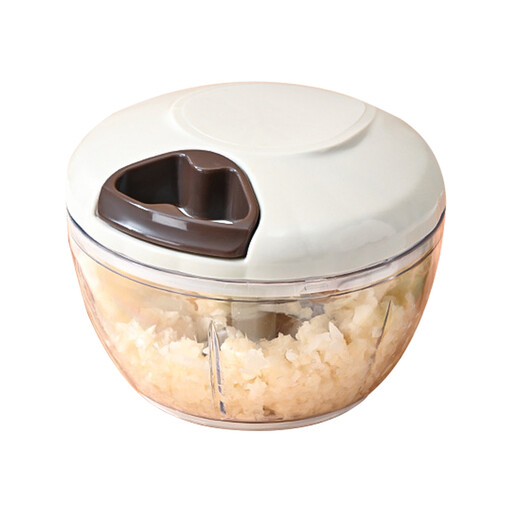 Image unavailable
Huacan Pull String Food Chopper, 500ml
The manual design may suit small preparations; its limited capacity means making small batches at a time.
The product title lists a capacity of 500 ml and stainless steel blades.
The parts must be washed by hand.
View at Joybuy
Frequently asked questions
Do you need a food processor to make hummus?
No. For its hummus recipe, the Netherlands Nutrition Centre recommends both a food processor and a hand blender. Only choose an additional appliance if your portion sizes, number of batches or other workshop recipes call for one.
How should you make and store hummus after the workshop?
The Netherlands Nutrition Centre advises keeping homemade plain hummus in the fridge for 1–3 days and using a clean knife. It recommends a fridge temperature of 4 °C and says leftovers should be covered and refrigerated within two hours of preparation.
What allergen information must you provide at a workshop?
If you’re a provider offering unpackaged hummus to consumers, the Netherlands Food and Consumer Product Safety Authority describes a requirement to provide information about allergens present, along with rules for giving that information in writing or verbally. Whether those rules apply to a particular workshop depends on how it’s organised; don’t assume it has a particular legal status just because it’s called a workshop. Also check the ingredients, including the tahini used.
What should you check about guarantees or replacement parts?
For a consumer purchase, the seller is responsible, according to ACM ConsuWijzer, for ensuring that a product does what you can reasonably expect under normal use; a manufacturer’s guarantee doesn’t replace your statutory rights. Also compare the terms and availability of parts for the exact model.


