
Vandaag of morgen in huis

Kwaliteit gegarandeerd

Welkomstaanbiedingen ontgrendelen: GRATIS bezorging | Tot 80% korting | Gratis 30 dagen JoyPlus-proefperiode
Download de app
A food processor can chop vegetables, blend sauces, grate cheese, and prepare dough or batter. However, not every appliance is suitable for the same tasks. A compact electric chopper is useful for herbs and small portions, while a multifunctional food processor offers more accessories and a larger bowl.
That is why choosing the right model does not start with the highest wattage or the longest list of features. First consider how you will use it, the bowl capacity and how easy the appliance is to clean.
Higher power sounds appealing, but it does not tell you everything about the results. The shape of the bowl, the blade, the quantity of ingredients and the recommended operating time also play a part. For example, an 800 W food processor may be suitable for chopping, slicing and grating, while a smaller chopper with the same power may primarily be intended for short preparations.
So check whether the stated wattage, speeds and functions are suitable for your ingredients. For nuts, hard vegetables or meat, a suitable blade design is more important than motor power alone.
A 2-litre bowl does not always mean that you can process 2 litres of food at once. Different maximum quantities often apply to dry ingredients, liquids and moving blades. An overfilled bowl can result in uneven chopping, spillage or additional strain on the motor.
A mini food processor with a capacity of 500 to 900 ml is suitable for small portions, herbs, dips and dressings. For a family or meal prep, a food processor with bowl of around 1.8 to 2.3 litres is more practical.
An appliance with a blender, meat grinder, citrus press, grating and slicing discs may seem versatile. In practice, accessories take up space and need to be washed after use. Decide in advance whether you mainly want to chop vegetables, mince meat, make smoothies or carry out several tasks with one base unit.
Also check which parts are included rather than relying solely on terms such as “multifunctional”. According to a brand’s product description, “many functions” does not automatically mean that every function has the same capacity or speed.
For everyday chopping and blending, it is not only the rated power that matters. A pulse function delivers short bursts, giving you greater control over the texture of onions, herbs, nuts or vegetables. Two speeds are often enough for basic use; multiple settings are mainly useful when you want to prepare different textures.
A food processor with 650 to 800 W and a pulse function may be suitable for a range of household tasks. Always check the manual for maximum quantities and operating times.
Measure the available space on your worktop and in a kitchen cupboard. A compact food processor should not only fit when in use, but also be practical to store. Look for:
A glass bowl is generally resistant to odours and stains, but may be heavier than plastic. Stainless steel blades are sharp and suitable for chopping, but should be handled carefully during cleaning.
Removable parts make a food processor easier to maintain. Some product descriptions state that parts are dishwasher-safe; check the manual to see exactly which parts this applies to. The motor base should never be immersed in water.
Also look for a lid lock, non-slip ring and clear safety instructions. Unplug the appliance before removing blades or discs. When processing raw meat, baby food or sauces, clean the appliance immediately to prevent food residue from collecting in seams or around the blade shaft.
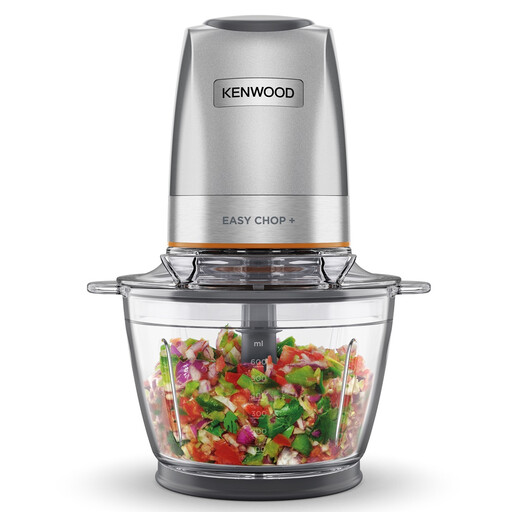
Why it suits this profile: The 600 ml capacity is ideal for small households, sauces, herbs and everyday portions.
The glass bowl keeps the contents visible, while the non-slip ring helps keep the appliance stable. Two speeds keep things straightforward.
600 ml glass bowl, two speeds, QuadBlade blade system and, according to the product description, suitable for crushing ice.

Why it suits this profile: The spacious bowl and multiple functions suit families, meal prep and keen home cooks who want one appliance for different preparations.
The specifications clearly state 800 W, 2.3 litres, two speeds and pulse. This makes the choice less dependent on vague marketing terms.
Suitable for chopping, mixing, slicing and grating; compact dimensions of 397 x 263 x 369 mm according to the product information.
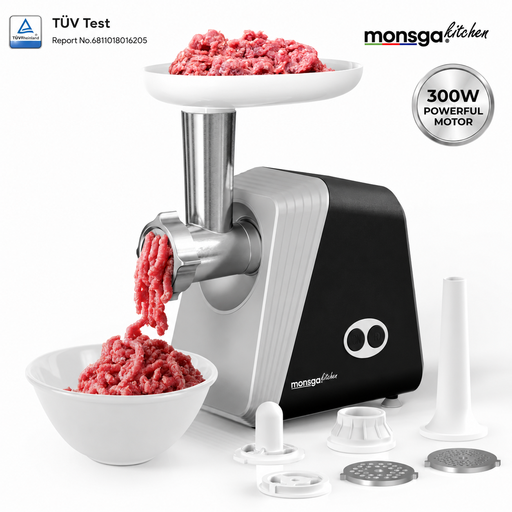
Why it suits this profile: This model focuses specifically on mincing meat and preparing foods such as sausages, kibbeh and biscuits, rather than general food processor tasks.
The three mincing discs let you choose the desired texture. Hand-washing the removable parts means you do not have to assume an unspecified dishwasher function.
300 W power, up to 1200 W maximum according to the product description, plus three cutting discs and accessories for sausages and kibbeh.
We have put together a complete, up-to-date list of products that fully meet these strict selection criteria and the applicable European safety regulations.
An electric chopper is particularly effective for small quantities of onion, herbs, nuts or meat. A food processor generally offers more options, such as grating, slicing and mixing. A blender is a more logical choice for smoothies, liquid sauces and purées. A multifunctional model combines several functions, but often requires more storage space and cleaning.
A small bowl is useful for baby food or purée, but check the instructions regarding temperature and ingredients. For raw meat, a meat grinder with suitable accessories is better suited than a standard blender.
Its lifespan depends on use, maintenance, workload and storage. Allow the motor to cool down as instructed in the manual, do not fill the bowl beyond the stated limit and do not use hard objects that are not intended for the appliance. Replace or use blades and accessories only in accordance with the manufacturer’s instructions.
Power consumption depends on the wattage and the duration of each preparation. An 800 W appliance theoretically uses 0.8 kWh when running continuously for one hour, but a food processor usually operates only in short intervals. The actual cost therefore depends on how long you use it and your energy tariff.
Not automatically. Check the manual before processing hot soup or other warm liquids. Some product instructions warn against boiling liquids because of steam pressure and splashing. If necessary, allow ingredients to cool first and always use the specified quantity.
