
Vandaag of morgen in huis

Kwaliteit gegarandeerd

Welkomstaanbiedingen ontgrendelen: GRATIS bezorging | Tot 80% korting | Gratis 30 dagen JoyPlus-proefperiode
Download de app
Buying coloured pens seems simple, until you have to choose between fineliners, fibre-tip pens, brush pens, gel pens and colouring pens. A large pen set is not automatically suitable for your needs. Children require different features from someone creating hand lettering, journalling or detailed sketches.
When choosing, pay particular attention to the line width, type of ink, washability and age recommendation. This helps prevent a pen from drying out quickly, bleeding through the paper or proving unsuitable for its intended use.
A set with 50 colours offers plenty of variety, but may be unnecessary if you mainly make notes. For school, planning and everyday writing, a compact set of fineliners is often more practical. For large colouring pages or creative projects, a broader selection can be useful.
So do not just look at the number of pens. Also consider:
A 0.4 or 0.5 mm fineliner is designed for thin, precise lines. This type of tip works well for writing, hatching, doodles and details, but is less suitable for quickly colouring large areas.
For colouring, fibre-tip pens with a tip of approximately 1 to 3 mm are a more logical choice. Brush pens offer greater versatility: by changing the pressure and angle, you can create thicker and thinner lines, according to the product description.
Washable pens are handy for children, but washable does not mean that every stain will disappear completely from every material. According to the product information from various brands, stains are best treated with water as quickly as possible. For clothing, also check the washing instructions and, if in doubt, test the product on an inconspicuous area first.
An EN 71 reference or CE marking may provide relevant product information, but it does not replace supervision of young children. Also look out for warnings about small parts and the recommended minimum age.
The tip determines how much control you have:
A sturdy or pressure-resistant tip is important when children apply a little more pressure. A soft brush tip offers greater variation in line width, but requires more careful handling.
Water-based ink is common in fineliners and many fibre-tip pens. This ink is often low-odour and suitable for paper. The product information for STABILO point 88, for example, mentions water-based ink and a metal casing around the 0.4 mm tip.
Alcohol markers dry quickly and, according to the product description for Faber-Castell Goldfaber, are water-resistant and permanent once the ink has dried. This makes them suitable for sketching, but they can bleed through thin paper. It is therefore best to use marker paper or place a protective sheet underneath your work.
Gel pens and coloured pens are particularly suitable for writing and decorative details. A retractable mechanism prevents the tip from being exposed inside a bag, while a capless brush pen or fibre-tip pen requires extra care to ensure it is properly closed.
Many pens dry out because caps get lost or are not closed properly. Store sets in the supplied box and replace each cap immediately after use. Depending on the product, the product information may recommend storing pens horizontally or upright.
Before buying, also check:
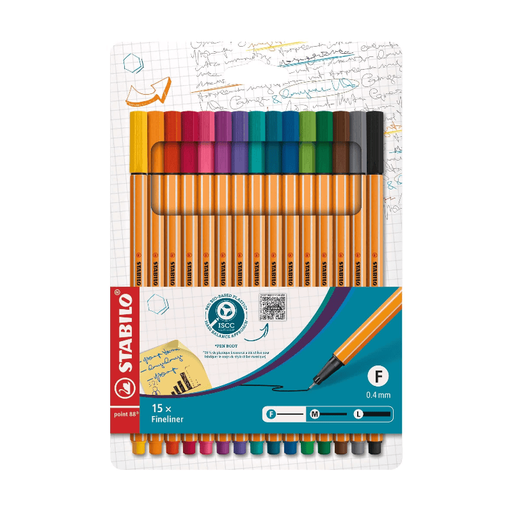
Why it suits this profile: This compact set offers 15 colours for notes, schoolwork, drawing and simple colour coding. The 0.4 mm line width is suitable for users looking for one pen for several fine-detail applications.
The fixed fine tip prevents you from buying a thick colouring pen for detailed work. According to the product information, the ink is water-based and the pen can remain uncapped for several days without drying out immediately.
0.4 mm metal tip, 15 standard colours, cap can be attached to the back and resealable packaging.
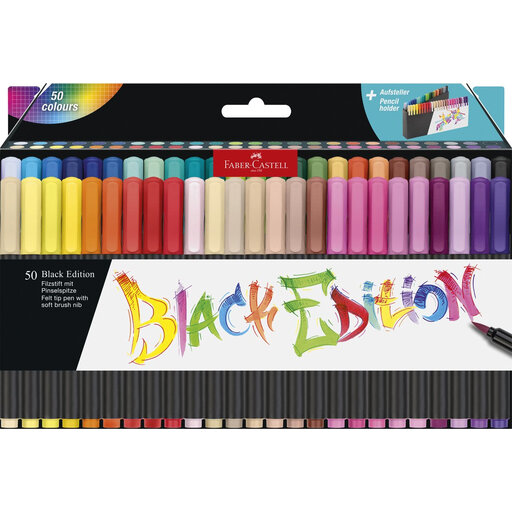
Why it suits this profile: The combination of 50 colours and a brush tip leaves plenty of scope for hand lettering, small illustrations, colour studies and creative writing for children from the stated minimum age and adults.
The brush tip is not an ordinary fine fibre-tip pen: the product description mentions variation between thick and thin lines. The set is intended for light-coloured paper; use on black paper is not recommended.
50 colours, washable ink based on food colouring according to the product information, EN 71 reference and a cardboard storage box.
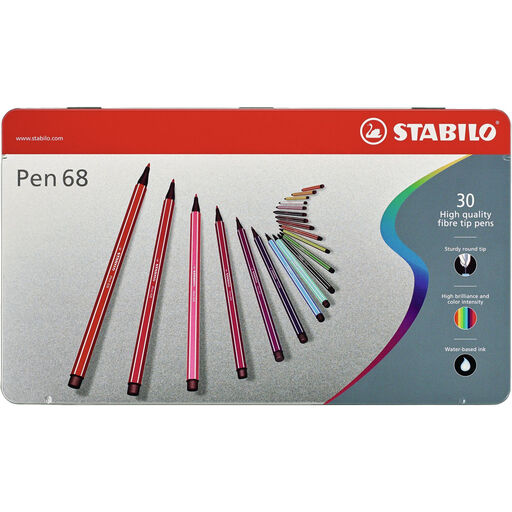
Why it suits this profile: This set is designed for drawing, colouring and creative techniques where a robust tip and a wider choice of colours are important. The approximately 1 mm tip works for lines and areas of colour.
The product information mentions a pressure-resistant tip and water-based ink. For watercolour effects, thicker paper or card is recommended to reduce bleed-through and warping.
30 colours, approximately 1 mm tip, water-soluble ink according to the product description and a metal tin for storage.
Children often benefit from a triangular grip, a sturdy tip and ink that is described as washable in the product information. The Faber-Castell set with 12 fibre-tip pens is intended for children aged 4 and over and has a strong tip. The STABILO Trio Scribbi has a triangular shape, a 1.5 to 2 mm tip and a spring-loaded tip. Always check the current age recommendation on the product page.
For use on the go, a cap ring can be practical. The STABILO Cappi range is designed so that caps can be attached to a ring. This reduces the risk of loose caps, but does not replace proper use and supervision.
We have compiled a complete, up-to-date list of products that fully meet these strict selection criteria and the applicable European safety regulations.
Fineliners from 0.4 to 0.5 mm are suitable for small lettering, outlines, sketches and journalling. For larger areas of colour, fibre-tip pens with a thicker tip are more practical. Brush pens are ideal for hand lettering and lines with varying thickness.
Replace the cap immediately after use and check that it closes securely. Store the set according to the product information, usually horizontally or upright. Avoid prolonged exposure to heat and direct sunlight. A cap ring, such as the one on STABILO Cappi, can help keep caps together.
According to the product description, washable ink is intended to make stains easier to remove, but the result depends on the fabric and how quickly you treat the stain. Use water as directed, wash clothing according to the care label, and take note of the recommended minimum age and any warnings.
