
For hosts who pour cups one after another
Would you like to pour just the right amount for each friend while entertaining, without having to fill a full kettle each time? Compare the portion settings, reservoir capacity and how it’s refilled.


A freestanding hot water dispenser is handy when you want to pour cups one after another while entertaining. Choose portion settings that suit your cups, and temperature control only if you need it. If you usually make a whole pot, a kettle is probably the better choice: don’t heat more water than you need, as Milieu Centraal advises. Check the CE marking and EU Declaration of Conformity for the exact model. Ondernemersplein and Business.gov.nl emphasise that CE is not an independent quality mark.
Would you like to pour just the right amount for each friend while entertaining, without having to fill a full kettle each time? Compare the portion settings, reservoir capacity and how it’s refilled.
If your guests choose different teas, being able to select the temperature for each cup can be useful. Compare the specific temperature settings, rather than just checking whether the temperature is adjustable.
If you only entertain occasionally but usually make a single pot of tea, compare a kettle too. That way, you can weigh up the convenience of pouring individual servings against the extra space and maintenance.
A good fit if: you want to fill individual cups at different times while entertaining.
Consider: you pour one cup at a time, and filters or descaling may mean extra maintenance.
A good fit if: you usually make a whole pot at once or want to save worktop space.
Consider: you heat a set amount of water at a time. Check whether your kettle can also handle the smaller amount you sometimes need. Milieu Centraal advises heating no more water than necessary.
A good fit if: you often want hot water instantly, even when you’re not entertaining, and the installation works in your kitchen.
Consider: a storage tap uses energy to keep water hot. Milieu Centraal describes savings only for specific usage patterns; figures for boiling water taps are not consumption figures for freestanding dispensers.
| What to consider | What to look for | Who is this important to? |
|---|---|---|
| Pouring several cups one after another | Compare the reservoir capacity, whether the reservoir is removable and which individual volume settings are available. | If I want to pour cups one after another while entertaining, I want to serve suitable portions without having to refill often. Around 36% of consumers say this is their top purchasing concern. |
| Different temperatures for different teas | Check the specific temperature settings and whether you can choose the temperature and volume for each cup. | When guests choose different teas, I want to be able to adjust the temperature for each cup. Around 29% of consumers prioritise temperature control. |
| Pouring safely when entertaining | Read the manual for the specific model and check the stated features, such as automatic shut-off, boil-dry protection and a safety lock. | When guests are around a hot water appliance, I pay attention to careful use and pouring. Around 21% of consumers say this is their main purchasing concern. |
| Worktop space and maintenance | Compare the appliance dimensions, filter replacement requirements, descaling instructions and how much water you usually heat. | If I only entertain occasionally, I don’t want to give up space or take on unnecessary maintenance. Around 14% of consumers say this is their main purchasing concern. |
Milieu Centraal describes energy use for boiling water taps under specific usage patterns. Those figures cannot automatically be applied to a freestanding hot water dispenser.
Think about how you use yours: do you pour individual cups or usually make a whole pot? Whichever option you choose, don’t heat more water than you need.
A large reservoir doesn’t mean the appliance will pour all of that water into your pot in one go. Dispensing settings may offer individual portions or a continuous flow.
Before choosing an appliance for a teapot, check the volume settings, whether there’s a continuous-flow setting and how much space there is beneath the spout.
The manual for the Inventum HWD722 recommends descaling monthly, even when using a limescale filter. This maintenance schedule does not automatically apply to other models.
Follow the manual for the exact model and check whether suitable replacement filters are available.
Tomado describes the TWD2503B as having a 2.5-litre reservoir and four stated volume settings for individual cups.
CASO describes the HW 660 as having seven temperature settings and several dispensing volumes to suit different cups.
Philips describes the ADD5910M/10 as an instant-heating dispenser with preset temperatures and volumes.
The specifications for the Princess 237001 list digital temperature control and a 2.5-litre reservoir.
DOMO describes the My Tea Deluxe DO497WK as having a 2-litre reservoir and dispensing settings for a large or small cup.
The products below are freestanding hot water dispensers for filling cups one after another while entertaining. Compare the dispensing settings, reservoir capacity and temperature options for each model.
 No image available
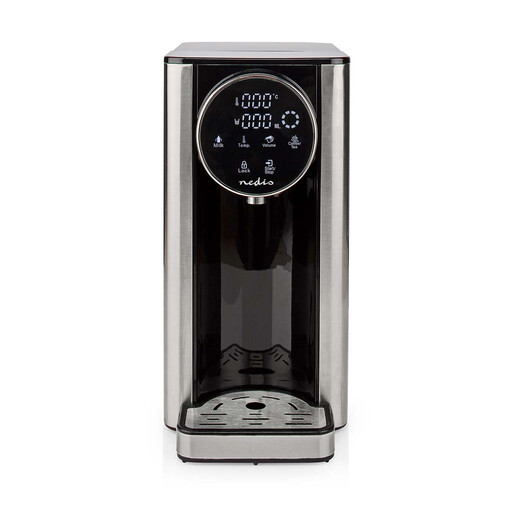
Suitable for pouring cups one after another, with volume settings you can match to your mugs.
Removable 2.7-litre reservoir, five volume settings and seven temperature settings.
 No image available
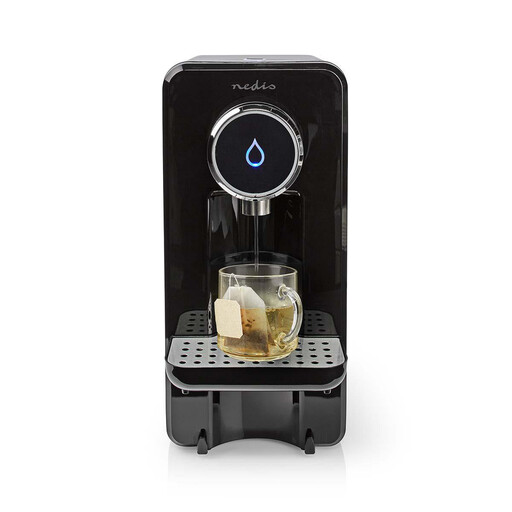
Suitable if you want to dispense a measured cupful or use a continuous flow each time.
2.5-litre reservoir, adjustable spout and descaling monitor. According to the product description, a short press dispenses around 200 ml; holding the button down gives a continuous flow of up to 500 ml per use.
 No image available
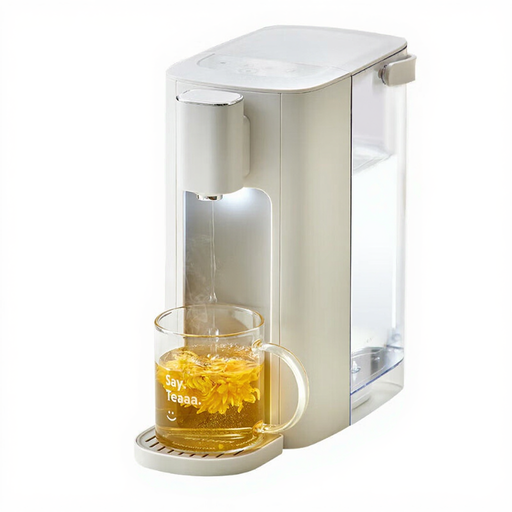
Worth comparing if your guests want different temperature settings and you’re looking for a removable reservoir.
Removable 3-litre reservoir and six temperature settings. The product information recommends descaling every 1–3 months.
 No image available
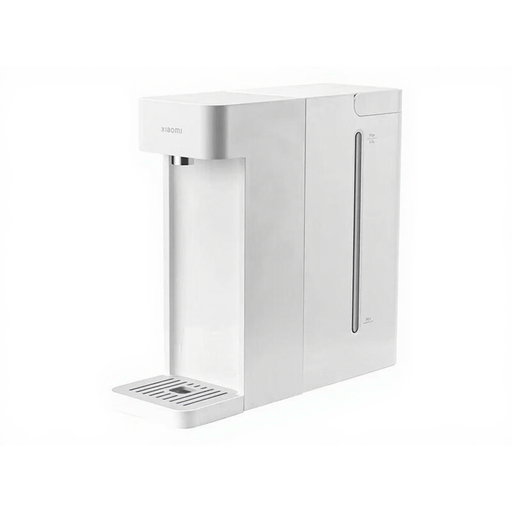
Ideal for serving cups of tea when you want to choose both a temperature setting and a preset volume.
3-litre reservoir, four temperature settings and dispensing options of 250, 500 or 750 ml.
 No image available
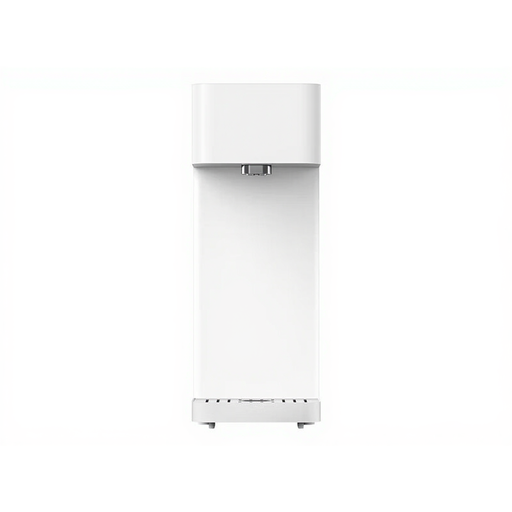
An option to consider if you want to serve water at different temperatures and in chosen volumes when entertaining.
3-litre reservoir, hot and cold water settings, four dispensing volumes and control via the Xiaomi Home app.
That depends on the model and the capacity of your pot. According to the manufacturer, the CASO HW 660 has a continuous-flow setting as well as portion settings of up to 400 ml; Philips also lists a continuous-flow setting for the ADD5910M/10. Before choosing one for this purpose, compare your pot’s capacity and the space beneath the spout.
The reservoir models described here are filled via their water tank. For the Tomado TWD2503B, the manufacturer lists a removable reservoir that you fill from the tap. Follow the installation and electrical instructions for your chosen model.
Follow the manual for the exact model. For example, the Inventum HWD722 manual recommends descaling monthly, even when using a limescale filter. Don’t automatically apply that schedule to other models.
No. According to ACM ConsuWijzer, in addition to any manufacturer’s or seller’s guarantee, you have a statutory guarantee for as long as you could reasonably expect the product to work properly under normal use. If a product is faulty, the seller is responsible for providing an appropriate solution.
No. For electrical equipment placed on the market in the Netherlands under the applicable rules, the manufacturer must assess the required conformity and affix the CE marking. Ondernemersplein and Business.gov.nl emphasise that CE is not an independent quality mark; check the marking and documentation for the exact version.