
Tea drinker with limited worktop space
Needs a freestanding appliance that fits on the available worktop, or is considering a tap that leaves the worktop clear.


A freestanding hot water dispenser is handy if you regularly make individual cups of tea and want to dispense the water straight into your cup. Check the space available on your worktop, the temperature settings and the amount dispensed each time. A small kettle is a practical choice if you prefer to pour the water yourself or want a simple, portable appliance. A boiling water tap keeps your worktop clear, but requires space and installation under the sink.
Needs a freestanding appliance that fits on the available worktop, or is considering a tap that leaves the worktop clear.
Wants to choose the water temperature, so checks which settings the specific model offers.
Wants to dispense water one cup at a time rather than heating a larger amount each time.
Choose this option: if you want to adjust both the temperature and the amount of water for different types of tea. Inventum lists four temperature settings and five volume settings for the HWD725B.
Bear in mind: it takes up space on the worktop and, for the HWD725B, Inventum says the filter needs replacing around three times a year.
Choose this option: if you mainly want to fill a single cup. Nedis lists a 200 ml cup setting and a width of 140 mm for the KAWD100FBK.
Bear in mind: check that the fixed cup volume suits your cup, and measure the depth and height as well as the space needed to refill it.
Choose this option: if you usually make one or two cups and are happy to pour the water yourself. Milieu Centraal recommends a small kettle for this situation.
Bear in mind: you’ll measure the amount yourself and pour from the kettle; check the minimum amount of water it needs.
Choose this option: if keeping your worktop clear is important and there’s room for a tank in a kitchen cupboard. Quooker describes this set-up for its system.
Bear in mind: check the space and connections under the worktop. Milieu Centraal points out that keeping the water hot uses electricity.
| What to consider | What should you look for? | Who is this important for? |
|---|---|---|
| Space and positioning | Measure the width, depth and height, as well as the space needed to fill the appliance. For a boiling water tap, check the cupboard and connections too. | In my small kitchen, the appliance needs to fit without getting in the way of making or filling cups. Around 29% of consumers put space at the top of their list when choosing. |
| Temperature settings | Check the settings on the exact model. A selected temperature setting isn’t the same as measuring the water in your cup. | If I want to make tea at different temperatures, I need to know which settings the model actually offers. Around 29% of consumers give temperature choice top priority. |
| Dispensing per cup | Compare the available volumes in millilitres with your cups and check that they fit under the spout. | When making a single cup, I don’t want to heat more water than I need. Around 24% of consumers mainly choose based on the amount dispensed per cup. |
| Maintenance and use | Check the manual for filter replacement and descaling instructions; compare energy use only if you’ll use the appliances in the same way. | I want to know in advance what maintenance the model I choose requires and what to bear in mind when using it. Around 18% of consumers prioritise maintenance and running costs. |
A selected setting or product description doesn’t automatically tell you what temperature the water will be in your cup.
Compare the settings on the exact model, and don’t treat a selected setting as a measurement of the water temperature at the spout.
An appliance can be narrow but still too deep or too tall, or awkward to fill. Nedis lists dimensions of 140 × 240 × 300 mm (width × depth × height) for the KAWD100FBK.
Measure the full space on your worktop and allow room to fill the appliance and place a cup. For a tap system, check the space under the worktop too.
Energy use depends partly on how much water you heat and how you use the appliance. Milieu Centraal advises heating only as much water as you need; the Nedis manual also lists standby power for the KAWD100FBK.
Compare appliances using the same amount of water, and take standby use and filter maintenance into account if relevant.
The HWD725B is designed for people who want to choose the temperature and amount of water.
The KAWD100FBK is a freestanding dispenser with cup-by-cup dispensing.
Philips says the ADD5910M/10 offers several volume and temperature settings.
The TWD2501B is a simpler dispenser for people who don’t need to select the temperature.
A boiling water tap is another option if you want to keep your worktop clear.
This selection includes freestanding hot water dispensers with cup-by-cup dispensing and temperature settings, plus a compact kettle as an alternative for those who prefer to pour the water themselves.
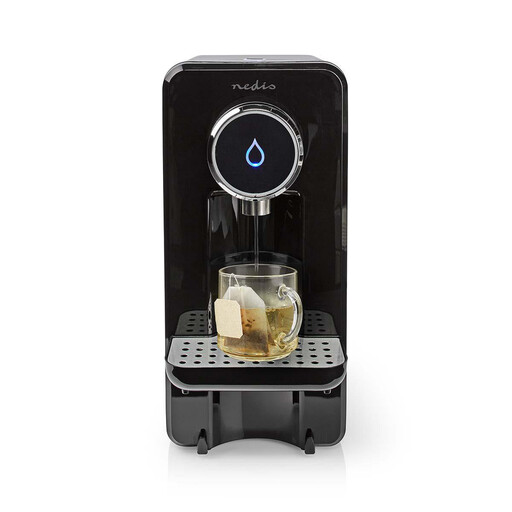 No image available
Ideal for dispensing individual cups, with continuous dispensing when you need more water.
The product description lists a 200 ml cup setting, continuous dispensing up to 500 ml and an adjustable spout. It says the water dispensed can be around 98–100 °C: keep your hands and face away from the spout.
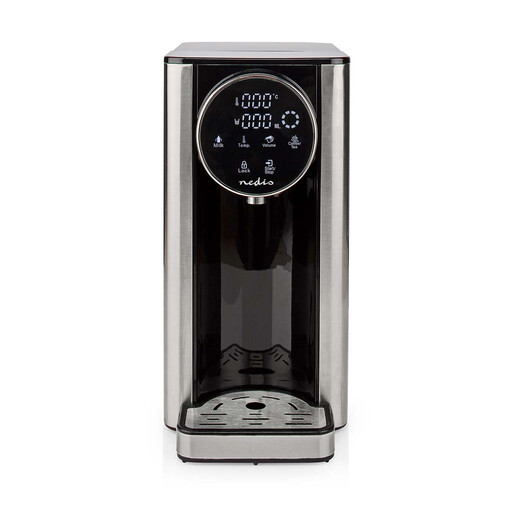 No image available
An option if you want to set different water volumes and temperatures for your tea.
The product description lists five volume settings and seven temperature settings, including a 40 °C shortcut. The stated dispensing range is 100 ml to 2.7 l; the spout accommodates containers up to 16 cm high.
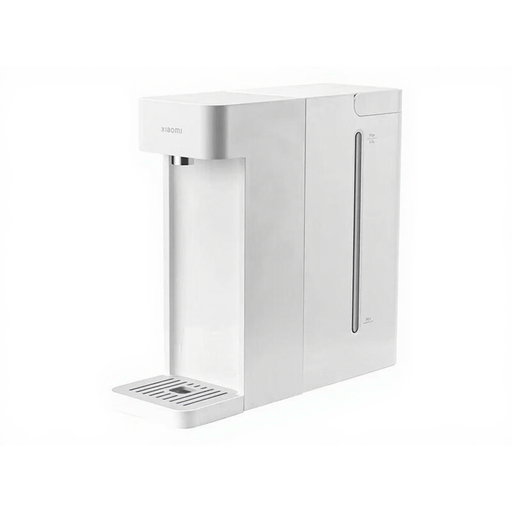 No image available
A good fit if you want to choose both the volume and temperature for your tea.
The product name lists four temperature settings. The product description mentions temperature adjustment in 1 °C increments and three volume options: 250, 500 and 750 ml.
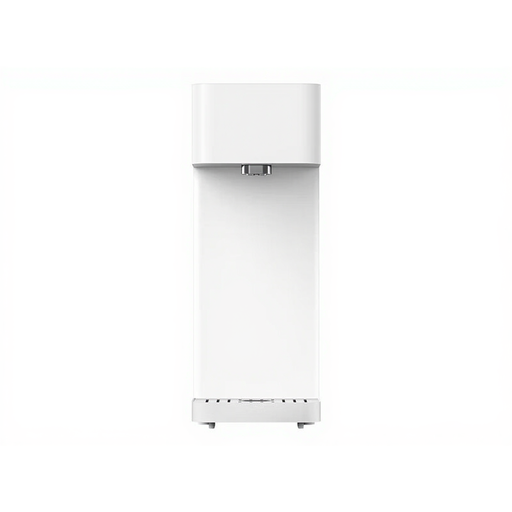 No image available
An option if you’re looking for a dispenser with a choice of temperatures and volumes.
The product name lists five temperature settings, while the product description mentions a 3 l tank and temperature adjustment in 1 °C increments. The listed presets include 55 °C and 95 °C.
 No image available
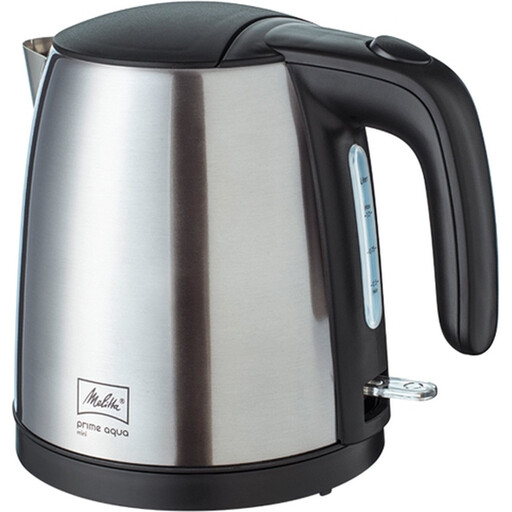
A good fit if you want to boil water in a compact kettle and pour it yourself.
The product description lists a 1 l capacity and a fill range of 0.5–1.0 l. It also mentions a 360° base, automatic shut-off and boil-dry protection. Check that the minimum fill amount suits the way you’ll use it.
Compare the temperature settings on the specific model. Inventum lists 45, 65, 85 and 100 °C for the HWD725B; Tomado says you can’t select a different temperature on the TWD2501B. A selected setting isn’t an independent measurement of the temperature in your cup.
A freestanding dispenser needs space on your worktop and a suitable electrical connection. For a Quooker system, you’ll also need to check the space and connections under the worktop and follow the installation instructions for your specific model.
Follow the maintenance instructions for the model you choose and descale it as directed. Milieu Centraal recommends descaling water-heating appliances regularly; also check whether your dispenser has a replaceable filter.
No. According to the Dutch government, there is no fixed statutory guarantee period in the Netherlands: you’re entitled to a product that is fit for purpose, and the retailer is your point of contact if something goes wrong. A manufacturer’s warranty is an additional benefit.