
Families making cup after cup of tea
If you fill several mugs at breakfast, compare the portion settings with the capacity of your mugs. Philips, for example, lists individual volumes from 150 to 500 ml, while Tefal describes a 2-litre reservoir.


For family breakfast, choose a hot water dispenser mainly by considering how many cups you’ll fill in a row and whether its portion and temperature settings suit the tea you drink. Compare the reservoir capacity with the amount of water you need for one breakfast round. If children can reach the worktop, safe positioning and easy-to-use controls matter too. A kettle is an alternative if you’d rather heat one amount of water at a time and pour it yourself.
If you fill several mugs at breakfast, compare the portion settings with the capacity of your mugs. Philips, for example, lists individual volumes from 150 to 500 ml, while Tefal describes a 2-litre reservoir.
If family members prefer different temperatures, temperature settings are an important factor. Tefal, Philips and Inventum describe temperature selection on the models mentioned here; check which settings the exact model offers.
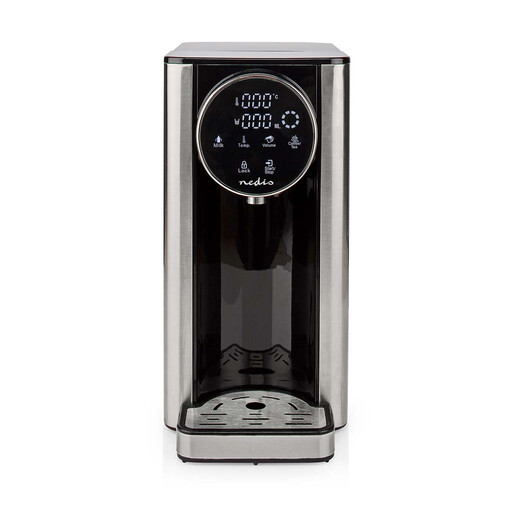
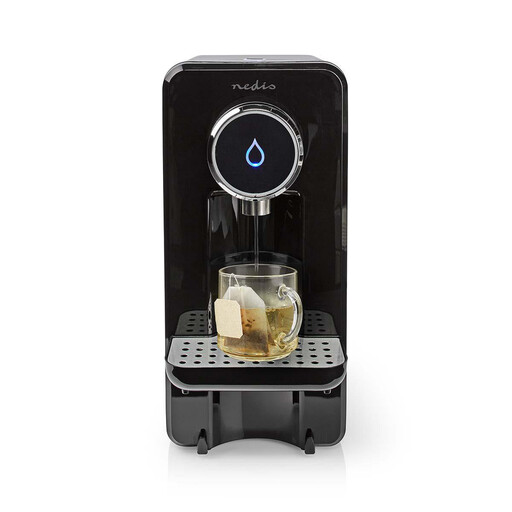
If children can reach the dispenser, consider where it will go, as well as its cable, spout and controls. The Netherlands Food and Consumer Product Safety Authority outlines the applicable product safety rules; the Nedis KAWD100FBK manual says children aged 8 and over should use it only under supervision or after receiving instructions.
First decide whether you want to dispense water one cup at a time or boil a quantity in one go. Then compare the reservoir, portion settings and temperature options with your breakfast routine.
Best for: breakfasts where you fill several cups or want to choose different temperatures.
Bear in mind: the reservoir needs filling and cleaning, and any filters may need extra maintenance. The settings alone don’t tell you how quickly it can serve a whole breakfast round.
Best for: families where everyone usually drinks the same type of hot tea and dispensing one cup at a time is important.
Bear in mind: check that the temperature of the exact model suits the tea you drink.
Best for: anyone who would rather heat one quantity of water for the table and pour it themselves.
Bear in mind: you’ll need to wait for the kettle to boil and pour the water yourself. There’s no comparable measurement showing that the dispensers discussed here save time or energy.
These are the main things to consider when choosing a hot water dispenser for tea at family breakfast:
| What to consider | What should you look for? | Who is this important for? |
|---|---|---|
| Filling several cups in a row | Add up the capacity of your usual mugs and compare it with the reservoir capacity and portion settings. | If I’m making tea for several family members in a row, I want to know whether the capacity and portions suit our mugs. Around 36% of consumers give filling several cups their top priority. |
| Temperature for different teas | Compare the listed settings with the teas you drink. A selected setting isn’t the same as an independent measurement of the temperature in the cup. | When we drink different teas, I want to be able to choose a suitable temperature for each cup. Around 29% of consumers put temperature selection first. |
| Children nearby | Check the position, cable, spout and any control lock on the exact model. | If children can reach the worktop, I want to keep them away from the hot water and controls. Around 21% of consumers say children’s access to hot water is their main concern. |
| Cleaning and filter maintenance | Check whether the reservoir, drip tray and filter are easy to access, and whether the manual specifies a replacement interval. | For everyday use, I want to be able to keep up with cleaning and filter maintenance. Around 14% of consumers put easy maintenance at the top of their list. |
The percentages show which of these buying considerations may be the top priority for consumers in each row when choosing a dispenser for tea at family breakfast.
Tefal’s claim of up to 25% energy savings is based on a comparison with the Tefal KO25 when heating one 250 ml cup to 95 °C. It doesn’t tell you how much energy a full breakfast round will use.
Only compare energy use when the amount of water and starting and finishing temperatures are the same. Without a like-for-like comparison, don’t assume you’ll save energy when serving a whole table.
The Inventum HWD725B product description lists a 2-litre reservoir, while the page title says 2.5 litres. This could lead to an inaccurate estimate of how many cups you can fill if you base it on the title.
Ask for confirmation of the capacity of the exact item before comparing it with your total water needs.
A Joybuy listing for a Nedis dispenser gives a capacity of 2.5 litres and a power rating of 2600 W, but doesn’t include the full model number KAWD100FBK. Similar headline specifications don’t confirm that it’s the same product.
Check the full model number on the product page and packaging before attributing features or manual information to the item.
Inventum recommends replacing the HWD725B filter around three times a year. This is ongoing maintenance, in addition to filling and cleaning the appliance.
Check whether a replacement filter is available for the exact model and what the replacement process involves.
The BR3508E0 is described as having a removable 2-litre reservoir and temperature settings from 70–95 °C.
The ADD5910M/10 is described as offering individual cup volumes and a continuous dispensing mode.
The HWD725B is described as having temperature and volume settings, as well as a removable filter.
CASO describes the HW 660 as having a 2.7-litre reservoir, seven temperature settings and seven preset dispensing volumes.
The KAWD100FBK manual describes a domestic dispenser with a water capacity of 0.5–2.5 litres.
This selection includes hot water dispensers with different reservoir and portion options, a hot and cold water dispenser, and a kettle as an alternative. Check the safety information and CE marking for each exact model. According to the Netherlands Food and Consumer Product Safety Authority, CE marking is required for electrical appliances covered by the Dutch Commodities Act Decree on Electrical Equipment. The marking is the manufacturer’s declaration of conformity, not proof of an independent inspection.
 No image available
The stated reservoir capacity and volume settings may be useful if you fill several cups in a row.
The product description lists a 2.7-litre reservoir, water dispensing from 100 ml to 2.7 litres, seven temperature settings and five volume settings. It also mentions a child lock; check the controls and safety information for the exact model.
 No image available
Individual portions may suit a breakfast where family members take turns filling a cup.
The product description lists a 2.5-litre reservoir, a portion of around 200 ml and continuous dispensing of up to 500 ml per use. Larger amounts require several dispensing cycles.
 No image available
The stated reservoir capacity and portion options are useful if you need different amounts of water during breakfast.
The product description lists a 3-litre reservoir, portion sizes of 250, 500 and 750 ml, four preset temperatures and temperature adjustment in 1 °C increments.
 No image available
This model may be a good option if you want to dispense cold water as well as make hot drinks.
The product description lists a 3-litre reservoir, several preset water volumes, hot and cold settings, and temperature selection. App control is also mentioned.
 No image available
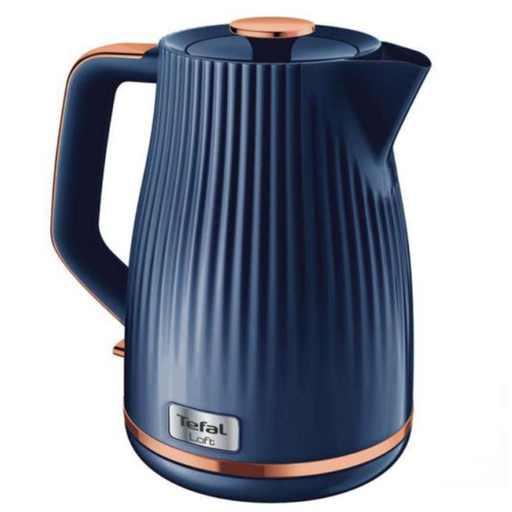
A kettle is an alternative if you’d rather heat enough water for several cups at once and pour it yourself.
The stated capacity is 1.7 litres. The product description mentions cordless pouring, a removable filter and automatic switch-off when the water boils. This model doesn’t dispense individual portions like a dispenser.
Add up the usual capacity of all your cups and compare it with the stated reservoir capacity. Also check that the portion settings suit your cups; a 2-litre reservoir doesn’t, by itself, tell you how much water you can dispense at a time.
Choose a stable spot where children can’t easily reach the spout, hot cup or cable, and follow the manual for the exact model. The Nedis KAWD100FBK manual says children aged 8 and over should use it only under supervision or after receiving instructions. A lock on another model doesn’t replace supervision.
It depends on the model: Inventum recommends replacing the HWD725B filter around three times a year. For purchases made by consumers in the Netherlands, statutory guarantees also apply. If the appliance doesn’t perform as you could reasonably expect under normal use, the seller is responsible for providing an appropriate solution. A manufacturer’s warranty doesn’t replace this right.
Electrical equipment covered by the Dutch Commodities Act Decree on Electrical Equipment must carry a CE marking. The Netherlands Food and Consumer Product Safety Authority explains that the manufacturer uses it to declare conformity; CE marking isn’t automatically proof of an independent inspection. Check the marking and safety information for the exact product before buying.
Don’t assume it can. If there’s a boil-water advisory for your address, follow the latest instructions from your water supplier. For such an advisory, Waternet recommends boiling water for at least three minutes before using it for things such as tea. A temperature setting or a brief burst of hot water doesn’t prove that this has been done.