
Vandaag of morgen in huis

Kwaliteit gegarandeerd

Welkomstaanbiedingen ontgrendelen: GRATIS bezorging | Tot 80% korting | Gratis 30 dagen JoyPlus-proefperiode
Download de app
A hot air brush combines warm air and a brush, sometimes with extra styling features, in one appliance. It sounds simple, but there’s a wide range to choose from. A hot air brush for fine hair, for example, needs different settings from a rotating hot air brush for thick or long hair.
If you only look at wattage, ionic technology or the number of attachments, you could still end up with an awkward appliance to use. Instead, pay particular attention to these common pitfalls and technical features.
Higher power can help dry your hair faster, but it doesn’t tell you much about how much control you’ll have while styling. An appliance with several heat settings, a lower airflow setting and a cool air button may be more practical than a model that simply offers high power.
A low temperature is important for fine, dry or coloured hair. Thick hair, on the other hand, may need more airflow. Control matters more than wattage alone.
Hot air brushes with ionic technology are often associated with less static and frizz. According to information from the brands themselves, the ions are designed to reduce static charge. However, the final result also depends on your hair type, humidity, technique and chosen temperature.
Think of ionic technology as a useful feature, not a guarantee of a particular look.
A multi-styler with five or seven attachments gives you more options, but it also takes up more space. Check in advance:
For everyday volume, a ceramic hot air brush with one well-suited brush can be more convenient than an extensive set that usually stays in the cupboard.
Check how many temperature and speed settings there are. The Philips BHA710/00, for example, lists two temperature settings and a Care+ mode. The Revlon RVDR5292E has three heat settings and a cool air setting. These details are easier to compare than vague descriptions such as “gentle heat”.
Whenever possible, use a hot air brush on towel-dried hair, unless the instructions say otherwise. Your hair shouldn’t be soaking wet. For curls or waves, working with a small section of hair is usually better than taking a large section.
The diameter helps determine the styling result:
A hot air brush for volume works particularly well when you lift the brush briefly at the roots and let your hair cool before releasing it.
Ceramic elements or a ceramic coating are used to distribute heat evenly. They don’t make overheating impossible, though. Keep the brush moving, use a suitable temperature and follow the instructions.
Clean the air filter regularly if your model allows it. A blocked filter can reduce airflow. Let the appliance cool completely after use, and don’t store it in a damp room.
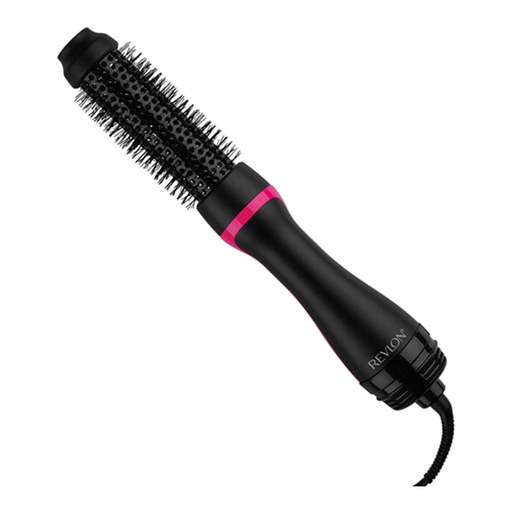
Why it suits this profile: This model combines drying and styling with a 38 mm round brush. Its three heat settings and cool air setting make it straightforward for beginners to use.
The product specifications list several heat settings, ionic technology, ceramic heating and an EU plug. That means you’re not relying on wattage alone.
800 W, three heat settings, cool air setting, ionic technology and a flexible swivel cord.

Why it suits this profile: This set is designed for different styling goals, including waves and volume. The rotating brush and multiple attachments give you greater control if you like to change your look regularly.
The specifications list a Care+ mode, tourmaline ceramic coating and 30 and 50 mm attachments. This means you’re not limited to one fixed brush size.
1000 W, ionic technology, rotating brush, two temperature settings and three included attachments.

Why it suits this profile: This rotating hot air brush is designed for medium to long hair, with separate attachments for curls, volume, smoothing and pre-drying.
The brush rotates in both directions and has two speeds, two heat settings and a cool air setting. This gives you more specific control than a basic model with a single setting.
800 W, four attachments, two rotation directions, ionic technology, ceramic elements and a 3-metre cord.

Why it suits this profile: This set is designed for anyone who wants to dry, smooth and add volume to their hair, as well as create curls automatically, all with one system.
The set includes three temperature settings, two speeds, a diffuser, concentrator, smoothing brush and two curling attachments. Do check that you’ll use all the attachments.
1200 W, seven functions according to the product description, three temperature settings, ionic technology and a 360° cord.
We’ve put together a complete, up-to-date list of products that meet these strict selection criteria and the applicable European safety regulations.
Towel-dried hair is usually more suitable than completely wet hair. Always check the instructions. Some models are designed for damp hair, while a thermal brush, such as the Wavytalk Thermal Brush, should only be used on dry hair.
Its lifespan depends on how you use and care for it, as well as the quality of the cord, filter and attachments. Clean the filter according to the instructions, pull the plug out by gripping it rather than pulling the cord, and only put the appliance away once it has cooled completely. In the Netherlands, many new electrical consumer products are covered by at least the statutory guarantee under the applicable consumer rules. Also check the seller’s and manufacturer’s terms.
Energy use depends on the appliance’s power and how long you use it. A 1000 W appliance running for ten minutes uses about 0,167 kWh in theory. In practice, consumption varies depending on the temperature settings and how often it’s switched on and off. So don’t just consider speed: think about how long you normally need to dry and style your hair.
